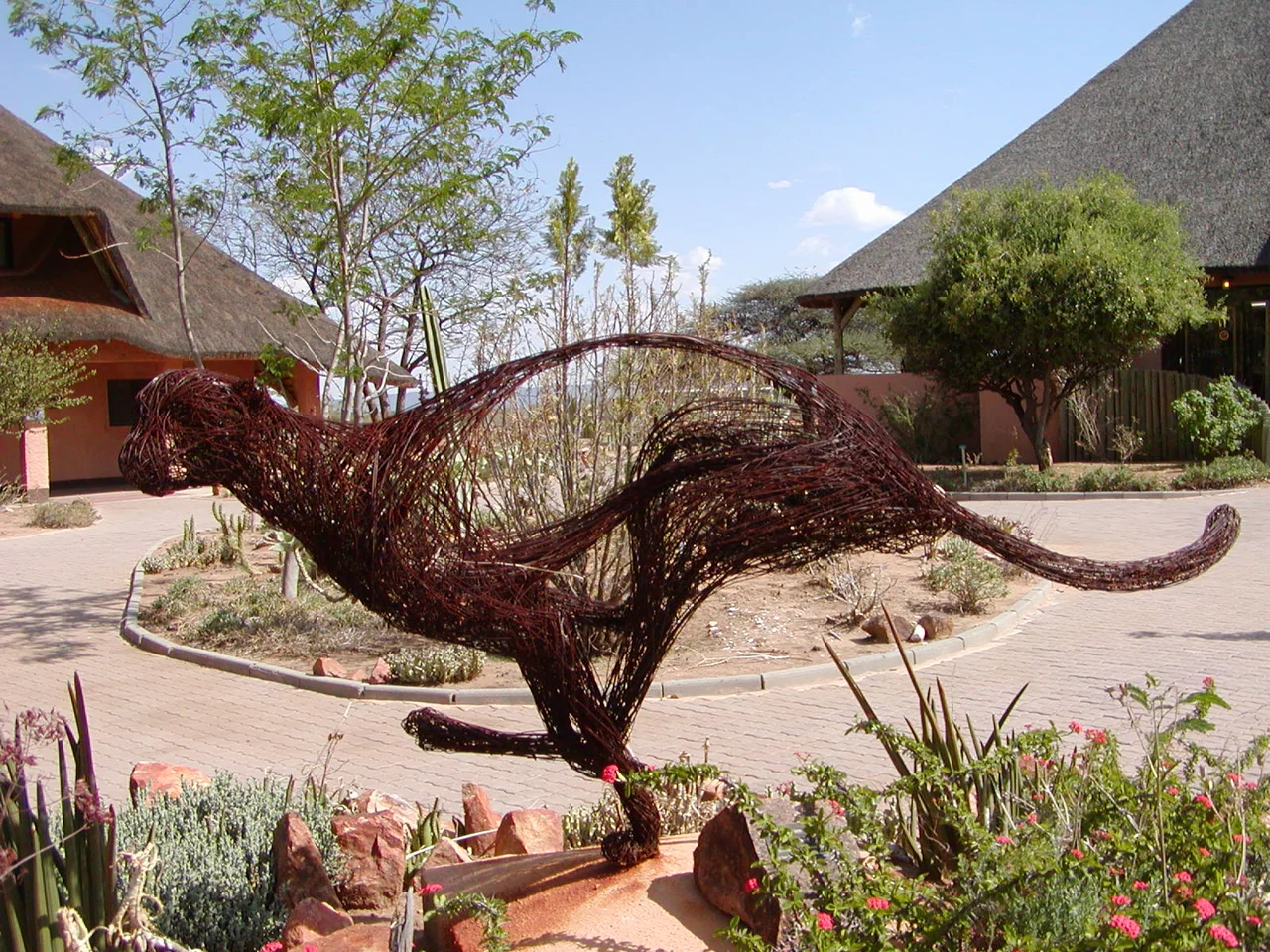

Cheetah Conservation Fund
Laurie Marker arrived in Namibia with an unwelcome message and a guard dog. As a young biologist she had raised cheetahs in the United States and learned a brutal arithmetic: most of the world's remaining wild cheetahs lived on private farmland, and the farmers were shooting them to protect their livestock. So in 1990 she moved to a farmhouse east of Otjiwarongo and started not with the cats but with the people - because the cheetah's survival, she understood, would be decided by ranchers, not by scientists. That single insight grew into the Cheetah Conservation Fund, today the world's leading authority on the species.
The Country That Holds the Cheetah
Namibia matters to cheetahs more than any other place on Earth. The country shelters the largest and healthiest wild population of the species - an estimated 2,500 to 3,000 animals, the biggest single population left anywhere. Crucially, most of them do not live in fenced parks but roam open ranchland, sharing space with cattle and goats and the people who raise them. That makes the cheetah's fate inseparable from the working life of Namibian farms. The CCF's Research and Education Centre sits 44 km east of Otjiwarongo, in the thornbush of the central plateau, surrounded by the very farmland where the battle for the species is won or lost.
A Dog Instead of a Gun
The CCF's most quietly revolutionary idea wears fur and barks. Its Livestock Guarding Dog Program places Anatolian shepherds and Kangals - big, ancient breeds bred for millennia to guard flocks - with farmers across the country. A dog raised among goats from puppyhood treats the herd as its own and drives off approaching predators with sheer presence, before a cheetah ever makes a kill. The result is fewer dead sheep, fewer dead cheetahs, and a farmer with no reason to reach for a rifle. Demand for the dogs has climbed steadily as word spread that the method simply works. It is conservation that pays the farmer back.
Fixing the Land Itself
A cheetah needs room to run, and across Namibia that room is vanishing into bush. Decades of overgrazing have let woody thornbush choke the open savanna in a process called bush encroachment, robbing the cheetah of the sightlines and sprinting space it depends on. The CCF turned the problem into a product: it harvests the invading bush and compresses it into Bushblok, a clean-burning fuel log. Clearing the thicket restores grassland and habitat; selling the logs gives landowners a reason to keep clearing. The same organization also maintains a genome resource bank and an extensive physiological database, building the scientific foundation for everything it does in the field.
The Genetics of Survival
The cheetah carries an ancient wound in its blood. The species passed through a severe population bottleneck thousands of years ago and emerged with remarkably little genetic diversity - leaving cheetahs unusually vulnerable to disease and inbreeding, especially in captivity. The CCF works against that legacy with reproductive science, including artificial insemination, in vitro fertilization, and the cryopreservation of sperm and embryos. These tools let researchers move valuable genes between animals that would never meet in the wild, widening the gene pool without hauling cats across continents, and banking the genetics of strong wild individuals against an uncertain future.
A Model That Travels
Laurie Marker's work earned international recognition, including the 2010 Tyler Prize for Environmental Achievement, one of the highest honors in the field. But the deeper measure of the CCF is how far its ideas have spread. Its blend of field research, farmer partnership, and predator-friendly ranching now informs cheetah conservation in Botswana, Kenya, South Africa, Algeria, and Iran. Within Namibia, the organization runs research across the Waterberg Conservancy and the vast Otjiwarongo farming area. The lesson it exports is disarmingly simple, and hard-won: to save a predator, you have to make room for it in the lives of the people who share its land.
From the Air
The Cheetah Conservation Fund's centre lies near 20.48°S, 17.03°E, about 44 km east of the town of Otjiwarongo in central Namibia's Otjozondjupa Region - flat-to-rolling thornbush savanna on the central plateau, with the distinctive flat-topped Waterberg massif rising to the east as the dominant landmark. The nearest airport is Otjiwarongo (ICAO: FYOW), roughly 45-50 km to the west; Windhoek's Eros (FYWE) and Hosea Kutako International (FYWH) lie about 250-280 km to the south. The dry season (May-October) brings clear skies and excellent visibility; the thinned, restored grassland around the centre stands out against the denser encroached bush nearby. Best viewing light is early morning or late afternoon.
Nearby Stories
- Battle of Otavi 69 km away
- Hoba Meteorite 79 km away
- Dragon's Breath Cave 114 km away
- Leopard Cave, Namibia 136 km away
- Okahandja 139 km away
- Etosha National Park 161 km away
- Brandberg 191 km away
- Kalahari Desert 521 km away