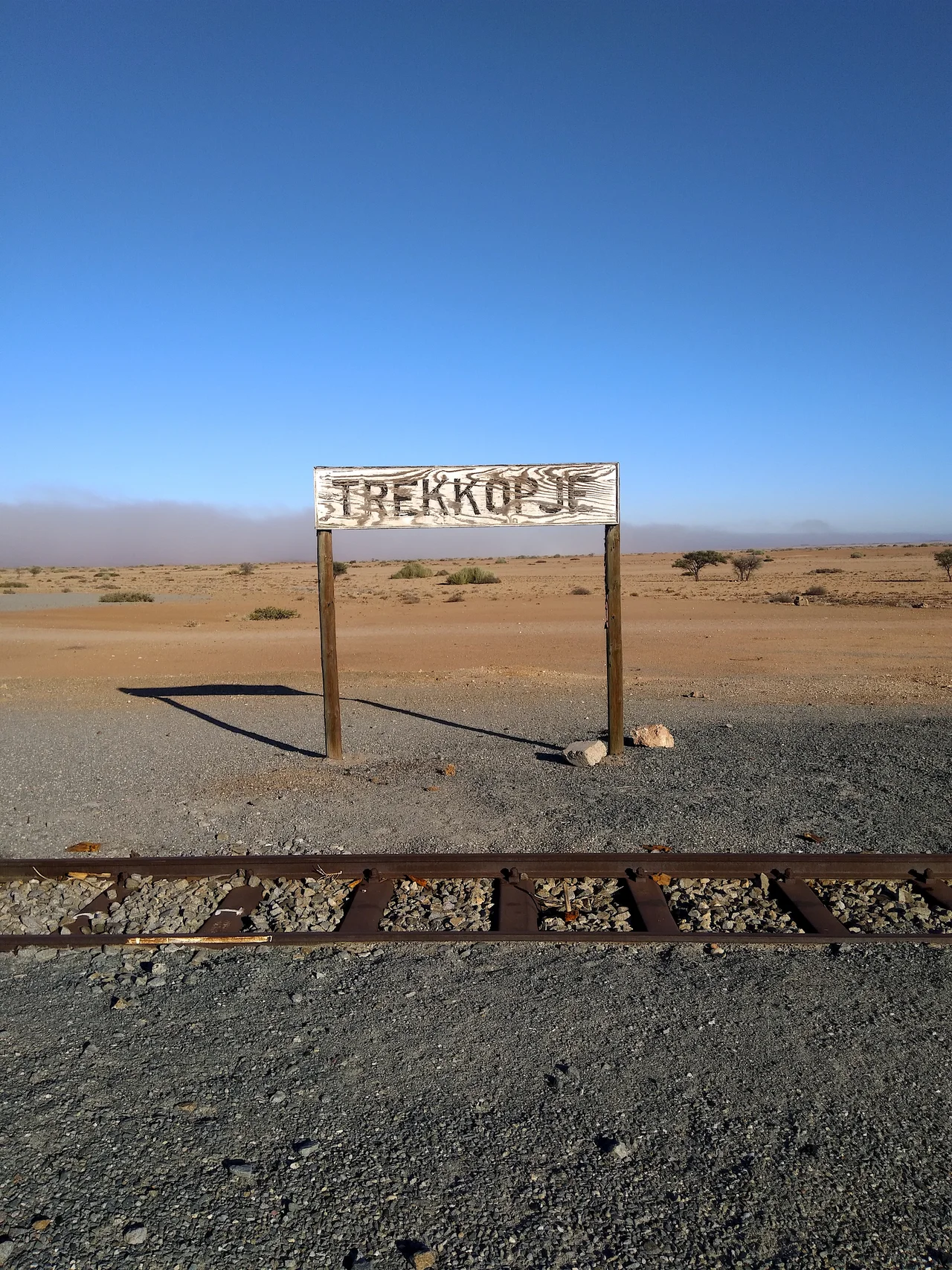

Battle of Trekkopjes
There was almost nothing at Trekkopjes worth fighting for, which is exactly why the fight mattered. A railway siding in the gravel plains of the Namib, a scatter of tents, a water point that the engines and the horses and the men all depended on in country where dehydration killed faster than bullets. Yet on the morning of 26 April 1915, the German army of South West Africa staked its last offensive of the First World War on taking this forgettable spot. They lost it to a weapon the desert had not seen before: machine guns bolted into armoured cars, circling at speed across the open ground.
Franke's Last Throw
By April 1915 the war in German South West Africa was going badly for Germany. South African forces under Louis Botha had pushed the German army of Colonel Victor Franke off ground it could not afford to lose. Rather than simply retreat, Franke gambled on one more blow, choosing the South African held railway station at Trekkopjes as his target. A German scout aircraft droned over the position first, counting tents and gauging the strength of the defenders. This was a small action by the standards of the slaughter then consuming Europe, but it carried the whole momentum of a campaign on its back, and Franke meant to seize it.
Skinner Digs In
The defense fell to the South African Major Skinner, ordered to hold Trekkopjes and quick to make contact with the German column closing on the station. He pulled his men back into the camp and dug them in. He had a problem: no artillery. When the Germans appeared near the siding at quarter to six in the morning and blew the rail line to the east to block any reinforcement, Skinner could only wait. By twenty to eight German guns were shelling the tents, and his troops, unable to answer the bombardment, hunkered down under it. What Skinner did have was a handful of unglamorous machines that would decide the day, including an improvised gun his men had nicknamed "Skinny Liz."
The Armoured Cars Turn the Flank
The fighting ran on for some five hours under a hardening desert sun, with heat, dust, and the constant shortage of water grinding at both sides as much as the enemy did. Then the South Africans played their hand. Machine guns mounted in armoured cars swung out against the German flanks, fast and protected, pouring fire from angles the German infantry could not pin down. It was a glimpse of a kind of war that would define the century to come, mechanized mobility loose on an open battlefield, and out here on the Namib gravel it broke the attack. The Germans were forced into retreat, and Trekkopjes held.
The Tide That Never Turned Back
Neither side left many dead on the field, but the meaning of Trekkopjes far outweighed its small butcher's bill. The defeat gutted the morale of Franke's men, who had bet their last offensive here and lost it. From that morning the Germans in South West Africa never attacked again. They fell back and back across the territory through the winter, harried by Botha's advance, until the main force finally surrendered a few months later after the Battle of Otavi. The men of both armies who did die are remembered at the small war cemetery beside the siding, graves in the gravel marking the spot where a campaign quietly turned for good.
From the Air
Trekkopjes lies at about 22.29 degrees south, 15.10 degrees east, on the Namib gravel plains of the Erongo region inland from the coast, near the rail line that still runs between Swakopmund and the interior. From the air the country is austere and almost featureless, pale plains broken only by the railway and the small war cemetery that marks the battlefield. The nearest airfields are Swakopmund Municipal Aerodrome (FYSM) and Walvis Bay International (FYWB) on the coast to the west. Visibility inland is usually excellent and the air clear, though the coastal fog of the Benguela current can reach this far on some mornings before burning off.
Nearby Stories
- Husab Mine 15 km away
- Spitzkoppe 31 km away
- Leopard Cave, Namibia 45 km away
- Cape Cross 53 km away
- Otjimbingwe 69 km away
- Spreetshoogte Pass 148 km away
- Twyfelfontein 183 km away
- Cospatrick 1629 km away