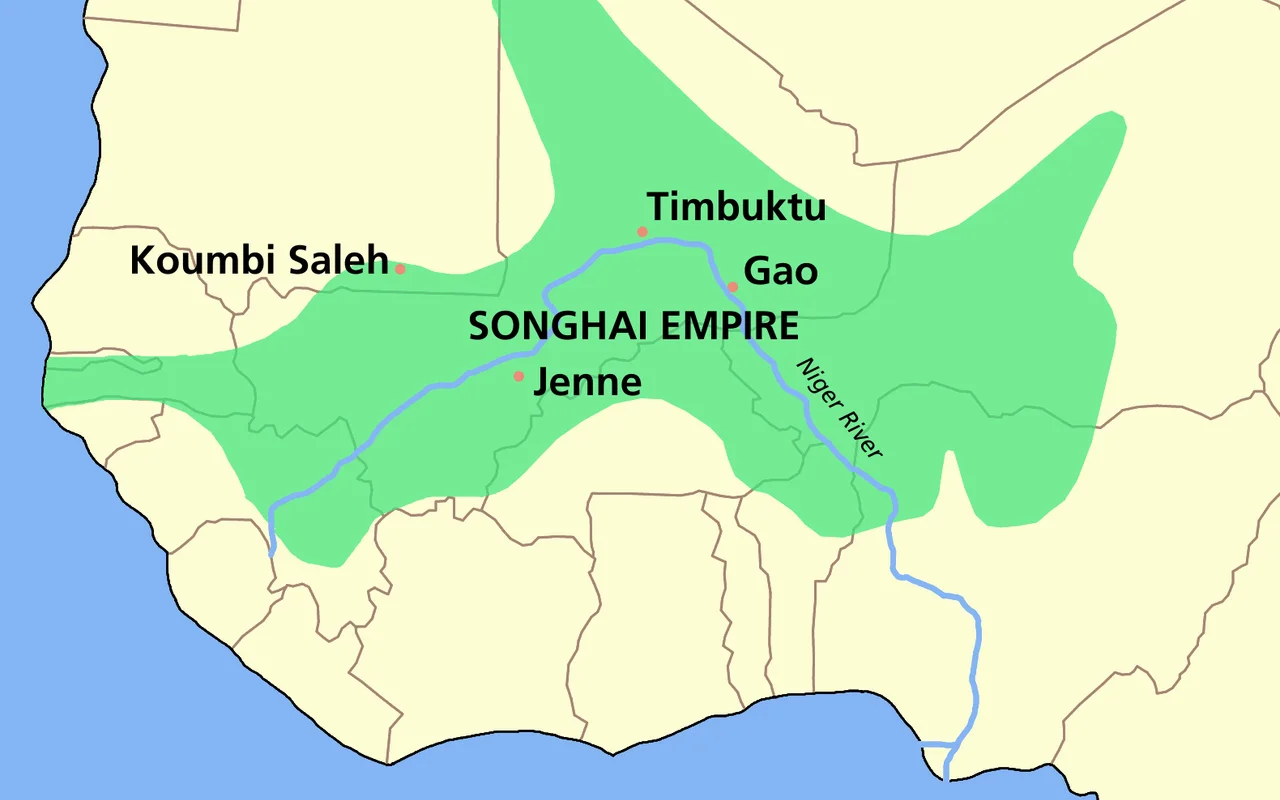

Songhai Empire
At its height, you could ride for two months across the Songhai Empire and never leave its territory. From the salt mines of the Sahara to the gold fields of the southern savanna, from the trading wharves of Gao to the libraries of Timbuktu, a single state held the Niger Bend and most of West Africa in its grip. It was the largest empire the region had ever produced, larger than the kingdoms of Ghana and Mali that came before it. And its heart beat at Gao, a city of merchants and scholars on the river's eastern bank, where the emperors held court and the caravans came to rest.
The Soldier Who Made an Empire
The man who built it was a warrior, not a saint. Sonni Ali, who took the throne around 1464 and ruled until 1492, threw off the last of Mali's authority over Gao and then spent nearly three decades expanding outward by river and by horse. He commanded a navy of war canoes on the Niger and a cavalry that struck deep into the Sahel, seizing Timbuktu in 1468 and the great river port of Djenne after a long siege. He was ruthless, feared, and effective. The Muslim chroniclers who later wrote his story resented his rough treatment of scholars and his attachment to older traditional beliefs, but even they conceded what he had achieved: he turned a riverside kingdom into an empire, and Gao into its capital.
Askia the Great
Power passed not to Sonni Ali's son but to one of his generals. Muhammad Ture seized the throne in 1493 and founded the Askia dynasty, taking the title that became his name. Askia Muhammad I ruled for more than thirty years and gave the empire what its conqueror had not: a system. He organized provinces under appointed governors, standardized weights and measures, and built a professional army. A devout Muslim, he made a famous pilgrimage to Mecca around 1497, returning with the title of Caliph of the western Sudan. Under him, Timbuktu's scholars flourished and Gao swelled with wealth. When the traveler Leo Africanus passed through around 1510, he found a rich, unwalled city full of merchants, its markets heavy with rice, melons, and gold.
Gold, Salt, and the Long Roads
Songhai's wealth came from controlling what crossed the desert. Caravans of camels carried slabs of Saharan rock salt south and returned north laden with gold from the forests beyond the river. Gao sat at the hinge of that trade, where the Tilemsi valley meets the Niger, and the empire taxed the goods that flowed through it. This is the uncomfortable truth at the empire's foundation: that wealth also rested on the sale of human beings. The same markets Leo Africanus admired sold enslaved men, women, and children alongside the salt and squash. The people bought and sold in those squares were not commodities but captives, often taken in the empire's own wars, and their suffering paid for the splendor the chronicles celebrate.
The Day the Sahara Crossed Over
The end came from an unexpected direction. In 1591 the Moroccan sultan Ahmad al-Mansur, hungry for Songhai's gold, sent his general Judar Pasha across the Sahara with an army of roughly four thousand men. It was an audacious gamble. Many died crossing the desert. But the survivors carried something Songhai had never faced: muskets and cannon. On the plain of Tondibi, just north of Gao, the Songhai army of Askia Ishaq II met them with a vast cavalry and a herd of cattle driven forward as a living shield. Gunpowder shattered both. The cattle stampeded back into Songhai's own ranks, the lines broke, and in a single afternoon an empire that had stood for over a century began to fall. The invaders took Gao, then moved the seat of power to Timbuktu, and the unified Songhai state dissolved into smaller successor kingdoms, its last rulers retreating downriver to govern a remnant from Dendi.
From the Air
The Songhai Empire was governed from Gao, Mali, at 16.27 N, 0.05 W, on the eastern bank of the Niger River. The decisive Battle of Tondibi (1591) was fought on the plain just north of the city. From altitude the great curve of the Niger Bend and the surrounding Sahel are the dominant features; the river is the empire's defining geography. Nearest airport is Gao International (GAGO). Best viewed in clear, dry-season conditions when the river ribbon stands out sharply against the desert.
Nearby Stories
- Askia Daoud 15 km away
- Agacher Strip War 124 km away
- Mount Hombori 132 km away
- Hombori 152 km away
- Liptako 197 km away
- Pendjari National Park 564 km away
- Oti-Keran National Park 675 km away
- Tin Hinan Tomb 850 km away