_interior_5.JPG)
St. James Church (Accomac, Virginia)
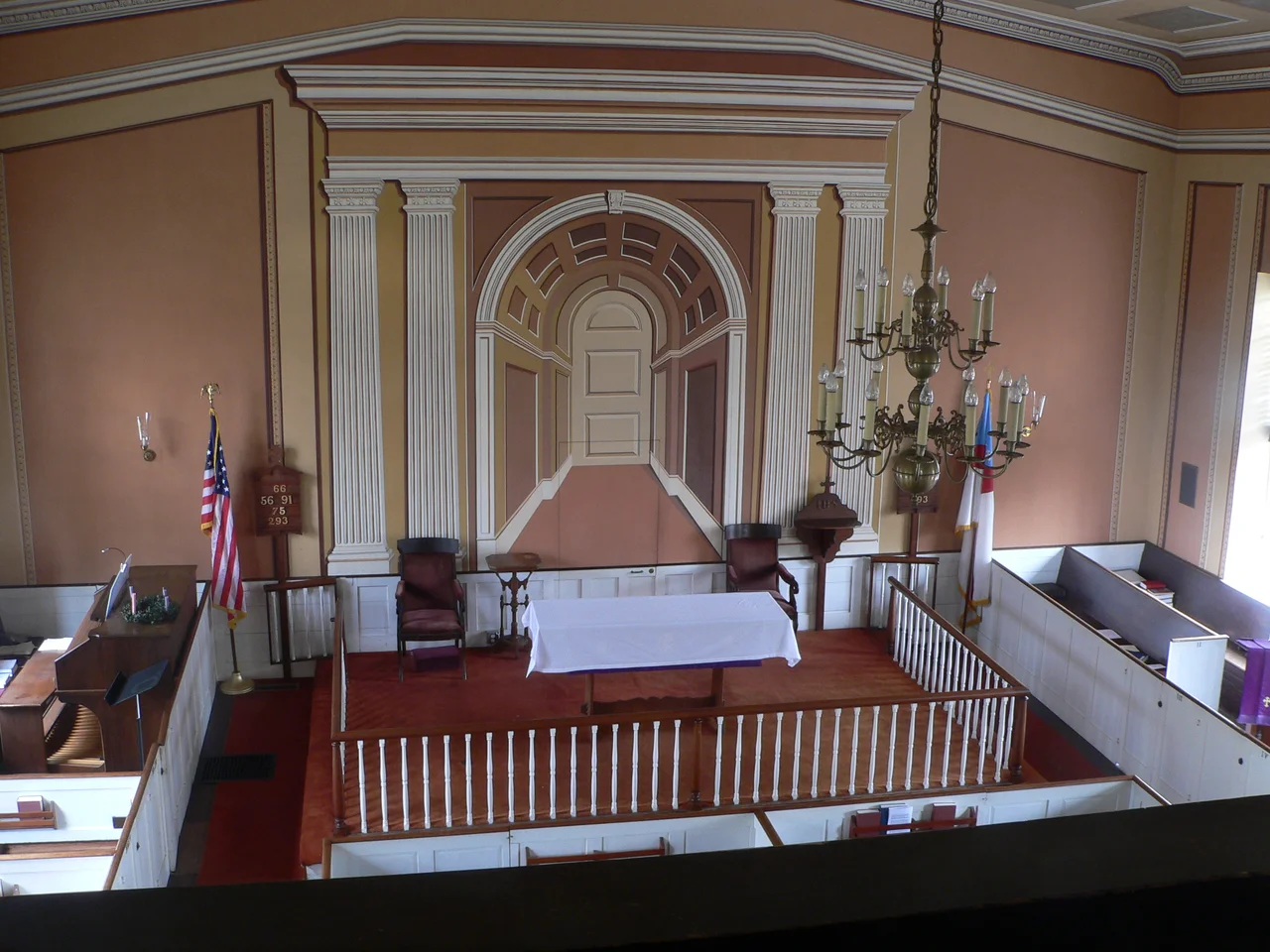
Step through the doors and the church gets deeper than it should. The chancel arch recedes into a coffered apse, fluted pilasters support an entablature, the ceiling vaults into ornamented panels framing a central medallion - and none of it is there. Every column, coffer, and shadow was painted onto flat plaster by a traveling artist named Jean G. Potts in the 1840s, a master of the trompe-l'oeil style whose entire trade was fooling the eye. Stand in the right spot and the back wall opens like a stage set. Walk closer and it flattens, the illusion collapses, and St. James Church becomes what it actually is: a brick box in a small Virginia county seat, holding a painting that pretends to be a building.
From Chapel to County Seat
Accomack Parish was carved off from Hungars Parish in 1663, and the first St. James was built in 1767 near present-day Onley to serve congregants in the southeastern reaches of the county. About twenty years later, Drummondtown was chartered as the new county seat - a town with two thriving hotels, furniture and hat-making factories, and a courthouse worth being close to. Parishioners voted with their feet. In 1838 they bought land near the courthouse, dismantled some of the original church for its brick, and built a new St. James in the Greek Revival style that had swept the country. The town outgrew its old name; in 1892 it became Accomac. The church it pulled toward itself is still standing on Drummondtown Road, almost two centuries later.
The Painter Who Fooled the Eye
The vestry hired Jean G. Potts, an itinerant artist who specialized in trompe-l'oeil - literally "fool the eye" - and gave him the entire interior. He covered all four walls beginning at the dado, painted simulated recessed panels rising to a painted cornice, and then ran a row of coffers around the four sides of a barrel-vaulted ceiling that culminates in a scrollwork medallion. The wall behind the chancel got his most lavish treatment: four fluted pilasters supporting an entablature, opening onto a barrel-vaulted apse with its own coffered ceiling, all on a flat wall. A door into the vestry hides inside the painted architecture. In the twentieth century, Linda Croison and Philip Ward restored the frescoes but deliberately left patches of Potts's original work visible at the back of the nave - a small honesty inside the larger illusion.
Greek Outside, Gothic on Top
The exterior is disciplined Greek Revival. Brick walls laid in three-to-one common bond, a tetrastyle Doric portico with a brick floor in herringbone, two doorways topped by a lunette window, a dentil cornice running across the front and down the sides. Inside, slip pews with doors carry Roman numerals. A central staircase rises in twin flights from the rear doors to a shared landing, then a flying stair continues up to the gallery. The only break with the Greek vocabulary is the wooden belfry and spire centered over the front gable: paired columns at each corner frame a lancet-shaped louvered opening, gothic arches floating above an otherwise classical building. It is the small inconsistency that lets the whole composition breathe.
A Governor, a War, and a Building Spared
This was the home parish of Henry A. Wise - lawyer, Virginia's 33rd governor, the man who refused to commute John Brown's death sentence in 1859 and then made fiery speeches for secession. His birthplace is still visible from the church's back lawn. When the Civil War came, much of the Eastern Shore was occupied by Union troops, and many nearby churches were damaged or destroyed, including St. George's at Pungoteague. St. James was spared. Union General Henry H. Lockwood listened when Accomac's citizens asked him to keep his soldiers disciplined, and he did. He took over a house abandoned by Dr. Peter Browne as his headquarters - the same house that later became the rectory. The frescoes survived because the people of a small town asked a general to be careful, and he was.
Still Active, Still Painted
St. James remains an active congregation in the Episcopal Diocese of Southern Virginia, part of St. George's Parish in Pungoteague. It was listed on the National Register of Historic Places in 1969 for its Greek Revival design and Potts's frescoes, and it is a contributing building of the Accomac Historic District established in 1992. Services still happen under the painted apse. Light from the lunette still falls onto the gallery stair. Somewhere in the back of the nave, behind the restored work, a few square inches of Potts's original brushwork persist - the actual hand of a traveling artist who, almost two centuries ago, walked into a small Virginia town and painted a building that wasn't there.
From the Air
St. James Church sits at 37.72N, 75.67W on the Delmarva Peninsula's Atlantic-shore lowlands, about 8 nautical miles inland from the Atlantic. Recommended viewing altitude 2,000-3,500 ft for the small church and surrounding Accomac Historic District. Nearest airports: Accomack County (KMFV) about 4 nm southwest, Wallops Flight Facility (KWAL) about 10 nm northeast. Flat terrain throughout - the Eastern Shore rarely exceeds 40 ft elevation. Best in clear mid-Atlantic weather; haze and summer humidity are common.
Nearby Stories
- Hog Island Light 7.5 km away
- Point Lookout Light 8.3 km away
- SS Monroe (1902) 9.8 km away
- Assateague Island National Seashore 13 km away
- Somerset County, Maryland 15 km away
- Gloucester County, Virginia 21 km away
- Werowocomoco 46 km away
- SMS Ostfriesland 67 km away