.JPG)
Stanford University Arboretum
Jane Stanford was unambiguous. In her 1903 address to the university's trustees, she declared that the arboretum should "always be sacredly preserved from mutilation." She called it a favorite project of her husband Leland, planted twenty-eight years earlier with "the choicest trees from all parts of the world." The university sold portions of it for a shopping mall and professor housing.
Olmsted's Vision
In 1885, Leland Stanford contracted Frederick Law Olmsted -- the landscape designer behind Central Park and the U.S. Capitol grounds -- to plan the university's grounds. An 1888 memorandum, signed by Stanford, stated that the arboretum should exhibit "all the trees and wood plants of the world that may be expected to grow to mature natural forms under the climatic and other conditions of the locality." The ambition was enormous: a living encyclopedia of global botany in the Santa Clara Valley. The arboretum began with the indigenous live oaks already growing on Stanford's estate and was augmented with specimens collected from around the world.
A Misnomer
The grand vision never materialized. A 1914 report by the Olmsted Brothers firm was blunt: the arboretum was "a misnomer" that consisted "mostly of a thick plantation of blue gums and Monterey Cypress" rather than the diverse botanical collection its name implied. The Department of Botany was given supervisory control to make better scientific use of the land, but the area was largely neglected for decades. At its peak, the collection held over 350 species from 150 genera and sixty families. The eucalyptus collection was once the most prominent feature, though it has declined from over 100 species to about 51.
What Remains
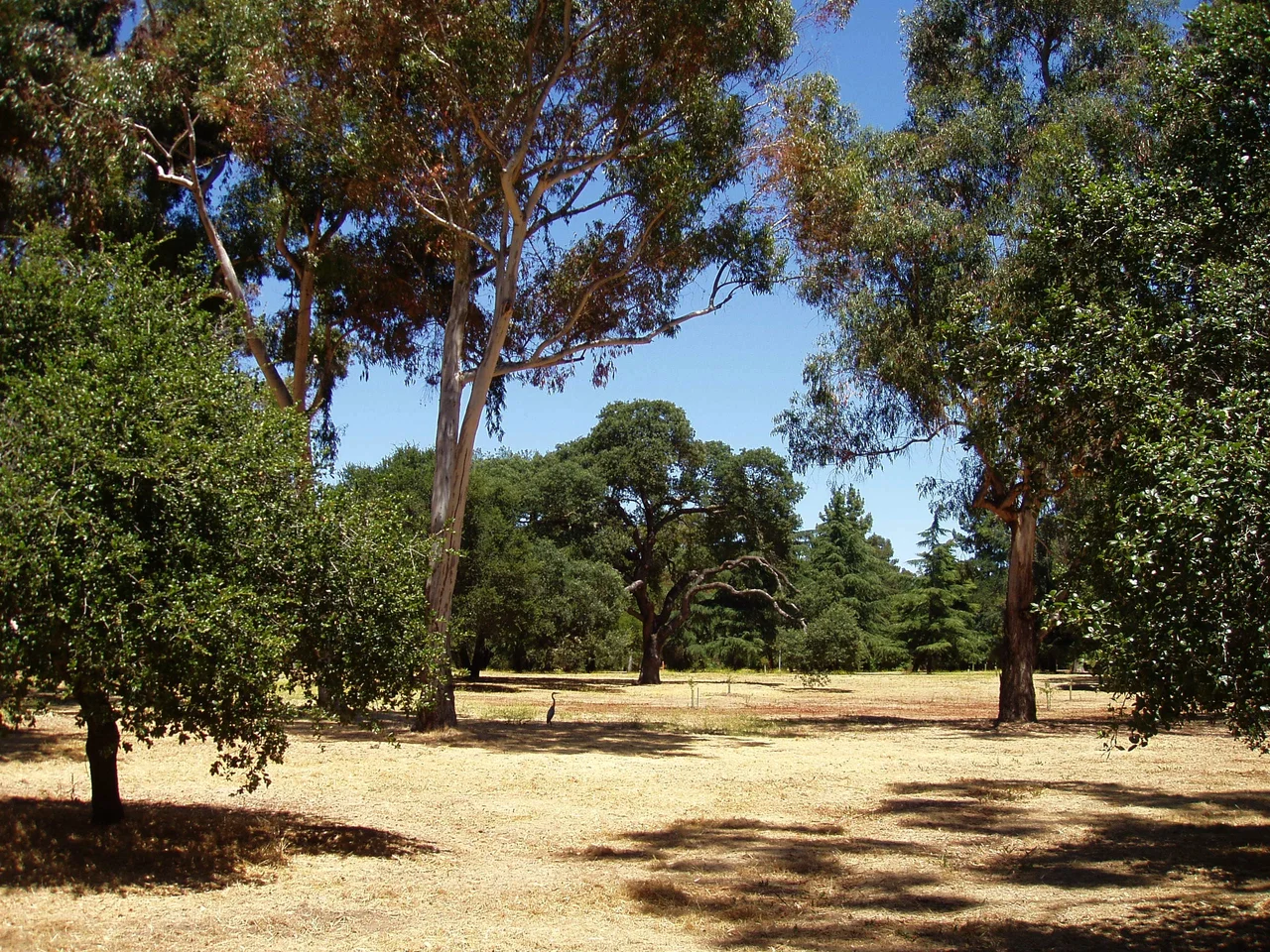
Today the arboretum is a shaded, somewhat wild open space within the campus, dominated by coast live oaks with scattered valley, blue, and black oaks. Older specimens include Atlas cedar, California sycamore, Canary Island date palms, deodar cedar, and Torrey pine. The Arizona Cactus Garden -- planted by the Stanfords before their son's death -- still grows within the arboretum, as does the Stanford Mausoleum where the family rests. During football games, parts of the arboretum serve as parking. The tension between Jane Stanford's sacred command and the university's practical needs has played out over more than a century, and the trees -- the ones that remain -- have witnessed every compromise.
From the Air
Stanford University Arboretum is at 37.438°N, 122.167°W on the northwest portion of the Stanford campus. The arboretum's tree canopy is visible as a green zone along Palm Drive. Nearest airports: Palo Alto (KPAO) 2 nm northeast, San Jose International (KSJC) 10 nm southeast.
Nearby Stories
- Altamont Free Concert 15 km away
- Mystery Spot 17 km away
- Ghost Ship Warehouse Fire 19 km away
- The Farallon Islands: California's Forbidden Rock 28 km away
- Kesterson National Wildlife Refuge 67 km away
- The Kilns That Never Burned 71 km away
- Panoche Hills: California's Last Desert Refuge 95 km away
- ʻAkaka Falls State Park 3679 km away