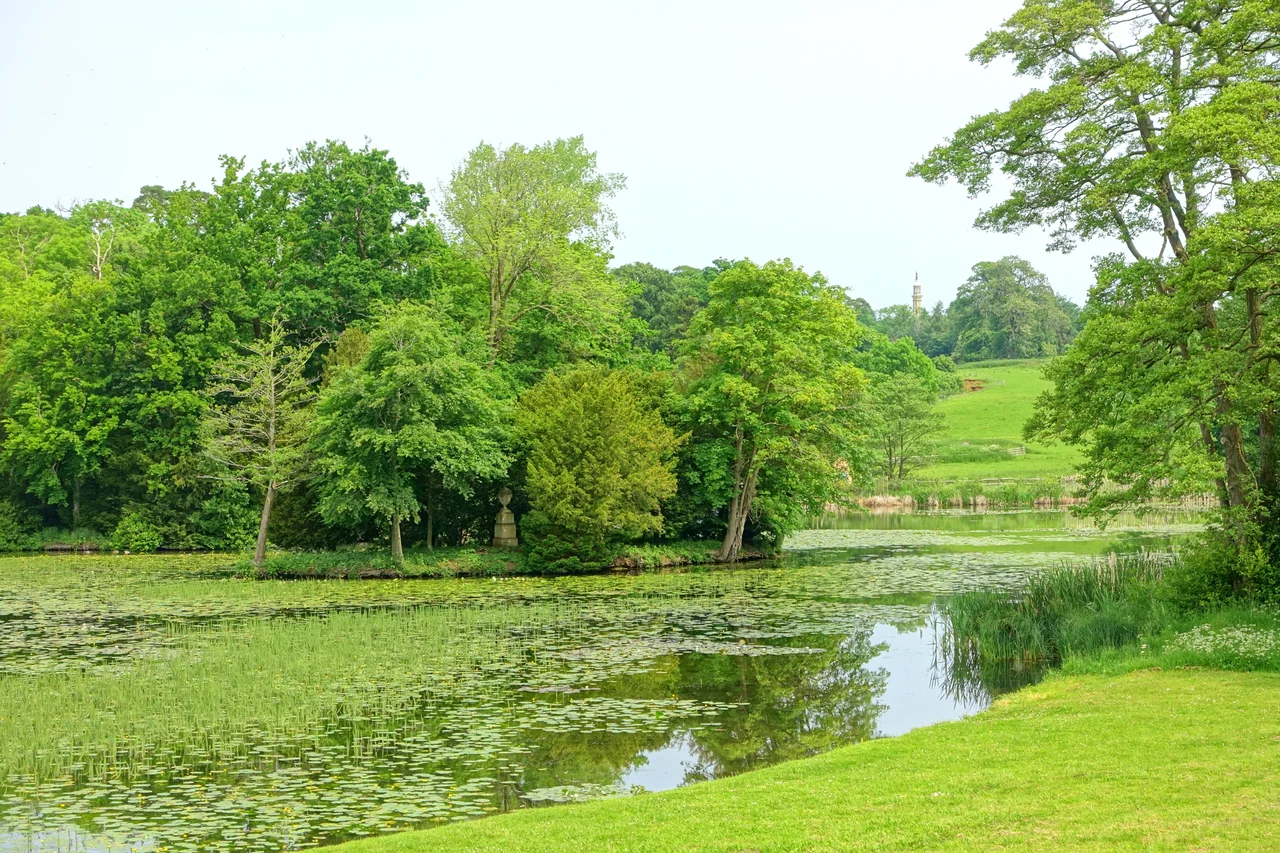

Stowe Gardens
There is a building at Stowe called the Temple of British Worthies. Sixteen busts of great Britons gaze out of niches across a pond - Shakespeare and Newton, Elizabeth I and Sir Walter Raleigh, John Milton and John Locke. Across the water stands the Temple of Ancient Virtue, a perfect circular tholos containing four classical figures: a general, a lawmaker, a poet, a philosopher. Between them, in the trees, you can find the empty foundations of what was once the Temple of Modern Virtue - deliberately built as a ruin, in 1730s England, as a sneer at the corrupt government of Sir Robert Walpole. The richest landowners in Buckinghamshire were making political arguments through architecture, and the language they were inventing - the English landscape garden - would change how every park in the world was designed.
Three Designers, One Lifetime
Stowe is the only garden in England where Charles Bridgeman, William Kent and Lancelot 'Capability' Brown all made major contributions. Bridgeman shaped the early baroque park from 1711 to 1735, with John Vanbrugh as his architect until Vanbrugh's death in 1726. Kent joined in 1731, took over the design after Bridgeman, and invented at Stowe one of the most consequential ideas in landscape history: the Elysian Fields, laid out according to natural lines and contours rather than geometric formality. Capability Brown arrived in 1741 as head gardener and lived at the East Boycott Pavilion. He worked here for a decade before leaving to begin the independent career that would make him the most influential landscape designer in British history. The three men did not collaborate so much as overlap, each layering his ideas on top of his predecessor's. Stowe records the moment, in slow geological strata of grass and water, when English garden design pivoted from the French formal to the natural - and then exported that revolution to the world.
Politics in Stone
Lord Cobham, the patron who pulled all this together, was a Whig and a member of the political circle that hated Walpole's government. The Elysian Fields are a political pamphlet built in landscape. The Temple of British Worthies celebrates Whig heroes - thinkers and statesmen who, in the Cobham circle's view, embodied liberty and virtue. The original Temple of Modern Virtue, built as a ruin, openly mocked what Cobham saw as the moral decay of contemporary government. The Temple of Concord and Victory commemorated British triumphs in the Seven Years' War; the Temple of Friendship celebrated Cobham's political allies. Even the seven Saxon Deities arranged in a circle - Sunna, Mona, Tiw, Woden, Thuner, Friga and Seatern - were a Whig statement, asserting that English liberties had Saxon roots predating Norman tyranny. A visitor in 1740 would have walked the paths and read the inscriptions like a series of pamphlets. Most modern visitors miss the politics entirely. The gardens are so beautiful that the argument they were built to make has become merely a backdrop.
Capability Brown's Beginning
Lancelot Brown was an obscure young head gardener from Northumberland when he arrived at Stowe in 1741. Within ten years he had reshaped Bridgeman's octagonal pond into a naturalistic lake, contrived the Grecian Valley as an abstract composition of landform and woodland, married a local Buckinghamshire girl in the parish church of St Mary's (still standing in the woods between the house and the Elysian Fields), and made himself the most promising landscape designer of his generation. He left Stowe in 1751 to start his own practice. He would go on to redesign roughly two hundred and fifty English parks - Blenheim, Petworth, Chatsworth, Highclere - and earn the nickname 'Capability' from his habit of telling clients that their land had 'great capabilities.' The man who reshaped half the country grew into his craft on the lawns and serpentine paths of Stowe. The cascade he probably built, the Grecian Valley he probably designed, and the Cobham Monument that may be his work all still stand.
The Bankrupt Duke and the Auction That Saved a House
In 1848 the 2nd Duke of Buckingham and Chandos was so deep in debt that he was forced to sell the contents of Stowe House to pay his creditors. The Christie's auction of the dispersal made the name of the auction house. The contents went; the gardens remained. The 3rd Duke returned in 1862 to find sculpture missing, books gone, furniture sold, and the place visibly poorer, but the temples and lakes and avenues were still here. He replanted the avenues and reopened the gardens to the public in 1868. The remaining estate was sold in 1921 and 1922. In 1923, Stowe School was founded in the great Palladian house, which is the only reason any of this survived the twentieth century at all. The National Trust began formally acquiring parts of the gardens in 1967, took the bulk of the garden in 1989, and has spent the years since recreating lost statues, replanting avenues, restoring monuments. The Queen's Theatre, the Wooden Bridge, the Gothic Cross destroyed by a falling elm in the 1980s - all have been brought back.
Silverstone in the Old Park
The original Stowe estate stretched far beyond the modern garden boundary. The northern parkland reached over the county border into Northamptonshire, where what was once the extreme northeast corner of the park is now Silverstone Circuit. The riding that ran south from those woods is still partly visible, aligned on the Wolfe Obelisk a mile and a half away. Stand at the right point on the modern circuit and you can look down the surviving avenue toward the Stowe estate that owned this land for centuries before the bombers and the racing cars arrived. The deer park to the southwest of the gardens, restored in 2003, now holds about five hundred fallow deer. The 250 acres of formal landscape gardens, the largest collection of garden temples in the world, are open 365 days a year. A walk through Stowe takes most of a day. A proper one, with the inscriptions read, takes longer.
From the Air
Stowe Gardens lie at 52.030°N, 1.018°W in north Buckinghamshire, about three miles northwest of the town of Buckingham. From altitude, look for the distinctive radial pattern of avenues meeting at the Corinthian Arch, with the Octagon Lake and Eleven Acre Lake visible to the south of the great house. Silverstone Circuit sits immediately to the north, just over the county border in Northamptonshire - both estates were once the same property. Sywell Aerodrome (EGBK) is twenty miles to the northeast; London Oxford (EGTK) sits twenty miles to the south. The grand south vista runs roughly north-south, useful as a navigation reference under broken cloud.
Nearby Stories
- Coombe Abbey 3.5 km away
- Waddesdon Manor 3.7 km away
- Battle of Edgehill 5.8 km away
- Battle of Naseby 8.7 km away
- Hertfordshire 9.9 km away
- Connington South Rail Crash 11 km away
- St Neots 13 km away
- Cotswolds 35 km away