
Sullenberger Aviation Museum
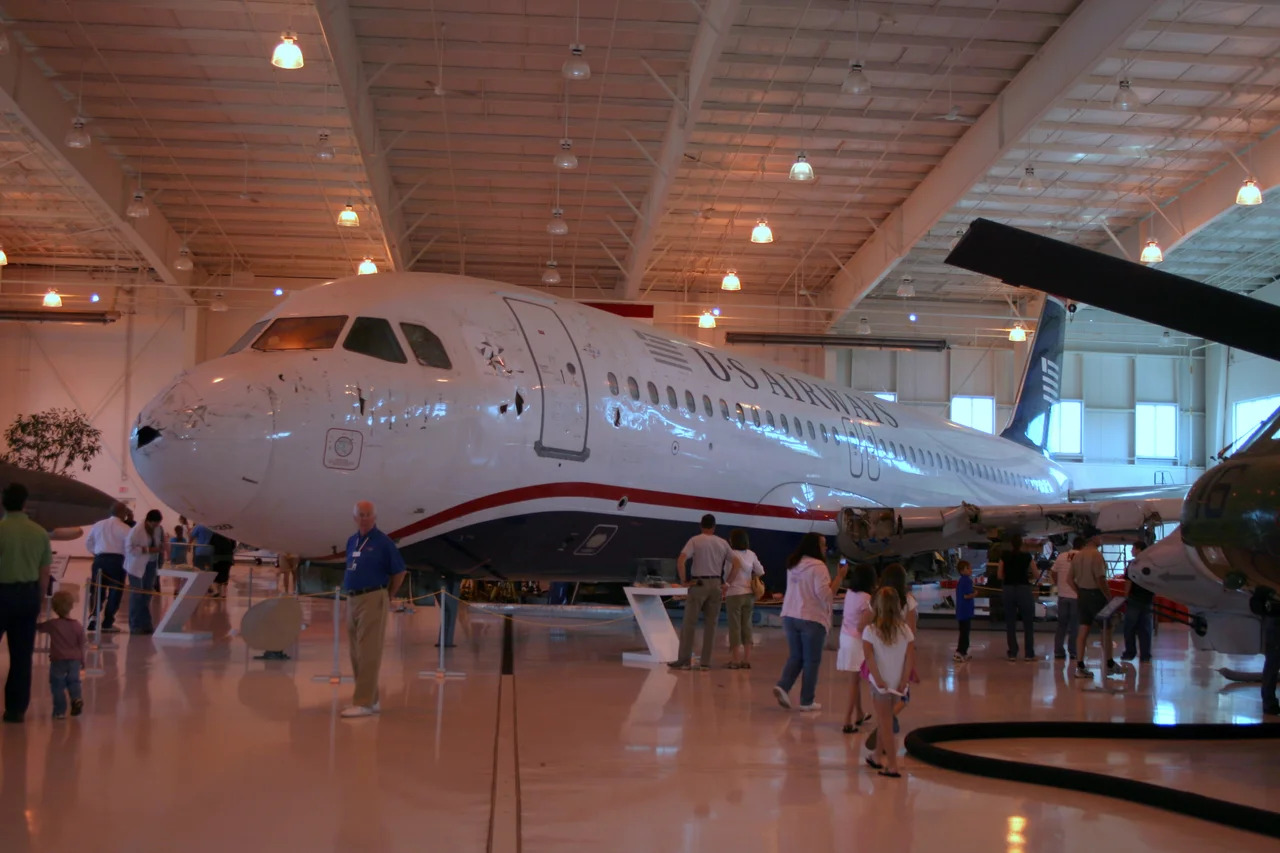
On January 15, 2009, six minutes after takeoff from LaGuardia, US Airways Flight 1549 hit a flock of Canada geese over the Bronx. Both engines lost power. Captain Chesley Sullenberger and First Officer Jeffrey Skiles had no time to reach an airport. Sullenberger glided the Airbus A320 onto the surface of the Hudson River. All 155 people aboard survived. The airplane that did that - tail number N106US, the actual Airbus, every dent and every scrape - now sits inside a museum hangar in Charlotte, North Carolina, displayed in as-recovered condition. Everything that was in the aircraft remains there, except the passengers' personal belongings. It is the youngest commercial airliner on display in any American museum, by about 35 years.
From Carolinas Aviation to Sullenberger
The museum was founded in 1992 on the grounds of Charlotte Douglas International Airport as the Carolinas Aviation Museum. It built a collection of more than 50 aircraft - military jets, helicopters, a Piedmont Airlines DC-3 in original livery, an aviation library with 9,000 volumes. In January 2011, the museum acquired N106US. The airplane arrived in Charlotte that June after a slow road journey south from a hangar in New Jersey where it had been stored since the NTSB completed its investigation. In 2022, the museum announced it would be renamed for Sullenberger himself. Captain Sully attended the ribbon cutting on May 29, 2024. The new museum opened to the public on June 1.
Aviation City
The reopened museum is organized into three galleries. Aviation City occupies the airport's original 1936 hangar - a Works Progress Administration structure that has been continuously in use since Eastern Air Lines started scheduled service at Charlotte Municipal Airport. The hangar is itself an artifact. Inside it: a DC-3 in Piedmont colors, an air traffic control console, an airport beacon. Aviation Society holds an F-14 Tomcat and a small Ercoupe. Innovation Nation - the gallery that draws the visitors - displays an F-4S Phantom, a Lockheed TV-1, and the Hudson Airbus. The three galleries together cover most of a century of flight, from the era of wood-and-fabric biplanes to a January morning when a glide ratio and a pilot's nerve kept 155 people alive.
The Rare and the Recovered
Beyond the Hudson Airbus, the collection holds aircraft that exist nowhere else. One of only two surviving Douglas D-558 Skystreaks - the experimental jet that briefly held the world airspeed record in 1947. The second U.S.-built Harrier ever made, the AV-8B test airframe that logged over 5,000 flight-test hours. A Convair YF-102 Delta Dagger, a Grumman F-14D Tomcat, a Sikorsky CH-53A Sea Stallion. A 1903 Wright Flyer replica. Archive collections from Chesley Sullenberger himself, from the Piedmont Airlines Historical Society, from US Airways and the legacy carriers it absorbed - Allegheny, America West, Mohawk, PSA. The museum is an Airbus, but it is also the institutional memory of half the American airline industry.
The Gift That Made It Possible
The rebuild was paid for, in part, by people whose lives were directly bent by the events on display. Ric Elias, the CEO of Red Ventures, was a passenger on Flight 1549. He gave the museum a million dollars. Lonely Planet, the travel publisher, gave another five hundred thousand. The museum broke ground on its new facility in September 2022. Stephen Saucier, who shepherded the project as president, retired at the end of the fiscal year in January 2025 once the work was done. The museum he left behind is one of a handful of major airport aviation museums located directly on the field where the airliners still take off and land - a hangar inside a hub, holding the airplane that did not crash.
From the Air
On the grounds of Charlotte Douglas International (KCLT), at roughly 35.219 N, 80.930 W, field elevation 748 feet. The museum complex sits on the east side of the airport, accessible by road but visible from approach paths to runways 18C/36C and 18R/36L. Look for the original 1936 WPA-era hangar at the heart of the campus. Nearest other aviation museums: Smithsonian Udvar-Hazy (KIAD area), 350+ miles north.
Nearby Stories
- Winthrop University 4.4 km away
- Reed Gold Mine 5.7 km away
- Grace Evangelical and Reformed Church 8 km away
- Gardner-Webb University 9.8 km away
- 2025 North Carolina Cessna Citation II Crash 30 km away
- Spartanburg 34 km away
- Joara 38 km away
- Cheraw, South Carolina 64 km away