
Taishanese People
Walk into an old Chinatown — San Francisco's Grant Avenue, New York's Mott Street, Vancouver's Pender — and you are walking through a world the Taishanese built. Long before Cantonese speakers from Guangzhou arrived in large numbers, it was people from the Sze Yup region of Guangdong who crossed the Pacific, endured the exclusion laws, and turned small enclaves into communities. Their dialect, not standard Cantonese, was the original lingua franca of those streets. Their laundries and groceries were the foundation stones. And their money quietly funded Dr. Sun Yat-sen's revolution back home. The Taishanese — known in their own tongue as Hoi San Ngin — are a Han Chinese subgroup from five county-level cities centered on Jiangmen: Taishan, Kaiping, Xinhui, Enping, and Heshan. Small in population relative to China as a whole, they have had an influence on the world entirely disproportionate to their numbers.
A Language That Remembers the Tang
Taishanese is not simply a regional Cantonese accent. Linguists classify it as a distinct Yue Chinese language, and native Cantonese speakers can understand only about thirty percent of it on average. This is because Taishanese has preserved features of Middle Chinese — the language of the Tang Dynasty — that standard Cantonese has long since shed. Phonological patterns, tones, and vocabulary trace back over a thousand years to the ancestors who migrated south into Guangdong from central China. The language crossed the Pacific with its speakers and became the sound of Chinatown for generations of Americans who had no idea it existed. After the Immigration and Nationality Act of 1965 finally dismantled the old exclusion framework and opened the door to immigration from Guangzhou, Cantonese gradually replaced Taishanese as the lingua franca of the diaspora. But in the older neighborhoods, among the older families, you can still hear it — a living fossil of Tang-era pronunciation, spoken over mahjong tables in California.
Twelve Thousand Men and the Iron Road
The story of Taishanese labor in America is inseparable from the story of the transcontinental railroad. When the Central Pacific Railroad pushed east from Sacramento through the Sierra Nevada in the 1860s, it employed roughly 12,000 Chinese workers — about ninety percent of its entire labor force. Most of those men came from Sze Yup. They drilled tunnels through granite by hand and lowered themselves in wicker baskets to place black powder charges on cliff faces. They worked in winter conditions that killed dozens and in summer heat that punished even those who survived. J. O. Wilder, a Central Pacific supervisor, later wrote that the Chinese workers were "as steady, hard-working a set of men as could be found." The railroad was completed in 1869. The workers were paid less than their white counterparts throughout and were excluded from the commemorative photograph at Promontory Summit. Their contribution was real; the recognition was not. In 1906, a Taishanese immigrant named Chin Gee Hee built the Sun Ning Railway — one of only three railways in pre-1949 China built entirely with private Chinese capital — using savings accumulated partly from that American labor.
Watchtowers Built From Remittances
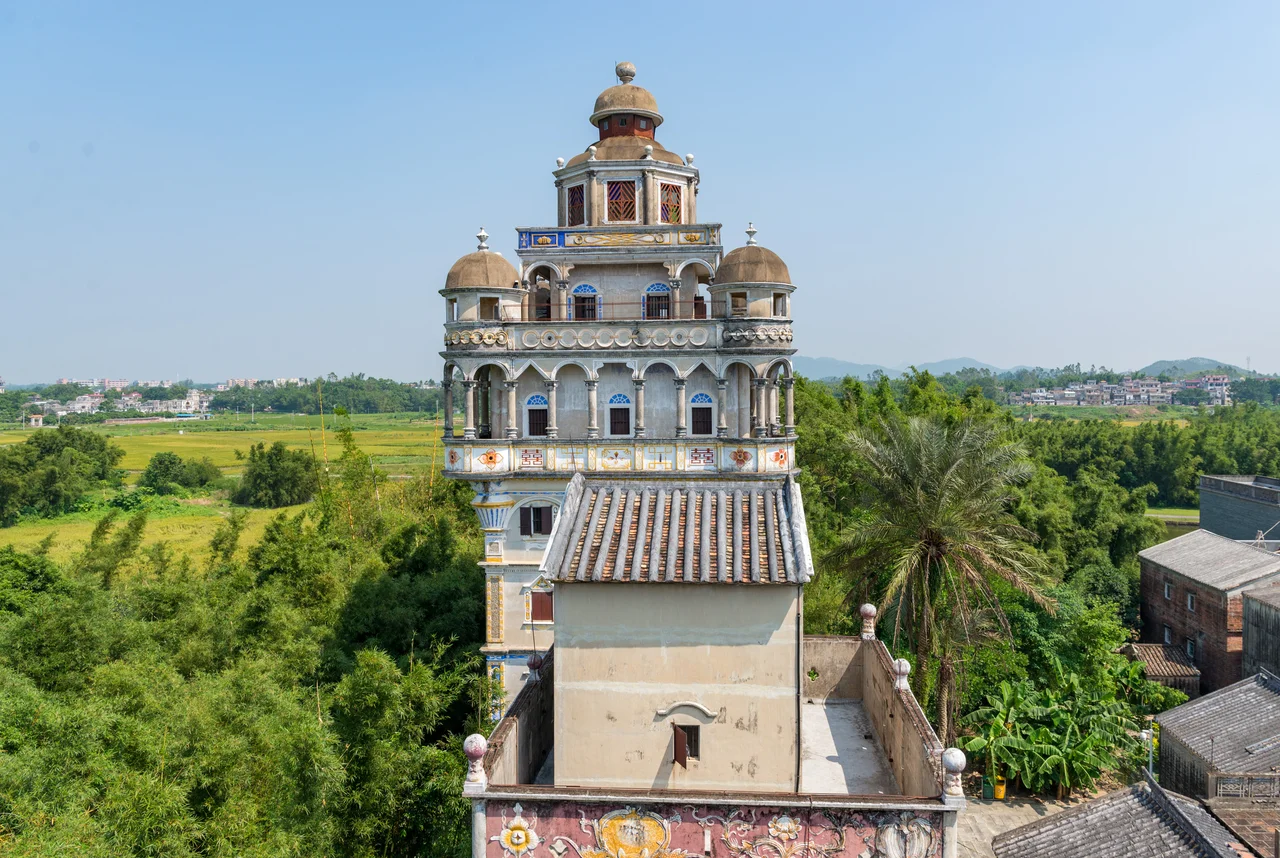
The money the Taishanese sent home left a permanent mark on the landscape of Guangdong. In Kaiping — one of the five Sze Yup cities — more than 1,800 diaolou still stand in the rice paddies and village lanes. These fortified watchtowers were built by overseas families in the early twentieth century to protect against bandits who preyed on the villages known to receive remittances from abroad. The architecture is extraordinary: Baroque columns, Romanesque arches, and Moorish battlements fused with traditional Lingnan construction in a style unlike anything else in China. UNESCO inscribed four village groups as a World Heritage Site in 2007, noting that the diaolou "reflect the significant role of émigré Kaiping people in the development of several countries in South Asia, Australasia, and North America." The towers are simultaneously a statement of wealth and a record of fear — the fear that came with being connected to a prosperous world elsewhere while remaining physically vulnerable at home.
Firsts in a Country That Excluded Them
The Chinese Exclusion Act of 1882 singled out Chinese laborers for permanent prohibition — the only law in American history to bar a specific nationality from immigration. It was enforced against the very people who had helped build the railroad that made westward expansion possible. The Taishanese lived under its restrictions for over sixty years, navigating paper son arrangements, hostile courts, and regular harassment. And yet, within those constraints, they accumulated firsts that the history books were slow to record. Anna May Wong became the first Asian American international film star. Arthur Chin was America's first ace pilot of World War II. Gary Locke became the first Chinese American elected governor of a continental U.S. state. Judy Chu became the first Chinese American woman elected to Congress. Wong Kim Ark won a Supreme Court case that established birthright citizenship as a constitutional right for the children of immigrants — a ruling that still governs American law today. These were not incidental achievements. They were hard-won assertions of belonging by people the law had tried to exclude.
A Diaspora Across Ninety-One Countries
Today the Taishanese diaspora reaches across 91 countries and territories. In Hong Kong, Taishanese make up roughly one-third of the population, though many have assimilated into the Cantonese-speaking majority. The region has produced the founders of Lee Kum Kee, the Bank of East Asia, Li & Fung, and Maxim's Catering — companies that collectively employ hundreds of thousands of people. In the arts, Sze Yup ancestry appears across generations of Hong Kong cinema: Donnie Yen, Andy Lau, Tony Leung Chiu-Wai, and the members of the rock band Beyond all trace roots to these five cities. The father of Hong Kong cinema, Lai Man-Wai, came from Xinhui. The father of Chinese aviation, Feng Ru, came from Enping. Liang Sicheng, the architect who fought to save Beijing's ancient city walls, came from Xinhui. The community that built Chinatown also built much of the modern Chinese-speaking world — quietly, without enough acknowledgment, from a patch of Guangdong that most maps still don't bother to label.
From the Air
The Sze Yup region lies at approximately 22.29°N, 112.57°E in the Pearl River Delta of Guangdong Province, roughly 140 km southwest of Guangzhou. At 5,000–8,000 feet you can see the broad flat delta giving way to the low hills that mark the edge of the Kaiping countryside. The city of Jiangmen is the administrative center; Taishan lies to the southwest. Nearby airports include Guangzhou Baiyun International (ZGGG), about 140 km northeast, and Zhuhai Jinwan Airport (ZGSD), roughly 80 km to the southeast. The Pearl River Delta is often hazy due to industrial activity; visibility is best in the cooler months from October through February.
Nearby Stories
- Zhongshan 16 km away
- Lampacau 30 km away
- Xinhui, Jiangmen 37 km away
- Wanshan Archipelago Campaign 57 km away
- Battle of Nanpeng Island 68 km away
- Temple of the Five Lords 287 km away
- Cua Ong Temple 512 km away
- Erhai Lake 1266 km away
Sources
- Taishanese people - Wikipedia
- Chinese Railroad Workers - FamilySearch
- Wikipedia - Sun Ning Railway Company
- The Vintage News - Kaiping Diaolou watchtowers
- Arthur Chin - Wikipedia
- Gary Locke - National Governors Association
- United States v. Wong Kim Ark (1898) - Immigration History
- Judy Chu - first Chinese American woman elected to Congress (NPR)