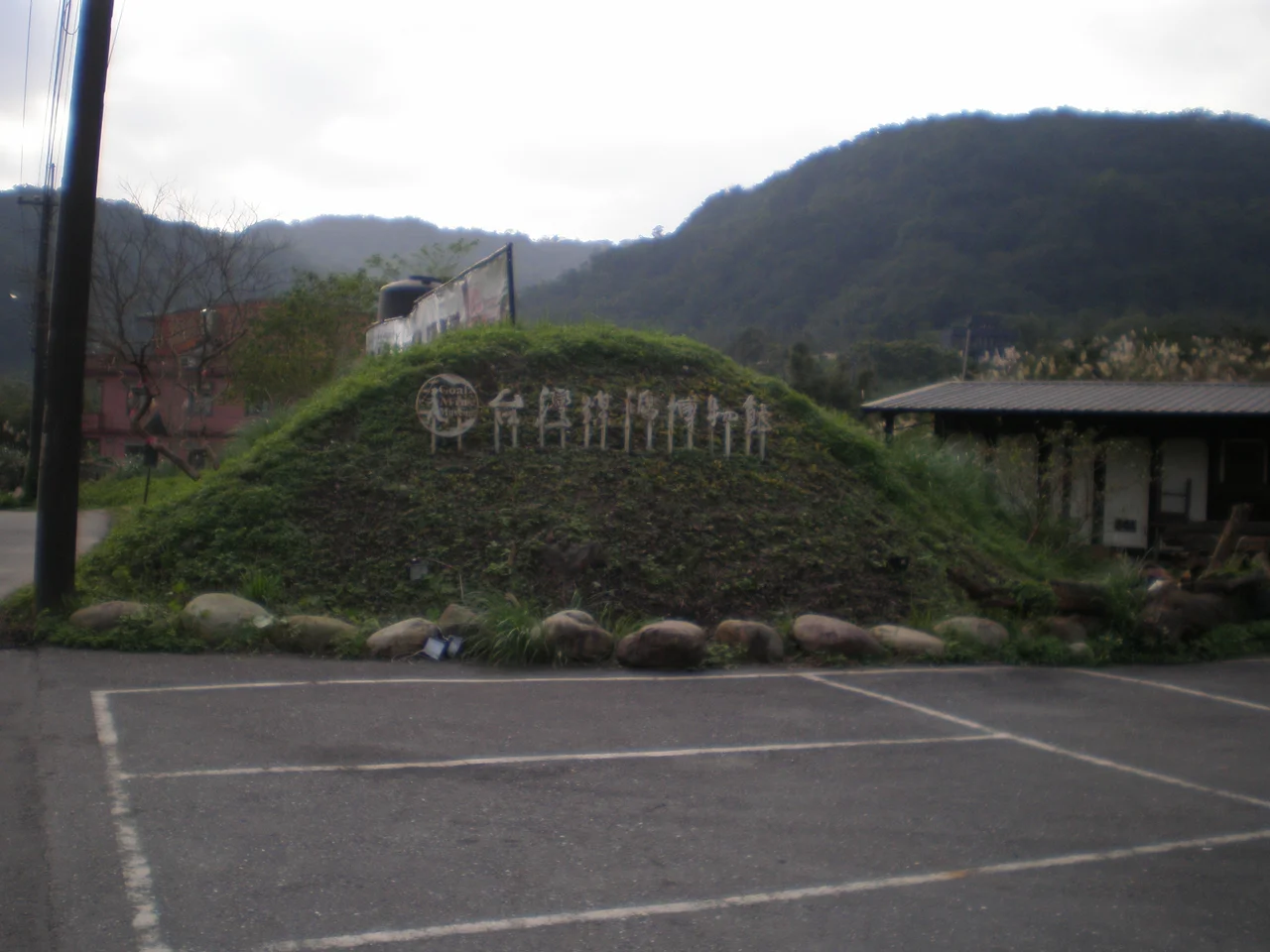

Taiwan Coal Mine Museum
The rock mountain behind the museum did not look like a mountain before the mining began. It grew over decades, load by load, as workers brought waste rock out of the earth and piled it where there was nowhere else to put it. By the time the New Pingxi Mine closed in 1997, the overburden heap had reached 140 meters — taller than most of the surrounding valley walls. In July 2005, one side of it slid. The resulting scar, still visible today, is called the Abandoned Rock Mountain: a landscape shaped entirely by labor, by the accumulated weight of what was extracted and what was left behind.
The Men Who Dug This Valley
Coal mining came to Pingxi District under Japanese colonial rule, and it reshaped the valley's communities as thoroughly as it reshaped the terrain. The men who worked these mines — and they were almost all men — descended into narrow shafts each morning in a region where the mountains press close and daylight is scarce even above ground. Underground, ventilation was poor, gas pockets were unpredictable, and roof collapses were a persistent reality rather than a remote risk. Mining gave the valley its livelihood, its identity, its railway — the Pingxi Line was built in 1921 specifically to carry coal down to the coast — and its losses. Across northern Taiwan, mining accidents were a routine part of industrial life; the year 1984 alone saw nearly 270 miners die in three separate disasters in New Taipei's coalfields. The men of Pingxi worked within that same system, under those same conditions. The museum does not let you forget them.
The New Pingxi Mine: Rise and Closure
The specific mine whose site the museum now occupies — known as the New Pingxi Mine, operated by Tai-Yiang Mining Inc — opened in 1965 and extracted its first coal in 1967. By then, Taiwan's broader mining industry was already past its peak. Cheaper imported coal began arriving in the 1970s, and after the disasters of 1984 accelerated government efforts to restructure the industry, the economic logic of domestic mining eroded further. The New Pingxi Mine continued operating until 1997, when the cost differential with imports finally made continuation impossible. The last shift ended quietly. The machinery was not stripped out but left in place, which turned out to be fortunate.
From Colliery to Museum
The transformation of the site into a museum was the work of Gong Yung-tsang, working with railway enthusiasts and others who understood what was being lost. Rather than demolishing or redeveloping the industrial infrastructure, Gong chose to preserve it in place — the mine locomotives, the large-scale processing machinery, the storage buildings that became the entrance hall. The museum opened in 2002. A simulated pit lets visitors understand the physical reality of the work: the confined space, the low ceiling, the sense of the mountain above you. A small-scale exhibition hall provides historical context. The machinery itself, enormous and immovable, speaks more directly than any signage. These were not tools; they were the instruments of a working life that thousands of families in this valley depended on.
The Abandoned Rock Mountain
The 140-meter heap of waste rock behind the museum carries its own complex history. Overburden — the rock and earth displaced in extracting coal — accumulates over the life of any mine, and there is never a clean way to dispose of it. At the New Pingxi Mine, decades of extraction produced a mass of loose gravel and stone that, after the mine closed, had no vegetation to hold it in place. On a day in July 2005, one face of the mountain gave way. The slide left an exposed scar of grey rock that has not re-vegetated in the years since. The museum has named it the Abandoned Rock Mountain and integrated it into the visitor experience, not as an attraction but as evidence: this is what extraction looks like when the accounting is done honestly, when the costs that mining does not pay for are finally made visible in the landscape.
Memory and Dignity
Museums about industry can slide toward nostalgia — the gleaming locomotive, the hard-hat photograph, the pride of production disconnected from the toll it carried. The Taiwan Coal Mine Museum works against that tendency. The preserved machinery is extraordinary, and visitors who know nothing of mining history will find it visually compelling. But the site itself insists on the fuller story: the waste mountain, the closed shaft, the records of a community whose working life was shaped by forces — colonial administration, global commodity markets, government policy — largely beyond individual control. To walk through this museum is to understand that coal mining in Pingxi was not simply a chapter of economic history. It was what thousands of people spent their working lives doing, sometimes losing those lives in the process, to keep the lights on and the trains running in a country that eventually decided it could not afford them anymore. The museum asks you to hold that complexity.
From the Air
The Taiwan Coal Mine Museum sits at approximately 25.05°N, 121.77°E in the Jilong River valley, Pingxi District, New Taipei, at around 100 meters elevation. The 140-meter waste rock mountain (the Abandoned Rock Mountain) behind the museum is visible from the air as a grey scar against the green valley walls — one of the more unusual landscape features in this part of Taiwan. Nearest major airport: Taipei Songshan (RCSS), approximately 28 km west-southwest. The valley runs east-west; approach from the west follows the Jilong River upstream. Best viewed at 1,500–3,000 feet AGL.
Nearby Stories
- Taoyuan Air Base 4.7 km away
- Min Ping Yu No. 5540 Incident 6.9 km away
- Neiwan 14 km away
- North Jiangsu Main Irrigation Canal 982 km away
- Sinking of MV Sewol 1049 km away
- General Cliff Rock Paintings 1058 km away
- Yellow Sea 1108 km away
- Sibuyan Island 1376 km away