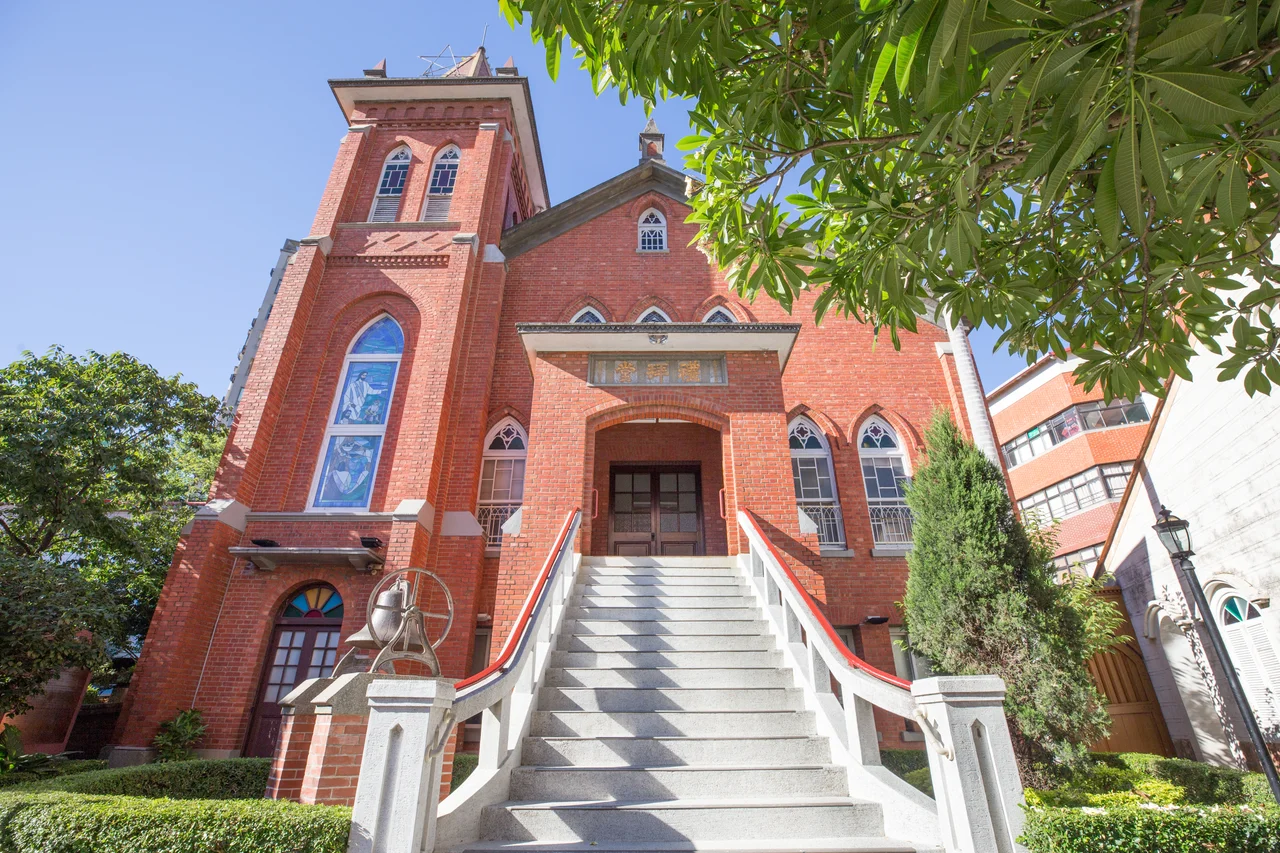

Tamsui Church
The church has a bell with a complicated history. Cast in the USA, its face inscribed with "YORK" and "No. 30," it hung in the clock tower of Tamsui Church from 1915, ringing across the river estuary loudly enough to be heard miles out to sea. Then war came, and the Japanese government requisitioned it — pulled it from its tower and mounted it on the roof of a nearby building to serve as a civilian air raid siren. An Allied bomb eventually silenced it, cracking the bell and ending its voice. After the war, it was sent back to the church. In 1985, installed at the chapel's rear and renamed the "Gospel Bell," it was formally commemorated for what it had endured. A bell that rang over the sea, was conscripted into war, was broken by war, and then came home — all in the same town, all within living memory.
George Mackay's Legacy on the River
The Tamsui Church's roots run through one of the most remarkable missionary careers in Taiwanese history. George Leslie Mackay, a Canadian Presbyterian who arrived in northern Taiwan in 1872, made Tamsui his base for decades of work that transformed the region. He founded schools and hospitals, learned the Taiwanese Hokkien language, and — in a practice unusual enough to become famous — pulled teeth, treating thousands of patients and earning a reputation that preceded him across the island.
Mackay died in Tamsui in 1901, but his influence persisted through the institutions he founded and the community he built. The church that bears the congregation he helped establish was built during the Japanese colonial period, then deteriorated and was renovated in 1932. It was his son, George William Mackay, who formally opened the renovated building on November 28, 1933. The church thus reflects both the missionary generation that planted Christianity in northern Taiwan and the second generation that kept it rooted.
The White Chapel and Its Gothic Tower
The building completed in 1915 was called the "White Chapel," and it arrived with a clock tower that became the neighborhood's audible landmark. The Gothic architectural style — unusual in a town that had spent centuries under Chinese and then Japanese influence — announced itself visually as something foreign, deliberate, and permanent. The clock tower's silhouette became a feature of Tamsui's riverfront skyline.
The bell installed that year was American-made, its origins recorded only in the casting on its face: "YORK" and "No. 30." How it arrived, who paid for it, and what route it traveled from its American foundry to a Presbyterian church on a Taiwanese river estuary are questions the historical record does not fully answer. What it did once installed was clear: it rang. The sound was described as loud and round, carrying across the water in a way that made it a fixture of daily life along the Tamsui riverfront.
Wartime Requisition and a Broken Voice
When Japan went to war, civilian resources were mobilized throughout the empire. In Tamsui, the church's bell was taken by the Japanese government and repurposed as an air raid siren for what the records call the "Street Workplace" — erected on the roof of the Daguanlou, the prominent building known locally as the Red Building, overlooking the river.
The bell served its wartime function until an Allied air raid destroyed it. The bomb that ended its usefulness as a siren also cracked it, silencing a voice it had maintained for three decades. When Japan surrendered and Taiwan passed out of Japanese administration, the broken bell was returned to the church. Its condition was a kind of witness — physical evidence of what had happened to the town, the island, and the bell itself during a decade of war.
A Song and a Ringing That Carries
Tamsui occupies a particular place in Taiwanese cultural imagination. The river town at the mouth of the Tamsui River, where the water meets the Taiwan Strait, has attracted artists, writers, and musicians drawn to its combination of colonial history, natural beauty, and the particular quality of light over the estuary at dusk.
The famous Taiwanese folk ballad known as the "Twilight Song of Tamsui" captures something of that mood. Among its images: "the church bell rings to the sea with an empty heart." That line refers to this church, this bell — the American-cast instrument in the Gothic tower above the river. The song is part of the cultural inheritance of the place, and the bell is part of the song. After the war, after the damage, the bell was formally reinstalled at the back of the chapel in 1985 and named the Gospel Bell. The church itself, renovated again in 1986, still stands a short walk northwest of Tamsui Metro Station. The bell no longer rings across the water on its original schedule, but the song it inspired still does.
From the Air
Tamsui Church sits at approximately 25.1720°N, 121.4384°E on the northern bank of the Tamsui River estuary, where the river opens into the Taiwan Strait. From Taipei Songshan Airport (RCSS), fly northwest roughly 20 km; the Tamsui River is a clear navigational reference running from the city to the coast. The Gothic clock tower of the church is not easily distinguishable from altitude, but the riverfront town of Tamsui — with the distinctive brown-red roofline of Fort Santo Domingo on the hill above — provides good visual orientation. Taoyuan International Airport (RCTP) lies about 25 km to the southwest across the river mouth. Recommend 1,000 ft AGL or below for town-level features; watch for terrain to the northeast as the Yangmingshan hills rise quickly from the coast.
Nearby Stories
- Sanxia Car Attack 9.6 km away
- Dapu Incident 28 km away
- 2022 Chinese Military Exercises Around Taiwan 45 km away
- North Jiangsu Main Irrigation Canal 960 km away
- General Cliff Rock Paintings 1031 km away
- Sinking of MV Sewol 1042 km away
- Yellow Sea 1091 km away
- Twin Forts of Romblon 1377 km away