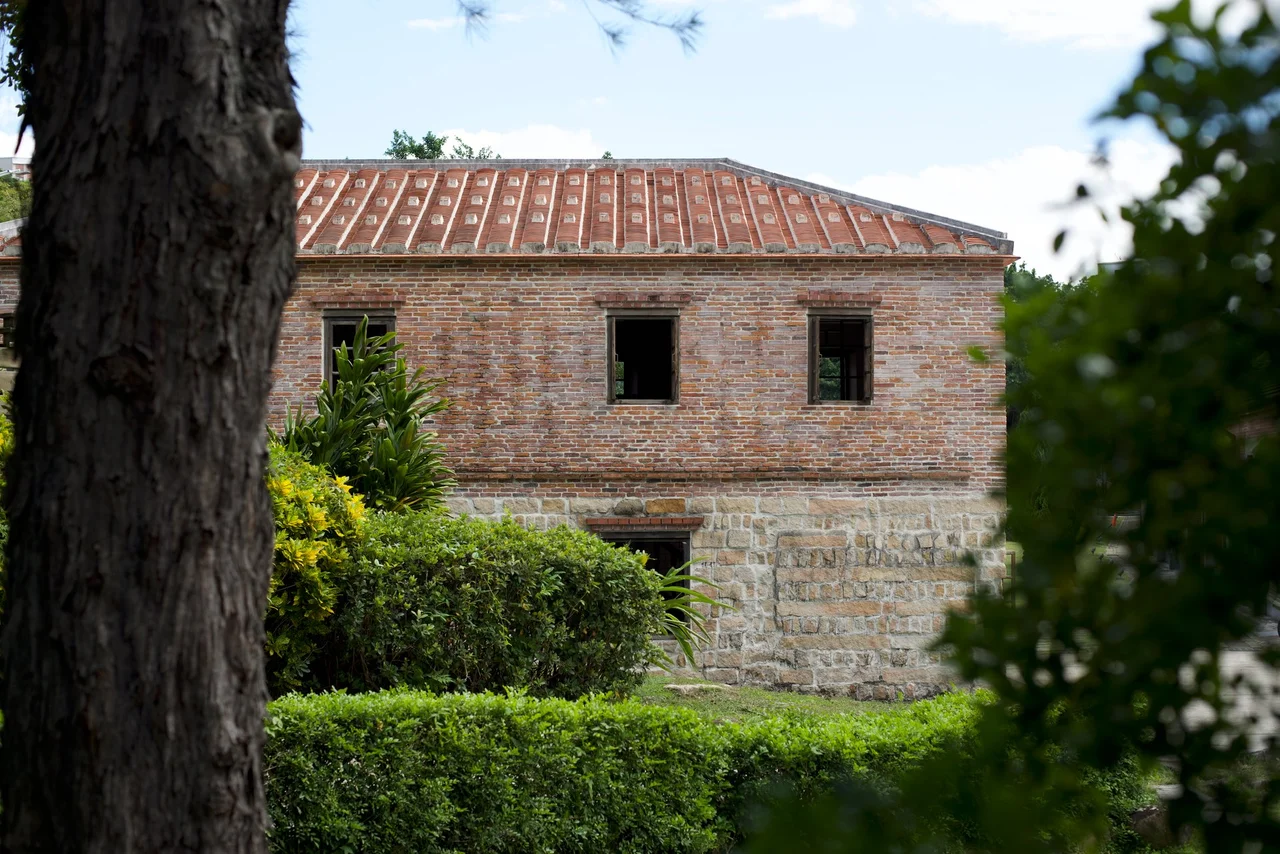

Tamsui Customs Wharf
Three flags have flown over this wharf. The Qing Dynasty built it; the Empire of Japan took it; the Republic of China inherited it. Each transfer brought different cargo, different customs officers, different languages in the ledger books. What did not change was the stone itself — blocks quarried from Mount Guanyin across the river in Wugu, stacked 150 meters into the estuary by workers whose names the records did not keep. The Tamsui Customs Wharf, opened as Huwei Port on July 18, 1862, is the only Qing Dynasty pier in Taiwan still standing. History moves; the stone remains.
Treaty Port on the River
Tamsui's entry into the global trading economy came through diplomacy imposed from outside. Following the treaties that ended the Second Opium War, China was required to open additional ports to foreign trade. Tamsui, at the mouth of the river that served the densely populated Taipei Basin, was designated one of those ports. In 1861 the Qing government established a customhouse; the following year the wharf officially opened as Huwei Port, taking its name from the old Chinese name for Tamsui.
What opened in 1862 was not merely a commercial facility. It was the physical point where the Qing Empire's control over Taiwan's north coast met the demands of the treaty system — where foreign merchants, consuls, and missionaries could arrive and depart under legal protections the Qing had not willingly granted. The missionaries who followed that opening included George Leslie Mackay, whose influence on Tamsui's culture would outlast the treaty port system itself.
Stone from the Mountain Across the Water
The wharf's construction material was not imported or manufactured — it was quarried from the landscape immediately at hand. The builders brought stone from Mount Guanyin in Wugu, across the Tamsui River from the town itself, piling those blocks into a structure that would extend 150 meters into the water. That length made it functional for the ships of the era, long enough to accommodate the vessels that came through when Tamsui was an active treaty port.
Mount Guanyin's stone proved durable. More than 160 years later, the wharf structure remains. The construction was simple by the standards of major colonial infrastructure projects, but it was built to last — and it has, outlasting the dynasty that ordered it, the colonial administration that inherited it, and the active commercial role that once made it worth building at all.
Handover, Reassignment, Quiet Retirement
The wharf's commercial life ended in stages. On August 5, 1895, following the Treaty of Shimonoseki that ended the First Sino-Japanese War, the customhouse was closed and Taiwan was handed to Japan. The wharf passed into Japanese administration along with everything else. By 1916, the commercial customs function had shifted inland to Dadaocheng in Taipei, leaving the Tamsui facility with a reduced role. In 1920 it was renamed the Customs of Tamsui Branch, Taiwan Government Monopoly — a bureaucratic designation that reflected its reduced importance in the colonial trade network.
The wharf's later history is less documented in the surviving sources, but its physical survival speaks to a kind of institutional persistence. Eventually designated as a heritage site, it continued to function — the sources note it operates as a naval base today, a shift that exchanged customs officers for sailors but kept the pier in continuous use. Whether that use preserved the structure or simply meant it was never neglected long enough to deteriorate is an open question.
What Remains at the River's Edge
The Tamsui waterfront today is a tourist destination — a pedestrian promenade lined with food stalls, the sunset over the river mouth famous enough to draw crowds every clear evening. The old commercial infrastructure of the treaty port era sits alongside this leisure culture, not always visibly. The Customs Wharf is a short walk northwest of Tamsui Metro Station, accessible but not heavily signposted in the way of more famous landmarks.
Its significance is specific: not the grandest structure on the waterfront, not the most photographed, but the oldest original pier. Everything else from the treaty port era is gone — the foreign trading houses, the consulates, most of the original infrastructure. The stone wharf endures as the single surviving artifact of the moment when Tamsui was forcibly opened to the world, when the river became an international waterway and the town at its mouth briefly mattered to merchants from Liverpool and Shanghai alike.
From the Air
The Tamsui Customs Wharf sits at approximately 25.1747°N, 121.4319°E on the northern bank of the Tamsui River, near the point where the river meets the Taiwan Strait. From Taipei Songshan Airport (RCSS), fly northwest roughly 20 km, following the Tamsui River as it broadens toward the coast — the river is an excellent low-altitude navigation reference. The wharf itself is close to the water's edge at the western end of the Tamsui historic district, adjacent to the Fort Santo Domingo hillside. Taoyuan International Airport (RCTP) lies approximately 25 km to the southwest across the river estuary. Recommend 800–1,200 ft AGL for waterfront detail; be aware that the Yangmingshan volcanic hills to the northeast rise sharply from sea level.
Nearby Stories
- Sanxia Car Attack 9.6 km away
- Dapu Incident 28 km away
- 2022 Chinese Military Exercises Around Taiwan 45 km away
- North Jiangsu Main Irrigation Canal 960 km away
- General Cliff Rock Paintings 1031 km away
- Sinking of MV Sewol 1042 km away
- Yellow Sea 1091 km away
- Twin Forts of Romblon 1377 km away