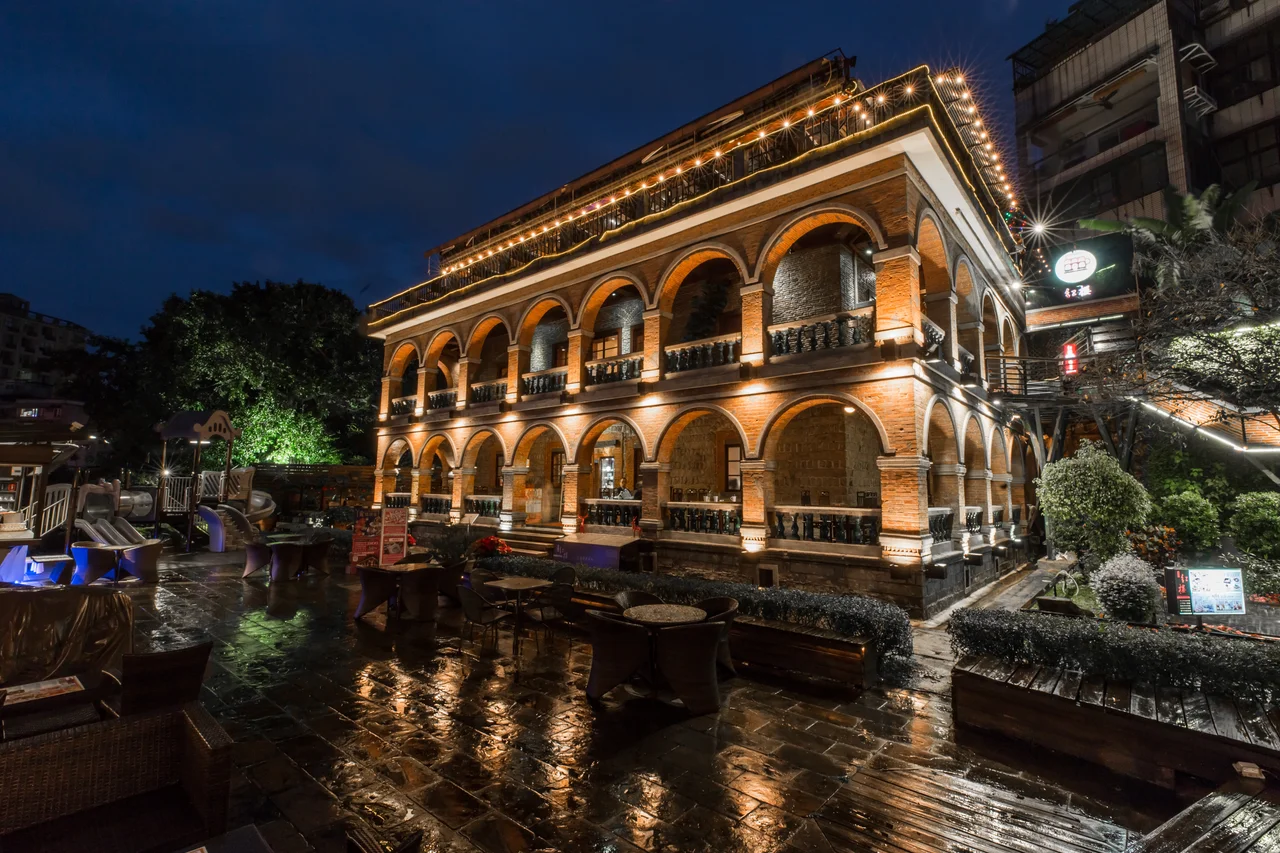

Tamsui Red Castle
Red brick on a hillside above the river — that is the first impression, and it still works. The Tamsui Red Castle, known in its original life as Daguanlo, was built in 1899 for a local businessman named Mr. Li at a moment when Tamsui's colonial economy was producing the kind of prosperity that made ambitious architecture feel appropriate. The Victorian style was unusual in a Taiwanese port town, but the late nineteenth century was an era when architectural languages traveled — colonial officials, missionaries, merchants, and the buildings they commissioned carrying European forms into Asian harbors. Li's mansion arrived in that current, a three-story statement in red brick and three-sided corridors, overlooking a river that had recently been forced open to the world.
A Merchant's Ambition in Brick
Daguanlo was planned in 1895 — the year the Treaty of Shimonoseki transferred Taiwan from Qing China to Japan — and completed in 1899, four years into Japanese colonial rule. That timing is suggestive: Mr. Li was building during the transition period, committing capital to a permanent structure at a moment when the rules of commerce and governance were being rewritten. Whether the choice reflected confidence in the new order, determination to preserve status through it, or simply the long timeline of construction during uncertain years is not recorded.
The building itself was an assertion of arrival. Three stories, Victorian in style, with three-sided corridors of red brick wrapping the structure. At the time of construction, few private residences in Tamsui could match its scale or ambition. It stood on the hillside with a commanding view of the river town below — the kind of position that had both practical and symbolic dimensions. In the hierarchy of the treaty-port era, your building's elevation above the waterfront announced something about you.
Fortune's Reversal and the Second Owner
Business fortunes in colonial-era Taiwan were not always stable. Mr. Li's family prosperity eventually declined, and with it his ability to hold the property. The Daguanlo passed to Mr. Hung, who served as chairperson of Tamsui Street — a civic position that suggests the building's new owner was a figure of local authority, whatever Mr. Li's family had lost.
The transfer illustrates something about how grand private residences survive across generations: they rarely stay with the families that build them. What a merchant constructs as a private home often passes to an institution, a new family with different means, or a civic function. Daguanlo passed from commercial ambition to civic ownership without losing its position above the town. After Mr. Hung, the building's history continues in less specific terms — the sources note it experienced many changes over time, the vague language that covers decades of use, partial neglect, possible repair, and the slow processes of a building finding its footing in each new era.
Red Brick Survivor
The Tamsui waterfront has been remade many times. The treaty-port commercial infrastructure is largely gone. Warehouses have been demolished, wharves rebuilt, and the waterfront promenade that draws tourists today replaced working docks that once served an active port. Through all of it, the Red Castle has persisted on its hillside.
Part of the reason is the material itself: red brick is durable, and Victorian-era construction in Taiwan tended to be solid. Part of the reason may also be the building's visibility — it is the sort of structure that gets noticed by people in a position to advocate for preservation. The three-story silhouette and the warm red of the brick make it conspicuous on the hillside, easier to remember and harder to dismiss than a more modest structure might be. Buildings that are easy to see are sometimes easier to save.
The Building Lives On, Changed
Today the Red Castle functions as a Chinese restaurant and café, with the ground and first floors given over to dining and the top floor serving as a café space. The adaptation is practical and not uncommon: the buildings of the treaty-port era that have survived in Taiwan often do so because someone found a commercial use for them, because being economically active is a form of preservation.
Visitors who come for the food or the coffee find themselves inside a structure that has been continuously occupied and adapted since 1899 — more than 125 years of use in a building that has watched the town around it transform from a Qing treaty port to a Japanese colonial outpost to a modern Taiwanese city. The three-sided brick corridors still wrap the building. From the upper café floor, the view down toward the Tamsui River is still what it was when Mr. Li commissioned this place: the commanding prospect of a man who wanted to see the town from above.
From the Air
The Tamsui Red Castle sits at approximately 25.1714°N, 121.4395°E on the hillside above Tamsui's riverfront district, northwest of the Tamsui Metro Station. From Taipei Songshan Airport (RCSS), fly northwest roughly 20 km; the Tamsui River estuary and the distinctive hilltop profile of Fort Santo Domingo are the primary visual references — the Red Castle sits on the same hillside below Fort Santo Domingo. Taoyuan International Airport (RCTP) lies approximately 25 km to the southwest. The red brick building is not easily distinguished from altitude, but the hillside location above the Tamsui waterfront places it clearly in context of the broader historic district. Recommend 800–1,000 ft AGL for town-level features along the river.
Nearby Stories
- Sanxia Car Attack 9.6 km away
- Dapu Incident 28 km away
- 2022 Chinese Military Exercises Around Taiwan 45 km away
- North Jiangsu Main Irrigation Canal 960 km away
- General Cliff Rock Paintings 1031 km away
- Sinking of MV Sewol 1042 km away
- Yellow Sea 1091 km away
- Twin Forts of Romblon 1377 km away