
Tanais
Strabo knew it. In his Geography, the ancient world's great encyclopedist marked a city at the far northeastern corner of the map, past the Black Sea, past even the Bosporan kingdom, where the Don pours into the marshes the Greeks called Lake Maeotis. That city was Tanais, and it sat at the hinge of three worlds: the sea-lanes of the Hellenic ports, the endless grass ocean of the steppe rolling east toward the Altai, and the shadowed rivers of the north that carried furs and captives downstream. Merchant adventurers from Miletus founded it late in the third century BC. It would be built, ruined, and built again over the next two thousand years.
At the End of the Grass Sea
Long before any Greek arrived, people lived and buried their dead here; a necropolis of more than three hundred kurgan mounds records occupation stretching back to the Bronze Age. When the Milesians came, they built not a colony of citizens but an emporium, a pure trading station, at the furthest reach of Greek culture. Here caravans out of the steppe met galleys from the Black Sea. The city stood at the eastern edge of the Bosporan kings' territory, ruled by an archon, and in Roman times its civic heart was rebuilt around a palace for client kings, Sauromates and his son Rescuporides, who carved their names into public stone. Then in AD 330 the Goths came and devastated it. The city clung on until the later fifth century, but the channel was silting up, the trade drifting elsewhere, and Tanais faded into the delta mud.
Tana of the Venetians
Nearly a thousand years passed, and then the site woke again. The Mongol conquest of Central Asia had turned the Black Sea into a gateway for the riches of China and Persia, and around the fourteenth century the Venetians refounded the place as Tana. Genoa administered it too; the two rival republics fortified their own quarters of the same walled town, which also held Byzantine, Russian, Jewish, and Zichian districts around the Orthodox church of St. Nicholas. Tana became a hinge of world trade. The traveler Giosafat Barbaro recorded six or seven Venetian galleys arriving each year for silk and spices, annual shipments of forty thousand cattle bound for Central Asia, caravans of six thousand animals setting out for India. Caviar and salt, amber and grain, furs, horses, wine, and enslaved people all passed through its bazaars.
Fire on the North Wind
Wealth on a frontier invites the sword. In 1438 the Great Horde advanced, and Barbaro was sent as an envoy to turn them away; another time he helped a band of fewer than fifty men drive off a hundred raiders. The real catastrophe came in 1442, when Tatars set fire to the Venetian quarter. It began in the bazaar near the fortress and a hard north wind fanned it. The walls were breached in four places so people could flee, one gap opened by Barbaro's own hands, and even then women and children had to be lowered over the ramparts by rope. The fire burned for three hours before human effort and rain finally beat it down. More than four hundred people died. Tana would be conquered by the Ottomans in 1471 and its trade severed for good when Constantinople fell; the site changed hands between Turks and Russians until the Russian Empire took it in 1771.
Reading the Layers
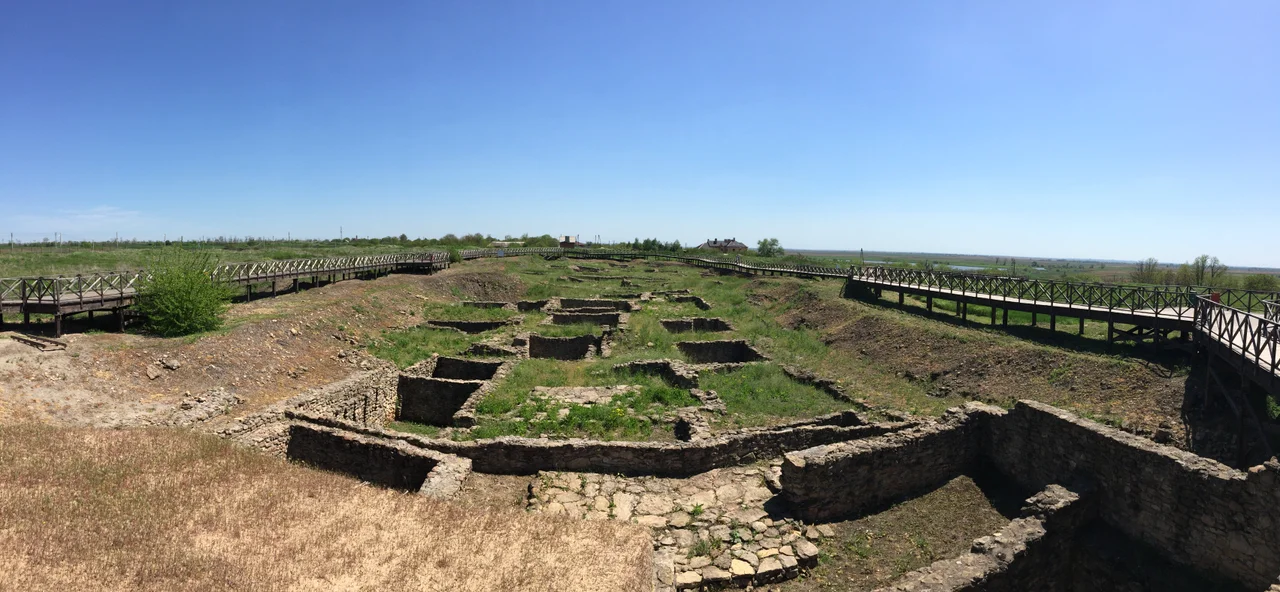
The connection between the ruins and the Tanais of the Greek geographers was made in 1823, when I. A. Stempkovsky matched the visible, mostly Roman remains to the ancient sources. Systematic excavation began in 1955, and a joint Russian-German team has worked to uncover the agora and trace how deeply Hellenistic city-planning shaped this outpost, and how it defended itself against the nomads at its walls. The place has drawn eccentric attention too. The explorer Thor Heyerdahl once dug here while chasing a controversial theory, drawn from the Norse sagas of Snorri Sturluson, that linked Tanais to the origins of Scandinavia. Among the finds, the inscribed Tanais Tablets remain the region's most important discovery, the ancient city speaking, in stone, its own name.
From the Air
Located at 47.2706 N, 39.3414 W, on a plateau above the Don delta about 30 km west of Rostov-on-Don, bordered by a natural valley to the east and an ancient ditch to the west. From the air the fan of Don channels spreading into the Sea of Azov is the defining feature. Best viewed at low to moderate altitude in clear conditions. Nearest airport is Platov International (URRR) at Rostov-on-Don.
Nearby Stories
- Klivazh 89 km away
- Battle of the Kalka River 89 km away
- Merheleva Ridge 107 km away
- Temryuk 210 km away
- Taman Peninsula 247 km away
- Abkhazia 448 km away
- Tbilisi 732 km away
- Cathedral of the Nativity of the Theotokos, Suzdal 997 km away