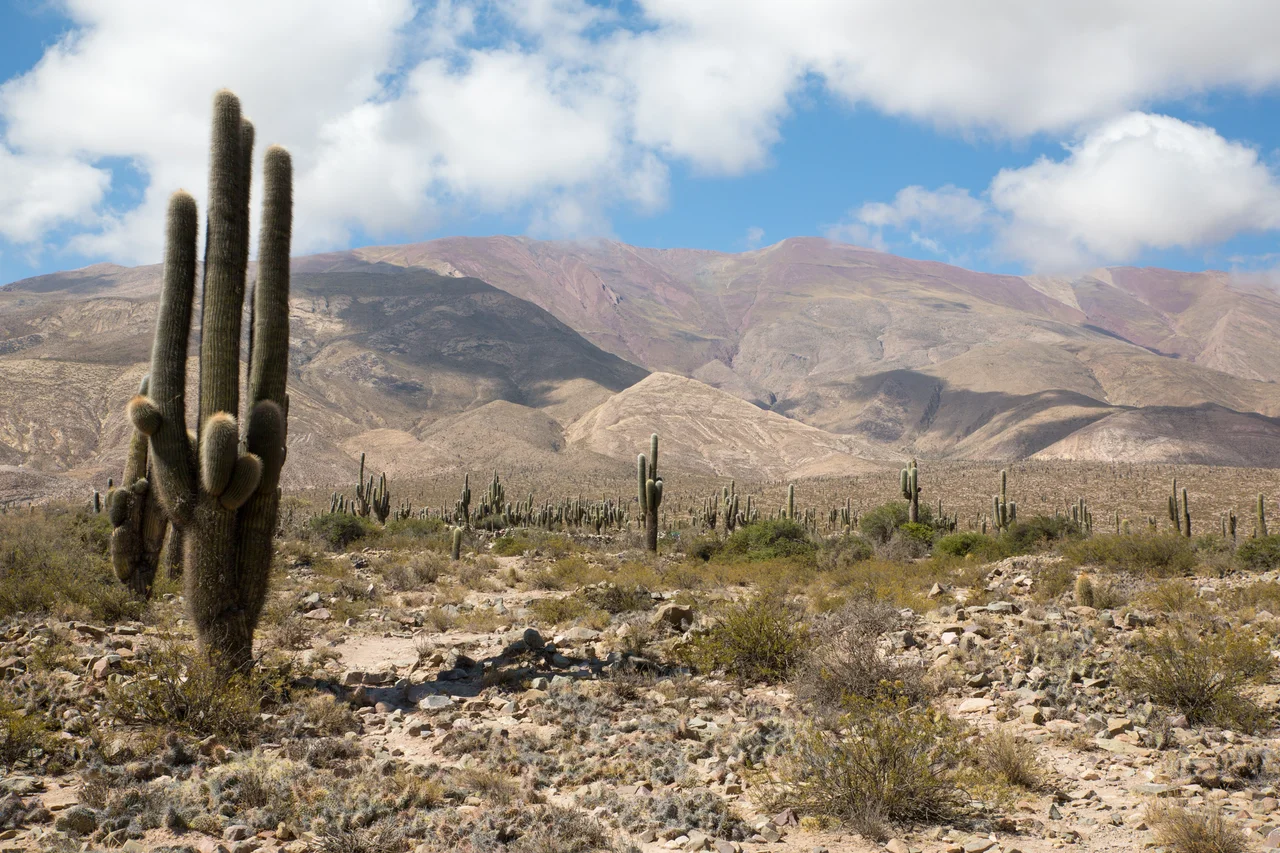

Tilcara
Some towns announce themselves; Tilcara simply absorbs you. It sits at about 2,400 meters in the Quebrada de Humahuaca, the long Andean canyon that UNESCO named a World Heritage Site in 2003, and it has become the unofficial capital of that valley, the place travelers make their base. But Tilcara is more than a way station. It is the archaeological heart of Argentina, a town where Spanish colonial architecture leans against pre-Columbian ruins and where the streets still carry the rhythms of the highlands. Arrive by bus from Jujuy or Humahuaca, step into the warm dry air, and the wider world begins, quietly, to recede.
An Andean People
Tilcara's population is predominantly indigenous, as is much of the Argentine northwest, and most residents trace their heritage to the Kolla. Their original language has been lost to history, possibly a tongue called Cacan; later Inca rule layered Quechua place-names over the valley, though Quechua never took root here as deeply as it did farther north, and today the everyday language is Spanish. This is a region of genuine Andean culture rather than a costume of it, and visitors are met with warmth. The valley is not wealthy by the standards of Buenos Aires or Patagonia, but it is rich in the things that draw people across the world to see it.
Stone, Old and Older
The town's signature sight rises on a hill a short walk away: the Pucara de Tilcara, a reconstructed pre-Inca fortress built by the Omaguaca and the only publicly accessible archaeological site in the Quebrada. But Tilcara wears its history in layers. Colonial buildings frame the central plaza, small museums hold the work of generations, and the surrounding hills carry their own marvels. You can hike between the village of Pucarama and Tilcara, and a little farther along admire the famous striped slopes around Maimara, including the ridge known as the Cerro Paleta del Pintor, the Painter's Palette. The geology that makes the nearby Hill of Seven Colors so celebrated runs through this whole stretch of valley.
A Taste of the Highlands
The food here is its own argument for the journey, and it bears little resemblance to the beef-and-malbec cuisine most associate with Argentina. This is Andean cooking: quinoa, papas andinas, the small native potatoes of the high country, stews of llama meat, hearty empanadas jujenas, sweetened pumpkin, and sopa de mani, a rich peanut soup. Several restaurants pair the food with live performances of regional music, and small cafes around the plaza serve strong coffee and round tamales while hosting evenings of music and poetry. Eating in Tilcara is an education in a culinary tradition that the rest of the country is only beginning to celebrate.
A Base for Wandering
Half the pleasure of Tilcara is that it points outward. Rent a bicycle and ride into the surrounding countryside, or arrange a day trip to the Salinas Grandes, the vast salt flats more than 3,500 meters above sea level, where the road climbing into the puna is as spectacular as the blinding white plain at its end. Humahuaca, the valley's larger town, sits to the north in a similar key. To the southwest lie Purmamarca and its Hill of Seven Colors, the valley's most celebrated natural attraction. Whichever direction you choose, you return to Tilcara at the end of the day, to a town that has spent a thousand years learning how to belong to these mountains.
From the Air
Tilcara lies at roughly 23.58 degrees south, 65.39 degrees west, in Jujuy Province at about 2,400 meters elevation, near the center of the Quebrada de Humahuaca. The canyon runs about 155 km north to south and ranges from roughly 1,600 to 4,500 meters in altitude, so terrain is steep and high on both flanks. The nearest airport is Gobernador Horacio Guzman International (ICAO SASJ) near San Salvador de Jujuy; Martin Miguel de Guemes International at Salta (ICAO SASA) lies farther south. From the air the town is recognizable beside the river, with the terraced Pucara de Tilcara on the hill just to the northwest and the striped slopes of Maimara to the south. Expect strong high-altitude sun and rapidly changing mountain weather; clear skies are most reliable in the morning.
Nearby Stories
- Calilegua National Park 21 km away
- Uquía 23 km away
- San Salvador de Jujuy 41 km away
- San Antonio de los Cobres 42 km away
- Cerro Tuzgle 60 km away
- El Rey National Park 97 km away
- Baritú National Park 99 km away
- Atacama Large Millimeter Array 174 km away