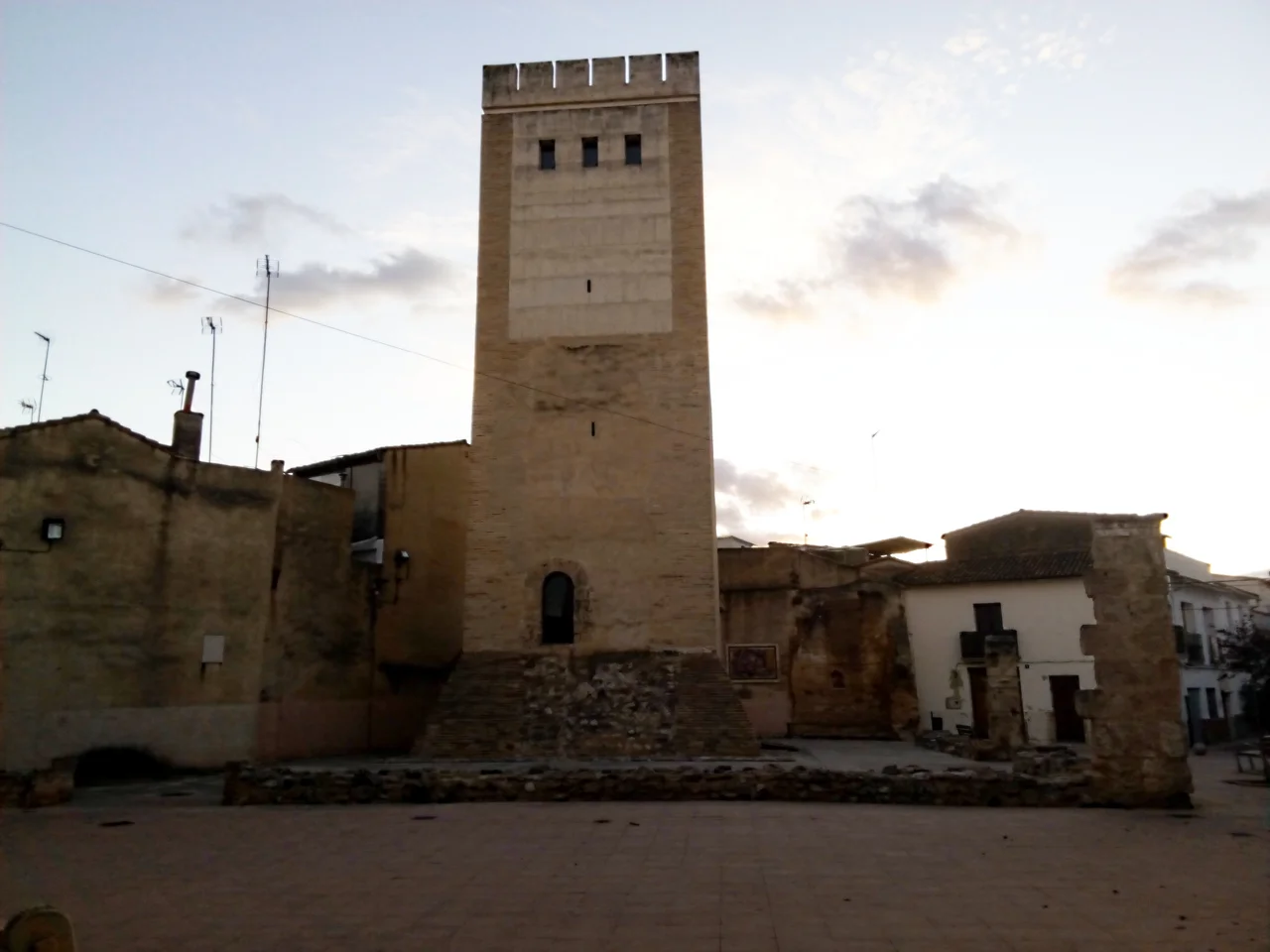

Tower and walls of the Borgias
The Borgias are remembered for poison, intrigue, and a papacy soaked in scandal — Cesare's ambition, Lucrezia's legend, a family name that Renaissance Rome learned to fear. But the dynasty did not begin in Italy. It began in a modest tower in the farm country of interior Valencia, in the small town of Canals, where a cadet branch of the Borja family held a minor lordship. Here, in 1378, a child was born who would carry the name all the way to the throne of Saint Peter.
A Tower Older Than the Name
Long before any Borja lived here, this was a piece of Islamic Al-Andalus. The tower rose in the 13th century, in the last generations of Muslim rule over this stretch of the Valencian interior, one of the fortified points that studded the region. When Christian lords took over, they did not tear it down. In the 14th century, builders wrapped a Valencian Gothic palace around the old Muslim tower and a surviving length of its walls, folding the earlier fortress into the new residence. The result — known in Valencian as the Torreta de Canals — is a building of layered eras. Its base speaks one architectural language; the rooms above it speak another. Walls that once guarded a frontier ended up framing the domestic life of a rising Christian family.
The Boy Born Behind These Walls
In this palace, in 1378, Alfonso de Borja was born. He trained as a lawyer, taught canon law at the University of Lleida, and served the Kings of Aragon as a diplomat — a careful, scholarly man, not an obvious candidate for legend. In 1455, already elderly, he was elected pope and took the name Callixtus III, the first of the Borja family to wear the tiara. During his brief reign he ordered the retrial of Joan of Arc, the case that cleared her name a quarter-century after she burned at the stake. He also raised his nephew Rodrigo into the College of Cardinals. That same Rodrigo would later become Pope Alexander VI, and Alexander's children, Cesare and Lucrezia, would make the family name notorious across Europe.
The Seat of a Lordship
This was no accidental birthplace. The palace was the power base of the cadet Borja line that had spread from nearby Xàtiva, and it carried the title to the Señorío de Torre de Canals — the small lordship that gave the family its rank and its foothold. From these rooms the Borjas managed land, collected their dues, and married into the web of Valencian nobility that would eventually propel them toward Rome. To stand at the tower is to stand at the family's starting line, in the years before the name meant anything beyond a few square kilometers of Valencian countryside. Empire, scandal, and myth all traced back to this quiet corner of La Costera.
Rescued from the Margins
For centuries the building drifted toward the edge of memory, an old pile in a town most travelers pass without stopping. In 1995 the town hall of Canals bought the tower and restored it, and in 2000 it was formally protected as a Bien de Interés Cultural, Spain's designation for heritage of the first rank. Today it anchors the Route of the Borgias, the heritage trail that links Canals, Xàtiva, Gandia and the other Valencian places the family shaped on its long climb to power. The Torreta is small and easy to overlook. Its place in history is not — few humble towers can claim to have cradled a pope.
From the Air
Coordinates 38.9562°N, 0.5895°W, in the town of Canals on the plain of La Costera, roughly 60 km south of Valencia city. Best appreciated low and slow at 1,500–3,000 ft AGL, where the tower reads against the surrounding grid of orchards and rooftops. Navigate by the larger neighboring town of Xàtiva and its dramatic ridge-top castle a few kilometers east. Nearest major airports: Valencia (LEVC) to the north and Alicante–Elche (LEAL) to the south. Clear, dry inland visibility is typical for most of the year.
Nearby Stories
- Font Roja Natural Park 1.9 km away
- Calpe 5 km away
- Battle of Almansa 7.6 km away
- Hēmeroskopeion 14 km away
- Battle of Alcalá (1129) 19 km away
- Jumilla 32 km away
- Requena 32 km away
- Festival Internacional de Benicàssim 95 km away