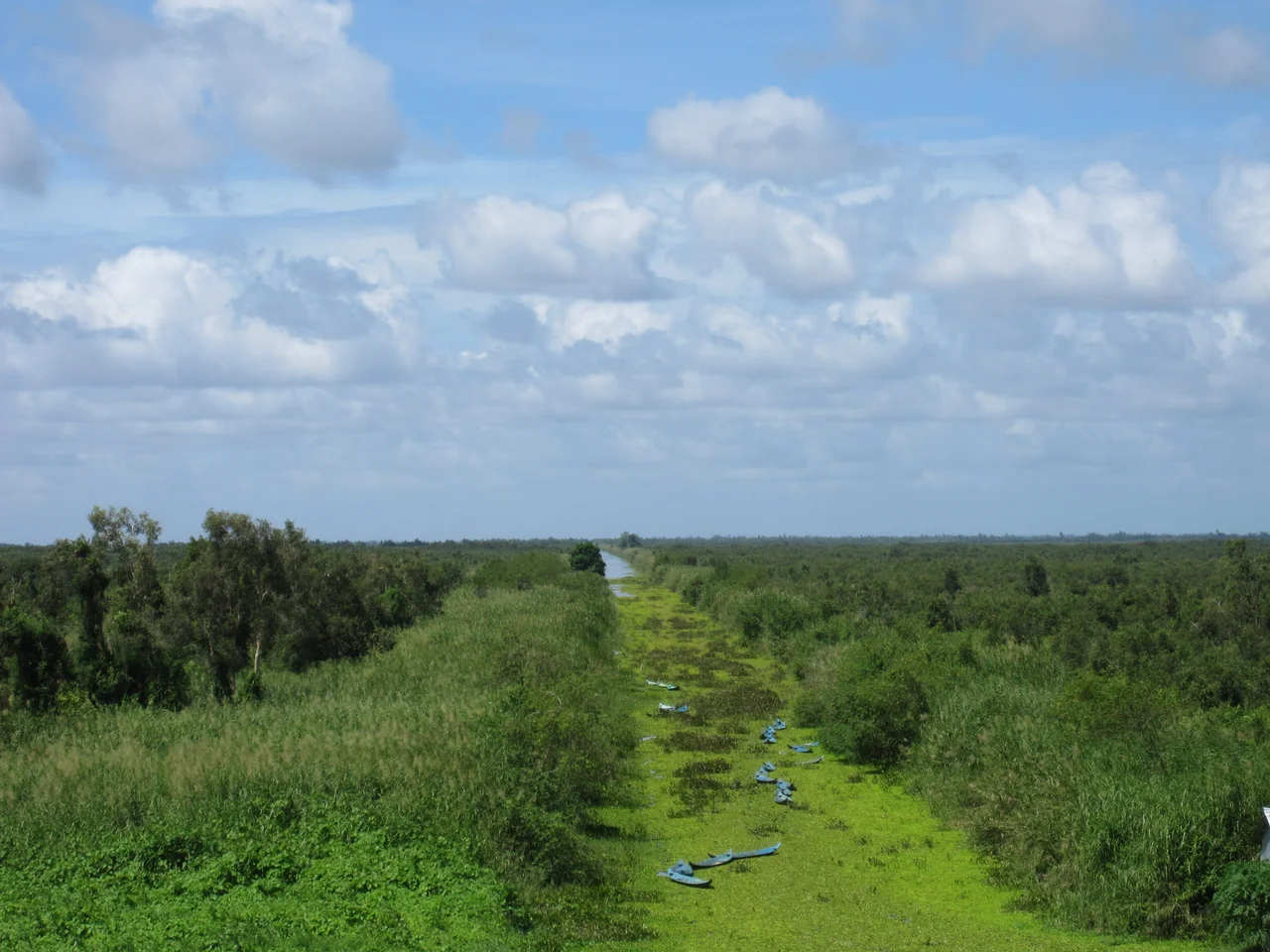

U Minh Thượng National Park
Two species of crocodile once lived in this forest — the saltwater crocodile and the smaller, rarer Siamese. In 2002, the year the reserve was upgraded to a national park, a survey went looking for both and concluded that neither was there any more. That is the shape of the story at U Minh Thượng: a place recognised as internationally important at roughly the moment people began counting what it had already lost. It is still, by a wide margin, the most biologically varied ground in the Mekong Delta.
Forest on a Peat Mattress
The rarity here is not any single species but the substrate. U Minh Thượng protects flooded melaleuca forest growing on peat — layers of organic matter laid down over centuries in acid, standing water, a formation classed among the scarcest forest types in the world and nearly extinct in mainland Southeast Asia. Prime Minister's Decision 11/2002/QĐ-TTg, dated 14 January 2002, turned the existing nature reserve into a national park. The protected complex covers 21,107 hectares in total: a strictly conserved core of 8,038 hectares surrounded by a buffer zone of 13,069. Nothing about it looks dramatic from ground level. The drama is under your feet, and it is measured in metres of accumulated carbon.
The Richest Corner of the Delta
Surveys have recorded more than 243 plant species here, along with 32 mammals, 187 birds, 39 amphibians and 34 fish. The mammal list carries names that have largely vanished from the rest of the delta — hairy-nosed otter, fishing cat, pangolin, sambar deer, civets. Eight waterbird species of conservation concern depend on the site. That combination earned U Minh Thượng designation as an ASEAN Heritage Park and, on 30 April 2015, listing as a Wetland of International Importance under the Ramsar Convention, site number 2228. The park lay in Kiên Giang province until June 2025, when Kiên Giang was merged into an enlarged An Giang.
A Landscape Built for Disappearing
Long before it protected otters, the U Minh forest protected people. Dense tràm, chest-deep water and a network of channels navigable only by those who knew them made this one of the most effective natural strongholds in southern Vietnam. During the First Indochina War it was a Việt Minh base. Through the American war it functioned as a Viet Cong base area, and the families who farmed its margins lived for years inside a zone that was fought over, patrolled and bombed. Vietnam recognises the forest today as a national historical relic of the revolutionary resistance, which means the park is managed simultaneously as an ecosystem and as a memorial.
Five Years in a Bamboo Cage
On 29 October 1963, three American advisers were captured in the U Minh forest during an operation with South Vietnamese irregular troops: Captain Humbert Roque Versace, Lieutenant James N. Rowe and Sergeant Daniel Pitzer. Versace refused indoctrination outright, attempted escape four times, and kept the others' morale up by singing messages set to the tunes of popular songs. He was executed by firing squad on 26 September 1965, after nearly two years in captivity. In 2002 he was posthumously awarded the Medal of Honor — the first US Army prisoner of war recognised with it for conduct in captivity in Southeast Asia.
The Escape
Rowe lasted longer. He spent 62 months in the forest, most of them in a bamboo cage measuring roughly three feet by four by six, and on 31 December 1968 he took the only chance he was ever going to get. American helicopter gunships passed overhead, his guard's attention went with them, and Rowe overpowered him, stripped the magazine from his weapon and got clear into the open. A UH-1 flown by Major David E. Thompson picked him up. He wrote about it in *Five Years to Freedom* in 1971 and later built the US Army's survival, evasion, resistance and escape training around what he had learned. In 1989, serving in the Philippines, he was assassinated in Quezon City. The forest that held him is now a Ramsar site managed partly for ecotourism, which is either an irony or simply what peace looks like.
From the Air
U Minh Thượng lies at 9.583°N, 105.083°E, inland from the Gulf of Thailand on the northern half of the Cà Mau peninsula. Ground elevation is within a metre or two of sea level and there is no terrain; the park reads from 2,000–5,000 ft as a solid dark rectangle of melaleuca canopy set inside a bright grid of rice paddy and shrimp pond, with a distinct rectilinear boundary where the buffer zone gives way to farmland. Rạch Giá (VVRG) is roughly 45 km north and Cà Mau (VVCM/CAH) roughly 50 km south. Best visibility runs December to April; in the wet monsoon expect low cloud, and in the late dry season expect smoke haze over the peatlands.
Nearby Stories
- Bạc Liêu 3.9 km away
- U Minh Hạ National Park 7.2 km away
- Tonle Sap–Mekong Peat Swamp Forests 19 km away
- Sóc Trăng 41 km away
- Collapse of Can Tho Bridge 43 km away
- An Thoi Naval Base 48 km away
- Phú Quốc Prison 68 km away
- Tho Chau Islands 102 km away