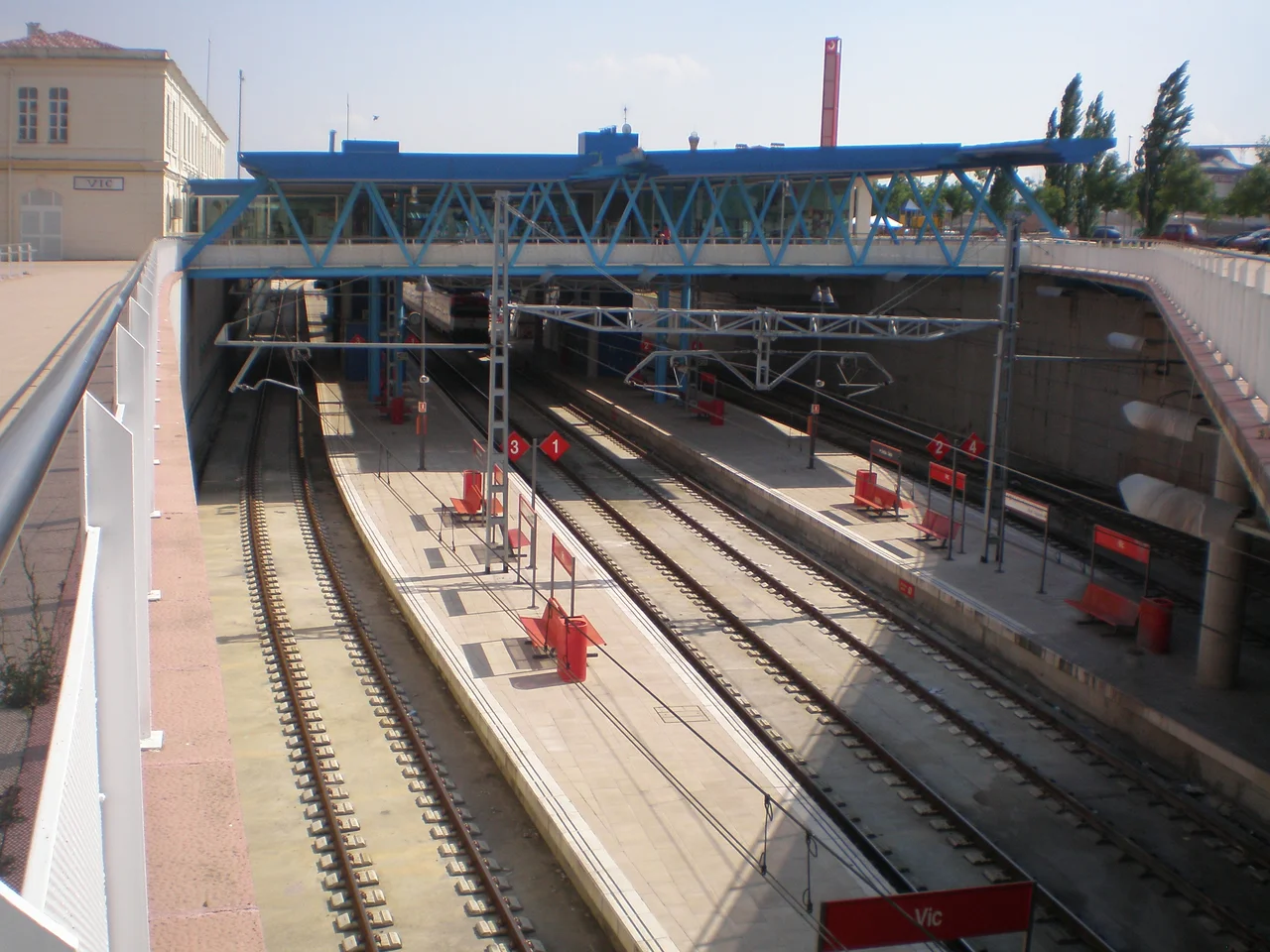

Vic (Barcelona)
Some winter mornings, the whole city disappears. A dense ground fog called the boira pools in the basin where Vic sits, swallowing church towers and rooftops until the sun burns it off toward midday. The people of this Catalan town have lived with the fog for two thousand years, and they have learned to wear it well. Beneath the mist lies one of the oldest continuously inhabited places in Catalonia, a city of cured sausage, arcaded stone, and a history that keeps insisting on being remembered.
A City Beneath the Fog
Vic occupies the floor of a wide inland depression, the Plana de Vic, ringed by hills that trap cold air and hold the morning mist. The same flat, still basin that breeds the fog also makes the plain unusually good for something else. On clear days, hot-air balloons drift above a patchwork of farms and steeples, and the region has become one of Catalonia's favorite places to fly them. Long before either the balloons or the sausages, the Iberian Ausetani lived here, and the Romans built a town they named Ausa. Coins struck by both peoples still surface in the soil, small metal witnesses to a settlement that has never really paused. Modern Vic wears all of it at once: Roman street lines, medieval squares, and the low agricultural horizon that has fed the city for centuries. The fog itself has become a point of local identity, half nuisance and half emblem of a city that has always kept its own weather.
Restored on the Frontier
In 879, Count Guifré el Pilós, known in English as Wilfred the Hairy, repopulated Vic and restored its bishopric, planting a Christian outpost on a dangerous seam. For much of the 8th and 9th centuries this was borderland, a contested enclave between the Frankish north and the Islamic south, where a town could change hands with a single campaign. The church took root and never let go. Vic became a bishop's city, dense with religious history, and today it sits on the Catalan Way of St. James, the pilgrim route that threads from the coast at El Port de la Selva toward the sawtooth massif of Montserrat. Pilgrims still pass through, boots on old stone, following a path first laid down when the frontier was raw.
Rebellions and Wounds
Vic has a habit of choosing sides at great cost. In the early 18th century, it led the Catalan revolt against Philip V during the War of the Spanish Succession, a losing bet that helped end Catalonia's old liberties. The Carlist wars of the 19th century tore through the region again, with Vic near the center of the fighting. The deepest modern wound came on 29 May 1991, when the separatist group ETA detonated a car bomb in the courtyard of the Civil Guard barracks. Ten people were killed, five of them children, and dozens more were injured, a grief the town still carries. The attack was part of ETA's campaign to seize the world's attention ahead of Barcelona's 1992 Olympics. The following year, in a far gentler footnote, Vic hosted the Games' roller hockey competitions.
The Plaça and the Larder
At the heart of the city spreads the Plaça Major, one of the grandest arcaded squares in Catalonia, and each December it transforms. During the Pont de la Puríssima holiday around the 8th, Vic stages a Medieval Market that turns the whole center into a re-created medieval town and draws more than 100,000 visitors. Food is the other constant. Vic is renowned across Spain for its cured meats, and the region's pork becomes llonganissa, botifarra, and fuet, the last being its most famous export. The calendar fills out the rest: the Mercat del Ram livestock fair before Holy Week, the Lactium cheese festival around Sant Jordi in late April, and, every September since 1989, the Mercat de Música Viva, where musicians gather from across the Mediterranean and the wider world. The philosopher Jaume Balmes, born in Vic, lies buried in the cathedral cloister, the town's mind resting where its faith began.
From the Air
Vic lies at 41.936°N, 2.255°E on the floor of the Plana de Vic, a broad inland basin about 60 km north of Barcelona. Recommended viewing altitude is 4,000-6,000 ft AGL; note that the basin is prone to persistent morning fog (boira), so plan clear-air passes for midday. Look for the dense old town gathered around the Plaça Major and the separate 46 m Romanesque bell tower of the cathedral. Nearest airports: Sabadell (LELL) and Barcelona-El Prat (LEBL) to the south, Girona (LEGE) to the east. Best visibility on clear afternoons once the basin fog has lifted.
Nearby Stories
- Bombing of Granollers 5 km away
- Castle of Cardona 6.1 km away
- Abric Romaní 15 km away
- Abbey of Saint-Martin-du-Canigou 39 km away
- Argelers concentration camp 46 km away
- Cave of Niaux 72 km away
- Palace of the Kings of Majorca 86 km away
- Cap de Formentor 192 km away