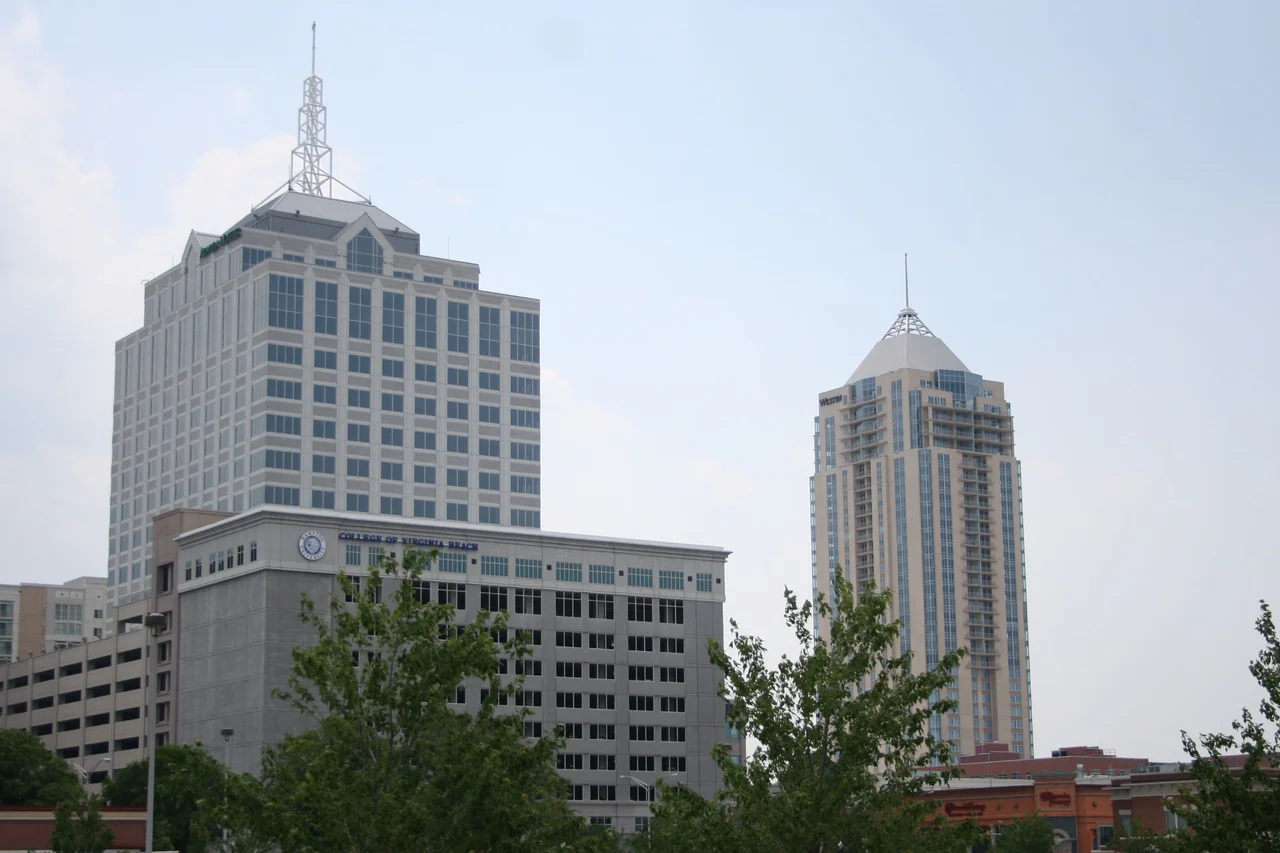

Virginia Beach, Virginia
After 144 days at sea, on April 26, 1607, Captain Christopher Newport's three small ships made landfall at a low sandy cape where the Chesapeake Bay meets the Atlantic. The colonists named the place Cape Henry for the eldest son of King James I, planted a cross, and sailed on to find a better-defended spot upriver. They built Jamestown. But the first English boot to touch what would become Virginia did so here, on the dune line of a future resort city. Four centuries later that same sand is still drawing people ashore: 2.75 million tourists a year, Virginia's largest population by city, the Guinness Book's longest pleasure beach in the world. Most of them have no idea their footprints are on the same patch of coast.
Princess Anne
The Chesepian people lived here when Newport arrived, part of the loose Powhatan Confederacy. Their settlements had been destroyed by the Powhatan themselves shortly before Jamestown was founded. The colonial county that emerged in 1691, Princess Anne, would survive for 272 years as a rural agricultural district covering everything from Cape Henry south to the North Carolina line. Adam Thoroughgood, who had come to Virginia in 1622 as an indentured servant at eighteen and worked his way up, was elected to the House of Burgesses for Elizabeth Cittie in 1629 and became one of the founding figures of the area. The Thoroughgood House, built about 1719 by descendants on his land grant near the Lynnhaven River, still stands as one of the oldest surviving colonial homes in Virginia.
The Resort
Tourism arrived by rail in 1883, when the Norfolk and Virginia Beach Railroad reached the oceanfront. The Virginia Beach Hotel opened the same year. In 1891 its guests stood on the porch and watched the Norwegian barque Dictator break apart in a March storm; the rescue and the eight dead became the seed of the Norwegian Lady monuments that now stand on the boardwalk and in Moss, Norway. The hotel reopened in 1888 as the Princess Anne Hotel. The town of Virginia Beach incorporated in 1906. In 1922 the completion of Virginia Beach Boulevard made it possible to drive from Norfolk to the surf, and the rail trade slowly died. The Cavalier Hotel opened in 1927 and is still there, a brick landmark on Atlantic Avenue. The amusement parks replaced the casinos. The boardwalk lengthened. The longest pleasure beach in the world filled with people.
Consolidation
In 1963, the voters of the tiny independent City of Virginia Beach and the large surrounding Princess Anne County voted to merge. The combined entity kept the better-known beach name and inherited a 253-square-mile county-sized footprint stretching from the Atlantic dune line all the way west to Norfolk's edge and south to the North Carolina state line. Today Virginia Beach is the most populous city in Virginia with 459,470 people at the 2020 census, and it functions less as a city than as a sprawling suburb of the Hampton Roads metro. NAS Oceana, the Navy's East Coast Master Jet Base, is the city's largest employer. The Joint Expeditionary Base at Cape Henry trains Navy SEALs. The Christian Broadcasting Network and Regent University, founded by Pat Robertson, anchor a religious-broadcasting industry that few visitors notice as they head for the beach.
The Land Crunch
Virginia Beach has run out of room. The Green Line, an urban growth boundary dividing the developed northern half of the city from the rural southern half, was meant to preserve farmland and limit the strain on roads and schools. It mostly worked. But the pressure to keep building pushed developers into floodplains. When Hurricane Matthew hit in 2016, more than 2,000 homes flooded and some neighborhoods sat in standing water for days. The city began rejecting further floodplain development. Developers sued. The courts mostly sided with the city. Mayor Bobby Dyer called the new posture "a confrontation with reality." In 2019 the city's reality became darker still: on May 31, a former employee walked into a municipal building and killed twelve people before responding officers killed him. The Virginia Beach Municipal Center memorial still stands as the city's quiet acknowledgement that public spaces are not always safe.
The Beach
On a clear July morning the boardwalk runs three miles from Rudee Inlet to 42nd Street: bicycles, joggers, lifeguards in trucks, the East Coast Surfing Championships every August, the Yuengling Shamrock Marathon every March, fishermen on the pier, the Norwegian Lady looking eastward over the water. First Landing State Park preserves a fragment of the dunes and maritime forest the colonists saw in 1607. The Military Aviation Museum in the Pungo neighborhood houses one of the world's largest collections of World War I and World War II aircraft, many of them still airworthy, many of them flown at airshows over the same beach where their grandfathers fought to keep ships off the East Coast. The Virginia Aquarium handles stranded sea turtles. The Virginia Museum of Contemporary Art is moving to a new building on Virginia Wesleyan's campus. The sand has carried more than four centuries of arrivals, and shows no sign of letting up.
From the Air
Virginia Beach centered at 36.85°N, 75.98°W, a 497-square-mile city spanning from the Atlantic surf west to Norfolk's border and south to North Carolina. From the air you cannot miss the boardwalk and oceanfront hotel strip running north-south, the Chesapeake Bay Bridge-Tunnel stretching across the bay's mouth at the city's northern tip, and the broad green expanse of NAS Oceana to the south. Best viewed from 3,000-5,000 ft AGL along the coast. Nearby airports: KORF (Norfolk International, 11 nm WNW), KNGU (Norfolk Naval, 11 nm W), KLFI (Langley AFB, 16 nm NW). NAS Oceana (NTU) and Fentress NALF (NFE) restricted - check NOTAMs and stay clear without coordination. Heavy Navy fighter activity in the surrounding airspace.
Nearby Stories
- James River Reserve Fleet 3.5 km away
- Coastal Virginia Offshore Wind 11 km away
- Cape Charles Air Force Station 15 km away
- Dismal Swamp Canal 24 km away
- Blackwater River (Virginia) 25 km away
- Bacon's Castle 32 km away
- SS Monroe (1902) 66 km away
- Bodie Island Lighthouse 83 km away