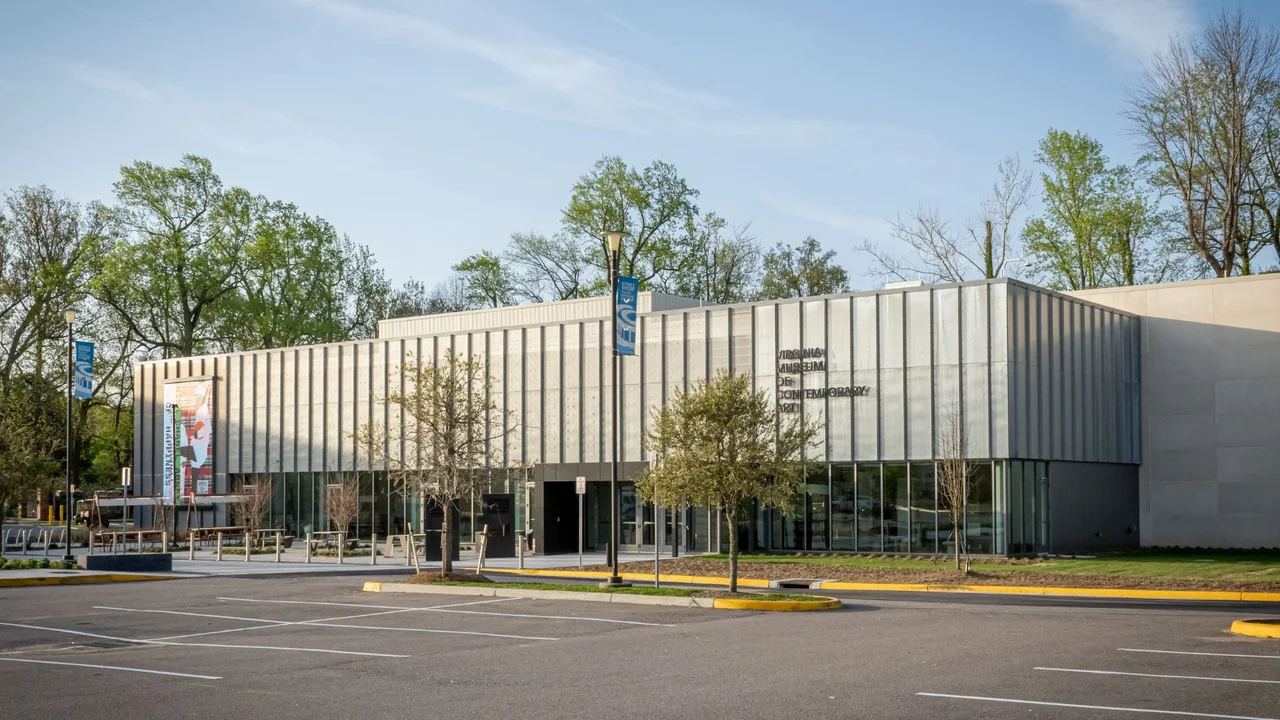

Virginia Museum of Contemporary Art
A.B. "Alec" Jackson chaired the art department at Virginia State College in Norfolk, the historically Black college that would become Norfolk State University. In 1962 he applied to join the Virginia Beach Art Association so he could enter the annual Boardwalk Art Show. The association quietly refused him because he was Black. When the issue became public, the membership voted on his admission. Fewer than a quarter of them bothered to vote. The 1962 show went on without Jackson. In 1963 he was admitted just as quietly as he had been rejected. His oil painting Veronica's Veil won an honorable mention that year and Best in Show in 1966. In 1968 he was exhibiting at the Smithsonian. The art association he had been turned away from is now the Virginia Museum of Contemporary Art, and in April 2026 it moved to a new building.
From Art Sale to Institution
It started in 1952 with an informal art sale to benefit a local artist. The participating artists organized, called themselves the Virginia Beach Art Association, and by 1957 had a hundred members. The Boardwalk Art Show, founded in 1956, drew crowds and money. By 1962 the VBAA had 275 members, an annual spring show at the Alan B. Shepard Civic Center, and a fundraiser called the Artists and Models Ball at the Cavalier Hotel. The Jackson controversy that summer was a quiet one, the kind of polite institutional racism that did not require a sign on the door. The association integrated, and the Boardwalk Art Show became one of the largest in the South.
The Buildings
In 1971 the VBAA merged with the Virginia Beach Museum of Art to form the Virginia Beach Arts Center, operating out of a surplus World War II temporary building at Arctic Avenue and 18th Street. In 1989 the institution opened its first purpose-built home at 2200 Parks Avenue, a 38,000-square-foot complex designed by Boston museum architect E. Vernor Johnson on 9.6 acres at the foot of Interstate 264. The city owned the land and leased it to the museum for one dollar a year. Inside were a copper-roofed entry walkway, a 240-seat auditorium, 6,600 square feet of galleries, and a 4,800-square-foot atrium with skylights and live trees. In 1999 a Dale Chihuly blown-glass sculpture called Mille Colori, fourteen feet long, was installed in a new pavilion, relocated from the Venice Biennale. The institution renamed itself the Contemporary Art Center of Virginia, then in 2010 became the Virginia Museum of Contemporary Art, branded as Virginia MOCA.
The Exhibitions
Virginia MOCA does not collect. It exhibits. The exhibition program over the last decade reads like a tour of contemporary American art's preoccupations. Courtney Mattison's Sea Change in 2016 filled a gallery with large-scale ceramic coral, mourning what climate change is doing to reefs. Wayne White's Monitorium in 2017 brought his goofy and political word sculptures from the world of Pee-wee's Playhouse to a museum audience. Inka Essenhigh's dreamlike paintings filled the galleries in 2018. Michael Kagan's giant astronaut paintings landed in 2019. Maya Lin came in 2022 with A Study of Water. Kara Walker's silhouettes hit hard in 2023 with Cut to the Quick. Mark Dion and Alexis Rockman brought taxidermy dioramas and landscape paintings to Journey to Nature's Underworld in 2024. The museum's mission has been less to enshrine art than to bring the world's working artists to a beach town.
Moving Inland
In July 2023 Virginia MOCA announced it would move. The new home is on the Virginia Beach campus of Virginia Wesleyan University, several miles inland from the oceanfront. Ground was broken in August 2024 and the building opened in April 2026. The new building will increase programmable space by 20 percent and double as a teaching facility for VWU, making it one of the largest classrooms on campus. The move reorients the museum away from the seasonal crowds of the boardwalk and toward a permanent college-aged audience year-round. Whether the institution gains more than it loses by leaving the beach is something visitors will discover one exhibition at a time.
Outreach
Between exhibitions, the museum has long run an outreach program for Hampton Roads schools, sending props, costumes, and lesson plans tied to the Virginia Standards of Learning into elementary classrooms. Students who participated received guest passes that let them bring five friends and family members back free, which mattered more in a region where the museum admission fee was a meaningful obstacle. In fiscal year 2015-2016 the program reached 10,950 students at 48 schools through 438 sessions. The new building on the Virginia Wesleyan campus will continue the work, with more space and a different audience but the same basic argument: contemporary art belongs to anyone willing to come look at it.
From the Air
Virginia MOCA at 36.85°N, 75.99°W on Parks Avenue near the foot of I-264, just inland from the Virginia Beach oceanfront. The distinctive copper-roofed entry walkway is hard to miss from low altitude. New facility opened April 2026 at Virginia Wesleyan University campus (about 4 nm WNW). Best viewed from 1,500-2,500 ft AGL. Nearby airports: KORF (Norfolk International, 10 nm WNW), KNGU (Norfolk Naval, 10 nm W), KLFI (Langley AFB, 15 nm NW). NAS Oceana airspace just south - observe restrictions and stay east of Oceana arrivals.
Nearby Stories
- James River Reserve Fleet 3.5 km away
- Coastal Virginia Offshore Wind 11 km away
- Cape Charles Air Force Station 15 km away
- Dismal Swamp Canal 24 km away
- Blackwater River (Virginia) 25 km away
- Bacon's Castle 32 km away
- SS Monroe (1902) 66 km away
- Bodie Island Lighthouse 83 km away