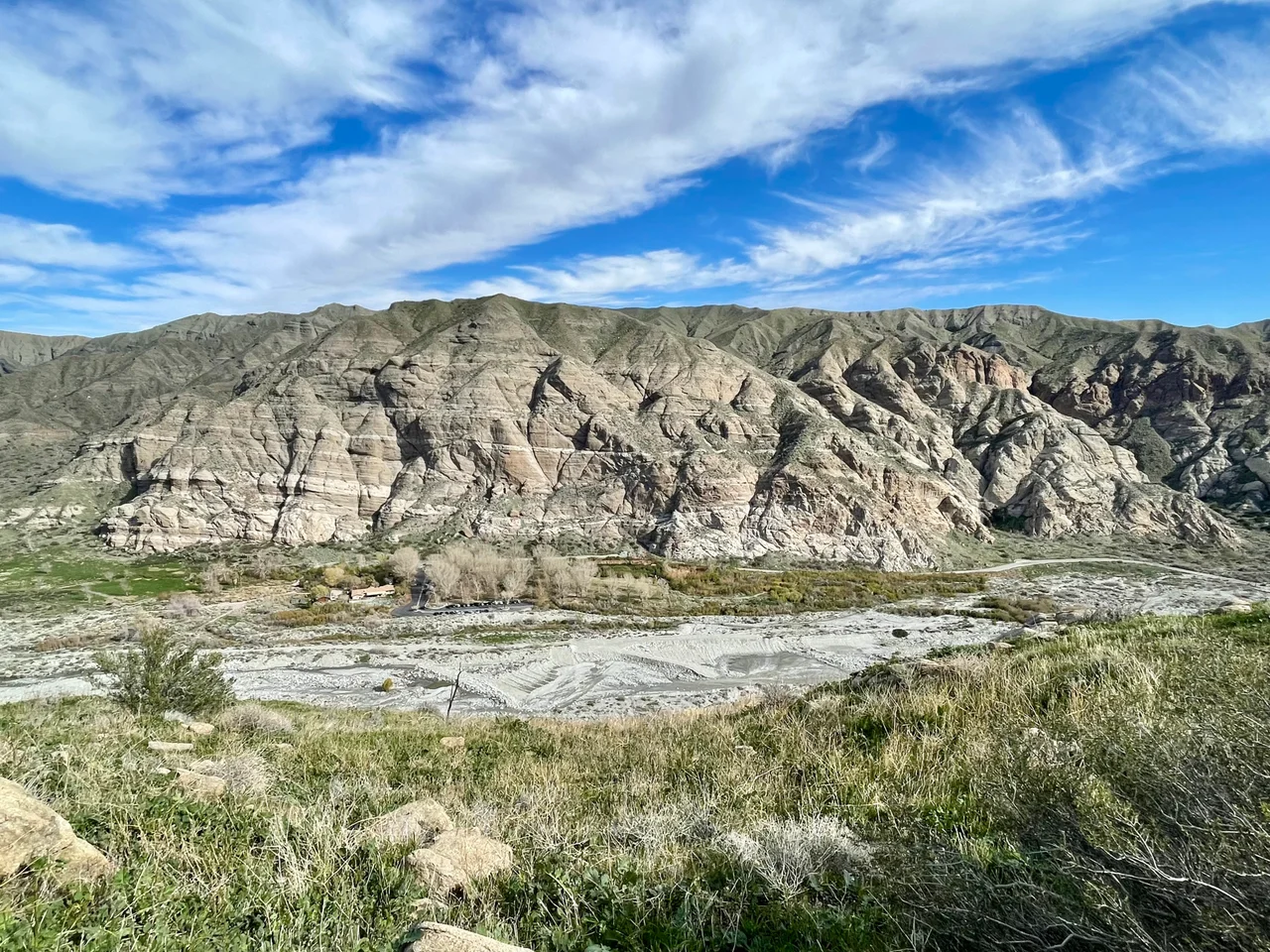

Whitewater Preserve
The Whitewater River runs year-round through its canyon — a fact so improbable in this corner of the Mojave that it explains nearly everything else about the preserve. Water that falls as snow on the flanks of San Gorgonio Mountain descends through the San Gorgonio Wilderness and emerges here, at the western edge of the Coachella Valley, to create an oasis that draws species and visitors from across the region. In 2,246 acres, the Wildlands Conservancy has protected a place where the desert reveals what it can support when given enough water.
From Fish Farm to Preserve
The land was once operated as a commercial trout farm, capitalizing on the reliable cold water descending from the mountains above. When the Wildlands Conservancy acquired it and converted it to a nature preserve, the fish farm's infrastructure was removed and native riparian vegetation was restored along the river corridor. That restoration has been working: willows, cottonwoods, and native grasses now line the Whitewater River through much of the preserve, providing the dense cover that southwestern willow flycatchers and least Bell's vireos — both federally endangered songbirds — require for nesting. More than 200 bird species use the preserve across seasons, drawn by the combination of water, shade, and the insect populations that riparian vegetation supports.
Large Animals in a Desert Canyon
The preserve is not only for birds. Desert bighorn sheep move through the canyon, descending from the rugged terrain of the surrounding mountains to reach the river. Mountain lions have been documented in the area, following the prey base that the canyon's vegetation and water support. Bears occasionally appear, descending from the San Bernardino Mountains during dry years when food at higher elevations becomes scarce. These larger mammals require connected habitat — the ability to move between the canyon and the surrounding wilderness without encountering roads or development — and the preserve's position adjacent to the San Gorgonio Wilderness provides that connectivity. In 2019, the Whitewater River through the preserve received Wild and Scenic River designation, recognizing its outstanding natural values and the threats those values face.
When the Water Turns Violent
The same river that makes the preserve possible periodically demonstrates what desert water can do when the weather cooperates. In 2019, a storm caused flooding severe enough to close the preserve and damage its infrastructure. Repairs costing $1.5 million were completed and the preserve reopened in November of that year. Then in August 2023, Tropical Storm Hilary made landfall in Southern California — an event rare enough to attract regional attention — and delivered rainfall that damaged the preserve again. Closure followed, and the preserve reopened on December 11, 2023. These repeated cycles of storm damage and restoration are part of the preserve's character, a reminder that the water it depends on is not always gentle. Desert canyons are shaped by floods as much as by the quiet seasons between them.
The Wildlands Conservancy's Vision
The Whitewater Preserve is one component of the Wildlands Conservancy's larger strategy for the Coachella Valley and surrounding mountains — a strategy that culminated in the designation of Sand to Snow National Monument in 2016. The organization spent two decades acquiring land in the corridor between the valley floor and the mountain summits, with the preserve serving as a key piece of the connected landscape that allows wildlife to move across elevation gradients as conditions change. Admission to Whitewater Preserve is free, a deliberate choice that reflects the conservancy's commitment to making protected land accessible to the communities around it. On weekends and holidays, the trailheads fill with families who have driven an hour or less from Los Angeles and the Inland Empire to find running water and shade in a landscape that offers little of either.
From the Air
Located at 33.989°N, 116.656°W at the western edge of the Coachella Valley, Whitewater Preserve occupies the canyon where the Whitewater River emerges from the San Gorgonio Mountains. The river corridor is visible from altitude as a thin green line descending from the higher terrain. Interstate 10 passes nearby at the mouth of San Gorgonio Pass. San Gorgonio Mountain (11,503 ft) rises prominently to the northwest — its summit is often snow-covered from October through May. Nearest airports: KPSP (Palm Springs International, approximately 22 miles southeast). The pass itself, carrying both the interstate and the river, is one of the most distinctive geographic features visible from the air in Southern California.
Nearby Stories
- Tell Them Willie Boy Is Here 1.7 km away
- Murders of Jan Pietrzak and Quiana Jenkins-Pietrzak 4 km away
- Rancho Mirage Library and Observatory 11 km away
- Cholla Cactus Garden 13 km away
- San Bernardino Train Disaster 29 km away
- Tenaja Fire 31 km away
- Amboy Crater 36 km away
- Edwards Air Force Base 102 km away