
Yaguarón
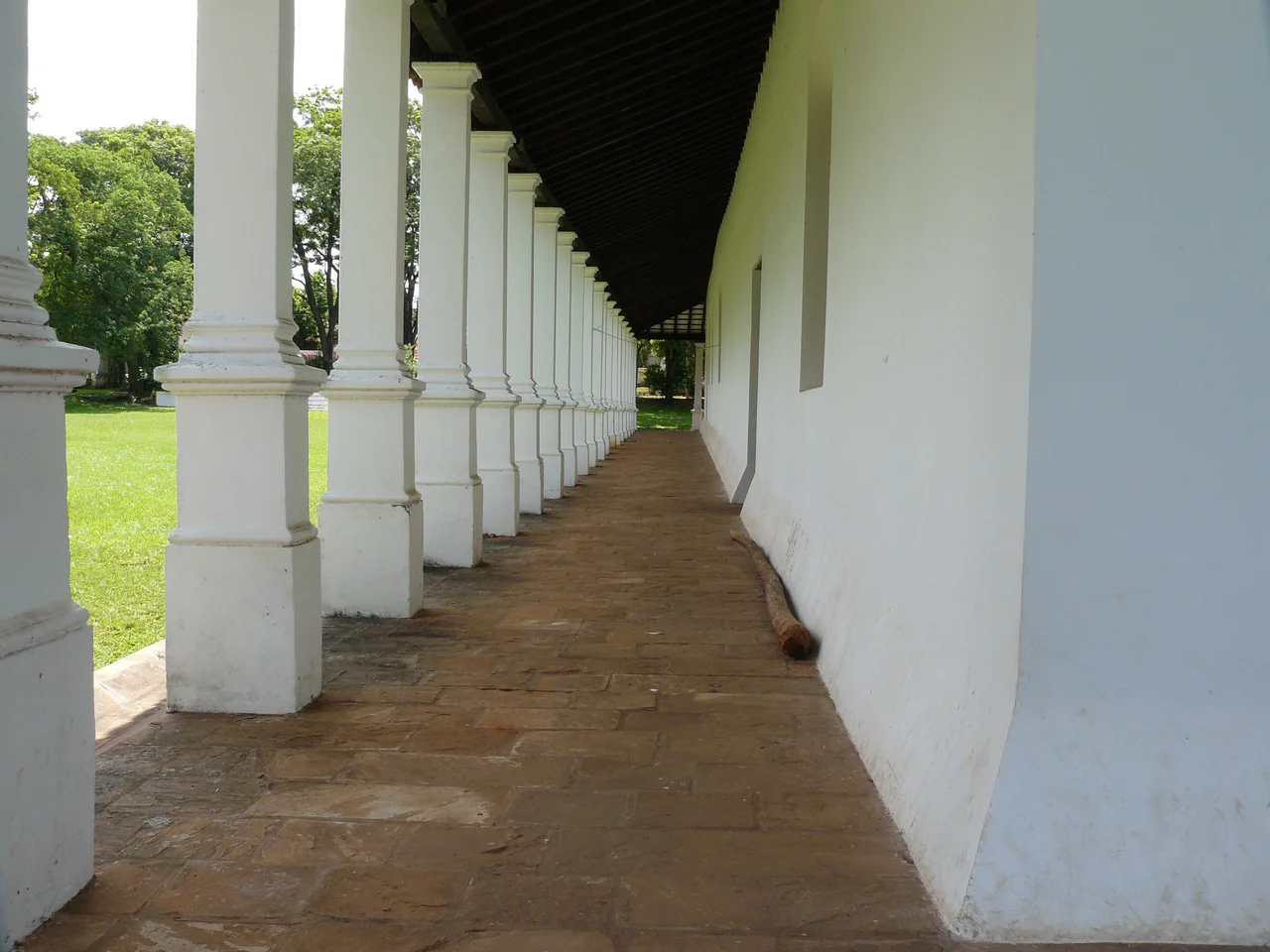
From the road, the church gives nothing away. A long, low building under a single sweep of tiled roof, its walls washed plain white, fronted by a wooden colonnade and a separate bell tower. Then you step inside, and the austerity detonates into gold. Every surface seems to glow with carved and gilded wood: saints, angels, vines, and flowers climbing toward the ceiling in a riot of color and leaf. This is the Templo de San Buenaventura in Yaguarón, a town of some 27,000 people at the foot of its namesake hill, and it is one of the finest works of colonial art in South America.
The Reduction at the Hill's Foot
Yaguarón began not as a town but as a mission. In the 1580s, the Franciscan friar Luis de Bolaños established a reducción here, one of the settlements where the order gathered Guaraní communities, drawing in people from the surrounding region. Together with neighboring missions at Altos and Itá, Yaguarón grew into a notable center, distinguished above all by its artisan workshops. The friars taught European crafts; the Guaraní brought their own deep traditions of carving and ornament. That fusion, forged in the mission's workshops over generations, is exactly what would later blaze across the walls of the great church. The art did not arrive from Europe finished. It was made here, by local hands trained over a century and more.
Sixty Years of Gold
The church that stands today rose between roughly 1755 and 1772, a generation-long labor of Franciscan friars and Guaraní artisans. Its soaring main altarpiece, a masterwork of colonial Paraguayan baroque, was directed by the Portuguese woodcarver José de Souza Cavadas, working alongside indigenous craftsmen trained in the mission's workshops. The style has a name of its own: Barroco-Guaraní, Guaraní Baroque, in which European baroque form is reimagined through indigenous eyes. The carvers reached for the flora and fauna they knew, folding local plants and creatures into the saints and scrollwork. Paraguay has placed the temple on its UNESCO World Heritage tentative list, a candidate for recognition as a paradigm of this singular American art.
El Supremo's Birthplace
Yaguarón gave Paraguay one of its most consequential and forbidding figures. On January 6, 1766, José Gaspar Rodríguez de Francia was born here, the son of a tobacco planter and former artillery officer. He would become the nation's first ruler after independence, holding power from 1814 until his death in 1840 and taking the title that history remembers him by: El Supremo, the Supreme and Perpetual Dictator. Francia sealed Paraguay off from the outside world, banning foreign commerce and turning the young country inward into near-total isolation. Admired by some as the architect of Paraguayan independence and feared by others for his iron rule, he remains a national landmark in human form. His house in Yaguarón, just a short walk from the great church, is now a museum.
Legends on the Hill
Above the town rises Yaguarón Hill, and the climb rewards you with an oratory and a long view: on a clear day the towns of Pirayú, Itá, Paraguarí, and Carapeguá spread across the plain below. The hill carries old stories. Local legend holds that Saint Thomas, remembered here as Pa'i Sumé, passed through the region long before the Spanish, leaving his footprints in the stone and teaching the people to grow maize. The town's very name reaches back further still, to the Guaraní Jaguarú, the name of an enormous mythic dog or jaguar said to roam this country. Faith and folklore braid together here, the saints of the church sharing the landscape with the spirits that preceded them.
Dogs and Drums
Yaguarón keeps its traditions close. Each August 16, the town celebrates the feast of Saint Roque, the saint honored as a protector of dogs, fittingly so in a place whose name conjures a great hound, and the celebration features offerings shaped like dogs. The musical life runs deep, too. The Petete Peteke Para'i band, from the nearby community of Guayaibity, plays on original, native-style instruments, keeping a homegrown sound alive. Beyond the famous church, Yaguarón is an ordinary working town built on agriculture and small manufacturing, where a world-class treasure of colonial art sits quietly among the rhythms of everyday Paraguayan life.
From the Air
Yaguarón lies at roughly 25.56°S, 57.28°W, about 48 km southeast of Asunción along Route 1. The clearest landmark from the air is Yaguarón Hill rising abruptly from the surrounding plain, with the town clustered at its base; the long, single-roofed church and its detached bell tower sit near the town center. A viewing altitude of 2,500–4,500 feet frames the hill, town, and the spread of neighboring towns visible from the summit oratory, including Itá and Paraguarí. The nearest major airport is Silvio Pettirossi International (ICAO: SGAS) at Luque, roughly 50 km to the northwest. Visibility is best in the dry season; the isolated hill is a reliable visual reference across the flat Paraguarí countryside.
Nearby Stories
- New Australia 20 km away
- Ypacarai Lake 22 km away
- Pilcomayo River 25 km away
- La Colmena, Paraguay 30 km away
- Río Pilcomayo National Park 56 km away
- El Paraíso Verde 57 km away
- Pilar, Paraguay 130 km away
- Laguna Blanca (Paraguay) 170 km away