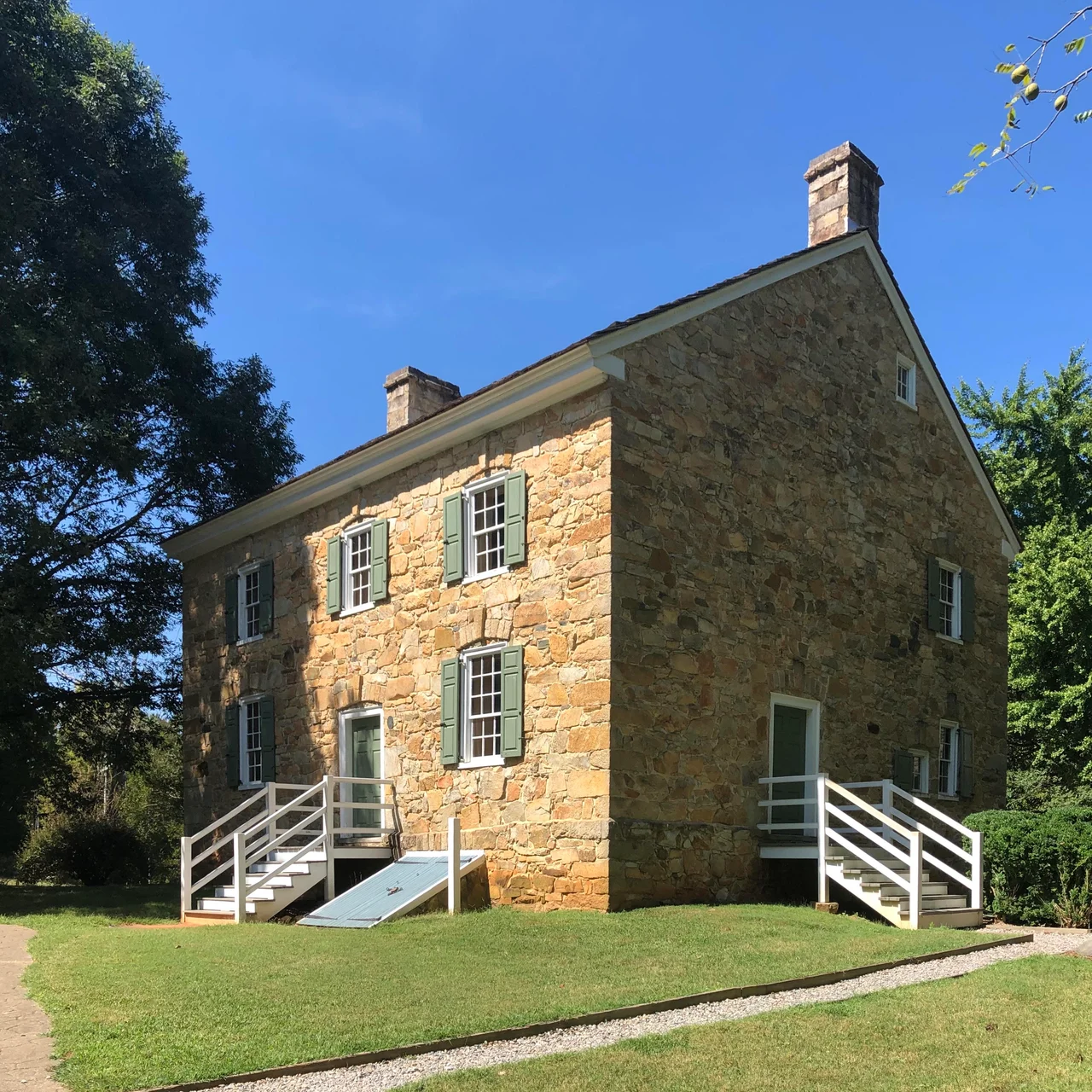

1774 Alexander Rock House
Hezekiah Alexander finished his stone house in 1774, two years before another stone - the cornerstone of American independence - would be laid in Philadelphia. The blacksmith from Cecil County, Maryland had moved south by way of Pennsylvania and Delaware, buying six hundred acres on Sugar Creek in 1767, and what he built on that land still stands at the edge of modern Charlotte. The walls are thick, the roof is steep, and the rooms are small in the way Georgian rooms always were. Everything else about the building - the city that grew around it, the museum that protects it, the centuries that have passed since the Alexander family wagons last creaked up the drive - is new.
A Blacksmith Who Helped Write a State
Hezekiah Alexander was not a quiet farmer. While his stone house was rising on Sugar Creek, he was riding to provincial congresses and arguing about constitutions. He served in the Fifth Provincial Congress that drafted North Carolina's first constitution in 1776, and he was a trustee of Queens College, the predecessor institution that lent its royal name to a charter the British eventually revoked. He worked iron at a forge, planted crops in the red Piedmont soil, and helped wire a colony into a state. When he died in 1801 at roughly seventy-three years old, his hands had shaped both metal and government - the kind of double life early American farmers somehow managed when the country was still figuring out what it wanted to be.
How a Family Loses a House
Property law in the early republic could undo a lifetime of accumulation in a single bad year. After Hezekiah's death the house passed to his widow Mary Sample Alexander, and after Mary's death in 1805 to their son Oswald. In 1826 Oswald married Mary Moore and then died, without a will, before the year was out. Mary petitioned for the estate, received it in 1828, and married William Lucky the same year. Under coverture, the rules that placed a wife's property in her husband's hands the moment she said "I do," the Alexander family's stone house slipped out of Alexander hands and into Lucky's. For more than a century afterward it changed owners again and again, surviving as something between a working farm and a curiosity, the kind of building that is too solid to tear down and too inconvenient to fully restore.
The German Stones of an English County
Look closely at the masonry and you can read a migration in stone. The Rock House is Georgian in its proportions and its symmetry, but the actual technique - the heavy fieldstone walls, the way the chimney rises through the gable end - belongs to the Pennsylvania Germans and the Hudson Valley Dutch. Those settlers brought stonework south as they followed the Great Wagon Road into the Carolina backcountry, and the Alexander house is one of the few surviving examples of that transplanted vernacular in North Carolina. It is a Maryland man's English-named house, built in a German style, on land claimed under an English king, by people about to break violently with that king. The Piedmont was always more complicated than the textbooks let on.
Rescued by Daughters
By the 1940s the Rock House and its outbuildings were what historic preservationists politely call "at risk" - meaning roofs leak, mortar crumbles, and the next bad winter could finish what neglect started. In 1949 members of the Daughters of the American Revolution leased the property to stop the bleeding, and in 1969 the Hezekiah Alexander Home Foundation was formed to fundraise and manage the long work of restoration. The Charlotte Museum of History became an independent institution in 1986 and has stewarded the site ever since. It earned a place on the National Register of Historic Places in 1970 - a list that, in a county where new construction tears down a neighborhood every season, is one of the few things that can stop a bulldozer.
Why It Matters
Charlotte is a city that does not look its age. Skyscrapers in Uptown, suburbs that sprawl past every horizon, an airport that ranks among the busiest in the country - the place reads as new, as if it appeared sometime around the founding of NationsBank. The Rock House interrupts that reading. It sits in the middle of all that growth, low and gray and quietly older than the United States. Walk through it and you are walking through the same doorways Hezekiah walked, looking out at trees descended from the ones he saw. The stone is not impressive in the way a cathedral is impressive. It is impressive in the way a witness is - because it was there.
From the Air
Located at 35.2319°N, 80.7667°W on the eastern edge of Charlotte near the I-485 outerbelt. Visible from low cruise; the museum complex sits in a wooded pocket northeast of Sugar Creek Road. Nearest airport is Charlotte/Douglas International (KCLT) about 9 nautical miles southwest; Concord-Padgett Regional (KJQF) lies northeast. Best viewing altitude 3,500-6,500 feet; the stone walls are too low to spot from cruise, but the green museum campus stands out against surrounding development.
Nearby Stories
- Battle of Colson's Mill 12 km away
- Kings Mountain Mine 13 km away
- Thyatira Presbyterian Church, Cemetery, and Manse 16 km away
- Andrew Jackson State Park 19 km away
- Hickory Motor Speedway 22 km away
- North Carolina Aviation Museum 29 km away
- Cheraw, South Carolina 40 km away
- Battle of Fishdam Ford 47 km away