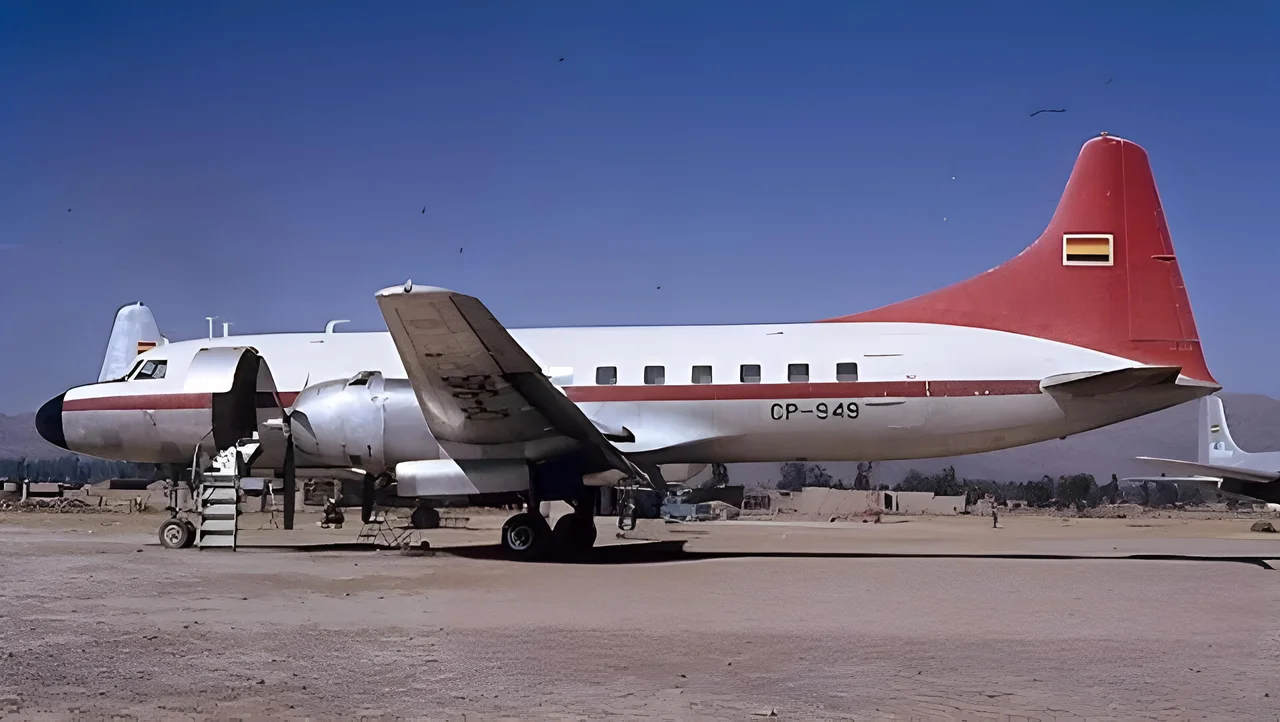

1975 Transporte Aéreo Militar Convair CV-440 crash
The aircraft had 48 seats. On the morning of 27 October 1975, it carried 67 people. Many of them were not soldiers but their wives and their children, packed aboard a military Convair for the short hop from the lowland strip at Tomonoco up toward the thin air of La Paz. They never reached it. About ten minutes after takeoff the pilot radioed that the engines were failing on the climb, and shortly after, the aircraft came down in heavy forest near Caranavi. Everyone aboard died. It remains the deadliest crash in the long history of the Convair CV-240 family, and behind that statistic is something harder to hold: dozens of families that vanished together in a single morning.
A Climb That Asked Too Much
The geography here is unforgiving. The flight began at Tomonoco, an airstrip in the warm lowlands roughly 170 kilometers northeast of the capital, and was bound for El Alto Airport serving La Paz, which sits among the highest of any major city on Earth. To get from one to the other, an aircraft must claw its way up over the eastern wall of the Andes, climbing thousands of meters into air so thin that piston engines lose much of their power. A Convair could manage that climb only if it stayed within its limits. This one did not. Investigators concluded the aircraft was grossly overloaded, carrying far more weight than its 48 seats were ever meant to hold, and at around 10:50, only minutes after lifting off, the pilot radioed an emergency call reporting a loss of power as the straining engines failed to hold the climb. Soon after, the aircraft came down in the forest. There was no time, and there were no survivors.
Who Was Aboard
When the remains were recovered and identified on 27 and 28 October, the human shape of the loss became clear. Of the 63 passengers, around twenty were military officers and six were male civilians. The rest, the majority of the people on that flight, were the officers' wives and children. This was not a combat mission or a routine cargo run. It was families traveling together, the kind of ordinary journey that fills regional flights everywhere. That ordinariness is what makes it land so heavily. Whole households were aboard, and whole households were lost, the youngest passengers among them children who never had the chance to grow up.
The Search in the Green
The crash site was steep, heavily forested, and hard to reach, the kind of terrain that swallows wreckage whole. The Bolivian Air Force led the search with fixed-wing aircraft and helicopters, and the Gendarmerie and Army joined the effort on the ground. President Hugo Banzer Suarez traveled to Tomonoco to oversee the operation himself. In the first chaotic hours the numbers shifted, as they often do after a disaster: early reports spoke of 60 dead, then 70, before the grim accounting settled at 67. Each correction was not just a figure but a family somewhere waiting for word, hoping the count would come back lower and finding that it did not.
What the Forest Holds
Half a century on, the forested ridges near Caranavi have folded the wreckage into themselves, the way the Yungas always reclaim what falls into them. The road and rail routes that thread these mountains are notorious for their hairpin drops and their sudden fog, and aviation offered a faster way over country that punishes every shortcut. That promise of speed was also the danger; the pressure to move people and cargo over the Andes is exactly what fills an aircraft past its limits. The 1975 crash endures in aviation records as a cautionary case about the brutal arithmetic of weight, altitude, and engine power, the same forces that have claimed other flights in these mountains before and since. But it deserves to be remembered as more than a lesson. It is a place where 67 people, most of them family members traveling together, were lost on an ordinary morning, and where the mountains have kept watch over them ever since.
From the Air
The crash occurred in the Bolivian Andes near Caranavi, at roughly 15.70 degrees south, 67.17 degrees west, in the rugged Yungas where the high Andes plunge toward the Amazon basin. The terrain is a tangle of steep, forest-covered ridges cut by deep river valleys, beautiful and treacherous in equal measure. The aircraft was bound for El Alto Airport serving La Paz (ICAO SLLP), the world's highest international airport at about 4,061 meters, roughly 75 km to the southwest. Rurrenabaque (ICAO SLRQ) lies to the north in the lowlands. This is demanding country for aviation: high terrain, narrow valleys, and fast-forming cloud that can hide the ridgelines. Clearest views come in the early morning before the day's clouds build over the mountains.
Nearby Stories
- Isiboro Secure National Park and Indigenous Territory 14 km away
- Yungas Road 43 km away
- Pilón Lajas Biosphere Reserve and Communal Lands 54 km away
- 2003 La Paz Riots 90 km away
- Mojeños 95 km away
- La Paz 103 km away
- Madidi National Park 137 km away
- Battle of Viluma 169 km away