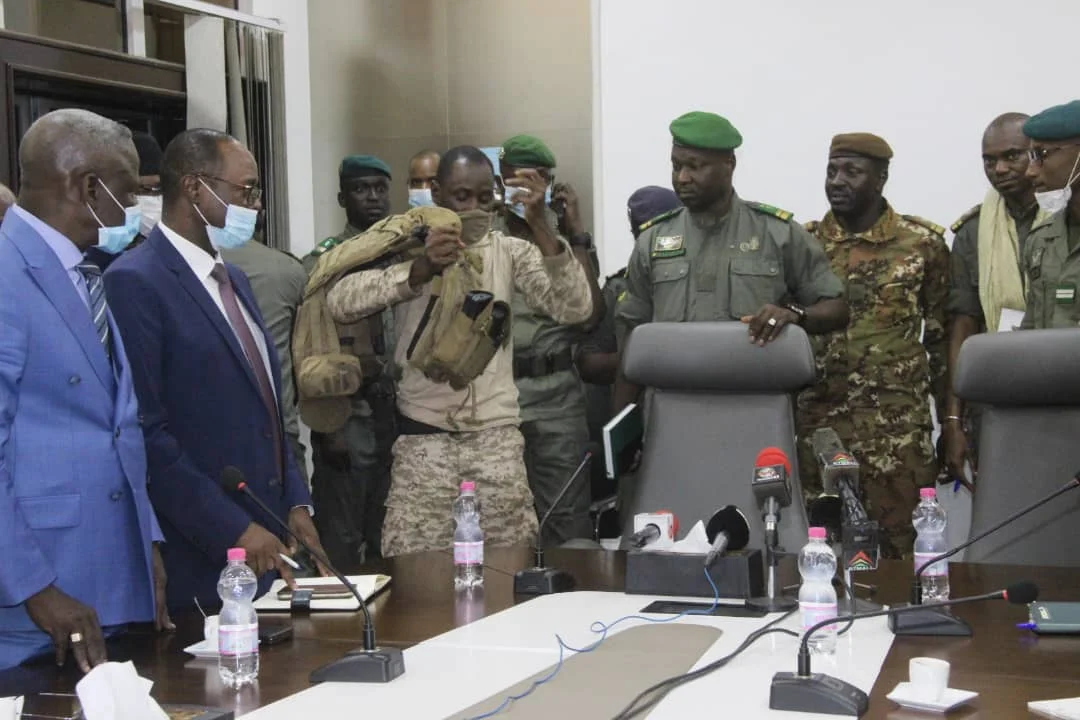

2020 Malian Coup d'État
It began with gunfire in the air. On the morning of August 18, 2020, soldiers at the Soundiata military base in Kati, a garrison town some fifteen kilometers from Bamako, started firing into the sky. Within hours, weapons were handed out from the armory, senior officers were under arrest, and tanks rolled into the streets while military trucks turned toward the capital. By midnight, the elected president of Mali had resigned. It was the country's second coup in less than ten years, and it ended a rare stretch of stability across West Africa — nearly six years in which not a single government in the region had been overthrown by force.
A Country at the Breaking Point
The soldiers did not act in a vacuum. Since June 5, mass protests had filled the streets of Bamako, demanding the resignation of President Ibrahim Boubacar Keïta. The grievances ran deep: a jihadist insurgency the government seemed unable to contain, accusations of corruption, the strain of the COVID-19 pandemic, and an economy in trouble. The protests turned deadly — eleven people killed and 124 injured before the soldiers ever left their base. Mali sat at the heart of the Sahel, a region the Global Terrorism Index would soon name the global epicenter of terrorism, where extremist groups competed for territory and weak governments struggled to hold the line. Into that pressure, the mutiny at Kati was less a bolt from the blue than a fuse finally reaching its end.
The Day at Kati
As the shooting started at the Kati base, Prime Minister Boubou Cissé appealed for dialogue, acknowledging the mutineers held "legitimate frustrations." It was already too late for talks. Soldiers drove to President Keïta's residence in Bamako and arrested both him and Cissé, along with other senior officials. The African Union confirmed the detentions and called for their release. The M5-RFP opposition coalition, which had led the protests, welcomed the arrests as a "popular insurrection," and demonstrators set fire to a building belonging to the Ministry of Justice. The men at the center of it were a small group of colonels, led by Assimi Goïta. By the day's end, the question was no longer whether Keïta would fall, but on what terms.
Resignation at Midnight
Around midnight, President Keïta appeared on state television and resigned, dissolving both the government and the parliament. "I want no blood to be spilled to keep me in power," he said. He was seventy-five years old and had been hospitalized only days earlier; in September he would leave the country for medical treatment in the United Arab Emirates. The next morning, the new military leaders sealed Mali off — all air and land borders closed, a nighttime curfew imposed from nine in the evening until five. Colonel-Major Ismaël Wagué of the air force read the announcement on television and invited opposition groups to talks about fresh elections. The coup had succeeded with remarkably little bloodshed at the moment of takeover. What came next was far harder to settle.
The Transition That Followed
The soldiers, organized as the National Committee for the Salvation of the People, promised a return to civilian rule but were vague about the timeline. Their experts initially floated a two-year transition led by a president of their own choosing — a plan that alarmed Mali's neighbors, who pushed for elections within a year. On September 12 the committee agreed to an 18-month transition. On September 21, a group of 17 electors named Bah Ndaw, a former defense minister, as interim president, with Goïta installed as vice president. The new government was inaugurated on September 25. The junta was supposed to dissolve once the transition began; by January 2021 it had been formally disbanded on paper, though the reality lagged behind the promise. The colonel who had stood at the center of it all, Assimi Goïta, was not finished — and Mali's experiment with military rule had only begun.
From the Air
The coup's flashpoint, the Soundiata (Kati) garrison, sits at roughly 12.75°N, 8.07°W, about 15 km northwest of Bamako in Mali's Koulikoro Region. Bamako itself spreads along the Niger River just to the southeast. The nearest major airport is Bamako-Sénou International, ICAO GABS, south of the capital — the same airport whose closure the junta ordered on August 19, 2020. From altitude, the Niger River and the dense sprawl of greater Bamako are the dominant features, with Kati a distinct urban cluster on the higher ground to the northwest. Dry-season months (November–April) offer the clearest air over the Sahelian plateau.
Nearby Stories
- Narena 35 km away
- Siby, Mali 48 km away
- Nyamina 55 km away
- Niagassola 88 km away
- Morila Gold Mine 106 km away
- Boucle du Baoulé National Park 129 km away
- Tukulor Empire 143 km away
- Ségou 185 km away