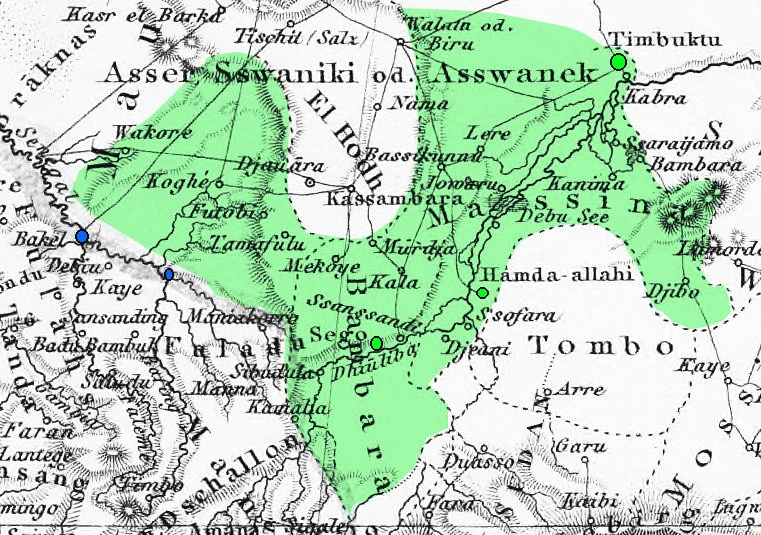

Tukulor Empire
A man came home from Mecca in 1836 carrying two titles and an idea that would reshape West Africa. He was Umar Tall, born in Futa Toro in what is now Senegal around 1797, and he returned from the pilgrimage as El Hadj and as the Tijaniyya brotherhood's caliph for the Sudan. For a decade he studied and wrote; then he turned to the sword. The empire he built between 1861 and 1893 was vast, brief, and bought at a terrible human cost, an Islamic state stretching across the western Sudan and centered, after 1861, on the conquered city of Ségou.
A Message for the Restless
Umar Tall's call reached across the social order of the mid-19th-century Sahel, and it found people ready to listen. Fula, Soninke, Moors, and others answered for reasons that were rarely only religious. Enslaved people heard a path to freedom in fighting for Islam. Men of mixed background and uncertain standing found a new identity and a new chance. Communities chafing under European pressure looked to Tall to drive the foreigners out, and marabout families saw a way to add political power to their spiritual authority. He gathered this following first at Dinguiraye, a city he founded in 1851 in the Kingdom of Tamba, where his growing stockpile of weapons soon alarmed the very king who had granted him the land.
Down the Niger by Force
The conquest moved east and grew bloodier. Tall took Bambouk, then in April 1855 seized Nioro du Sahel, capital of Kaarta, and made it his base. His newly conquered Bambara subjects rebelled against forced conversion. The decisive clash came on the Niger itself: in February 1861, allied Bambara and Massina forces gathered opposite Sansanding, and the two sides fought a battle of war canoes mid-river before Tall split his army, crossed at night, and crushed them. Ségou fell on March 10, 1861, and became his capital. The campaign that followed, against the Fulani state of Massina, was savage, costing tens of thousands of lives before Hamdallaye fell the next year.
Ahmadu's Long Defense
When Umar Tall died, the empire nearly tore itself apart. His nephew Tidiani Tall and his son Ahmadu Tall both claimed the succession, and Ahmadu spent his reign at Ségou struggling to hold a fractious state together. He fought the Fula aristocracy, leaned on the Bambara population of Ségou for support, and watched his own brothers rebel one after another in Nioro and Koniakary. From Ségou his ministers ran a surprisingly elaborate government, with portfolios for justice, the treasury, commerce, dealings with Europeans, and a fleet on the Niger. But inflation raged, soldiers raided the countryside for supplies the state could not provide, and trade routes shifted away from the troubled river.
The French and the Aftermath
While Ahmadu fought to centralize, France pushed inland from the coast, and the empire's days narrowed. The French captured Nioro in 1891 and drove Ahmadu from Ségou to Bandiagara. In 1893 they took final control, ending the Tukulor Empire and sending Ahmadu into exile in Sokoto, where the dynasty's last emperor died far from the Niger he had ruled. The empire lasted barely a generation, yet its mark endures. The campaigns of Umar Tall helped make Islam the dominant faith across a broad swath of the Sahel, a religious geography that still defines the region long after the empire that imposed it disappeared.
From the Air
The heart of the Tukulor Empire, the capital at Ségou, lies at 13.43 N, 6.27 W on the Niger River in central Mali. From the air the empire's old core is defined by the Niger as it crosses the flat Sahel between Ségou and the Inner Niger Delta to the northeast. Nearest major airport is Bamako-Sénou International (GABS), about 200 km to the southwest. Clear-weather visibility is good in the dry season; the harmattan can reduce horizontal visibility with airborne dust. The river and its floodplain are the dominant landmarks across otherwise featureless plain.
Nearby Stories
- Sansanding 16 km away
- Nyamina 36 km away
- San, Mali 80 km away
- Koutiala 91 km away
- Dia, Mali 101 km away
- Koulikoro 102 km away
- Morila Gold Mine 184 km away
- Boucle du Baoulé National Park 241 km away