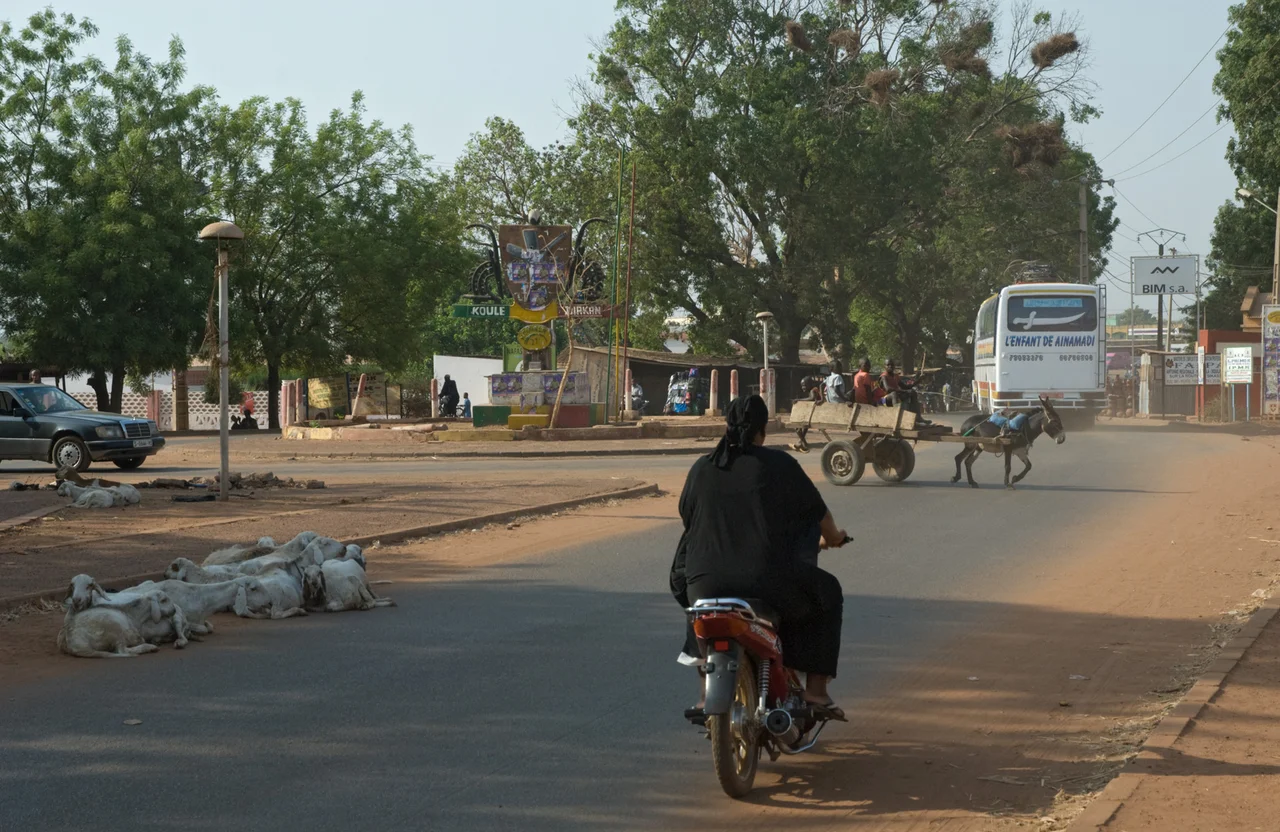
,sheep,traffic,motorbike,donkey_cart,bus_Koutiala(Sikasso_Rgn),ML_sun13apr2014-0831h.jpg)
Koutiala
They call it white gold. Across the plains of southeastern Mali, the cotton bolls open in the dry months like a field of low cloud, and into this whiteness comes Koutiala - the city that cotton built. Trucks heaped with the harvest rumble in from a thousand villages. The gins and oil presses run. For decades, the rhythm of this place has been set by a single crop, and few towns in West Africa have tied their fortunes so completely to one shrub with a soft white flower.
Founded in Minianka Country
Koutiala sits in the land of the Minianka, a farming people of the Mali-Burkina Faso borderlands known for their music, their masks, and their deep attachment to the soil. The city itself was founded in the 16th century by members of the Coulibaly family, who came south from the Bambara kingdom of Segou, the great power that once dominated the Niger River bend. That older world of kings and cavalry is gone, but its languages remain: walk the markets here and you will hear Bambara, which has its own elegant N'Ko writing script alongside the Latin alphabet, as well as the Minianka tongue. The town grew where farmland was generous and trade routes crossed, and it kept growing - by the 2009 census, nearly 138,000 people lived within Koutiala itself, the busy capital of a surrounding district of more than half a million.
The White-Gold Capital
Cotton transformed Koutiala from a market town into the second most industrial city in Mali. It is the heartland of Malian cotton production, and it earned the nickname "the white-gold capital" for good reason - the great processing companies set up here, from the state cotton developer known by its French initials CMDT to the cottonseed oil works of HUICOMA. When the harvest is good, the whole region feels it. Yet cotton is a hard master. Since the 1980s the industry has wrestled with stagnation, vulnerable to swings in world prices set far from any Malian field. So Koutiala hedges its bets the way farmers always have, with grain: pearl millet, sorghum, and maize feed the city when the white gold falters.
A City of Names
For a place few outsiders could find on a map, Koutiala has sent some notable figures into the world. Ibrahim Boubacar Keïta, who served as president of Mali, came from here, as did the government minister Berthé Aïssata Bengaly. The city also carries the quieter mark of care: it is home to an important hospital serving women and children, a lifeline in a region where such services are scarce. And in a gesture that links the Sahel to Europe, Koutiala is twinned with Alençon in France - the lacemaking town of Normandy and the cotton city of Mali, two places defined, in their different ways, by thread.
Where the Harvest Goes
To understand Koutiala, follow a single boll. It is picked by hand in a village field, bagged, and carried to town. It is weighed, ginned, and separated - lint to the textile chain, seed to the oil press. The lint may travel north to the river, then by long road to a distant port, bound for mills on another continent. The oil stays closer, frying the street food of the Sahel. Nothing is wasted, and everything depends on the next rains. This is the gamble Koutiala has made for generations: to build a city on a crop, and to live, year after year, by the unpredictable arithmetic of soil, sky, and the price of white gold.
From the Air
Koutiala lies at 12.38°N, 5.47°W on the plains of southeastern Mali's Sikasso Region, roughly 140 km north of Sikasso. From altitude, the city reads as a dense urban knot amid a patchwork of cotton and grain fields, with the industrial gin and oil-works compounds on its edges. The nearest major airport is Bamako-Sénou (GABS), about 280 km to the west-northwest; Sikasso lies to the south. Best viewed in the clear, hazy light of the dry season, when harvested cotton fields lighten the surrounding land.
Nearby Stories
- San, Mali 72 km away
- Tukulor Empire 92 km away
- Sikasso 93 km away
- Mare aux Hippopotames 103 km away
- Tominian 106 km away
- Morila Gold Mine 107 km away
- Ségou 122 km away