
Sikasso
In 1870 it was a village. Within a generation it had become the largest fortified city West Africa had ever seen, ringed by earthen walls thick enough to swallow cannonballs. Sikasso, in the green hills of southern Mali, owes its rise to a single decision: when Tieba Traoré became Faama of the Kénédougou Kingdom, he moved his capital to the town his mother came from. What he built there would resist two armies, outlast a fifteen-month siege, and end in a story of defiance that Malians still tell today.
A Capital Rises
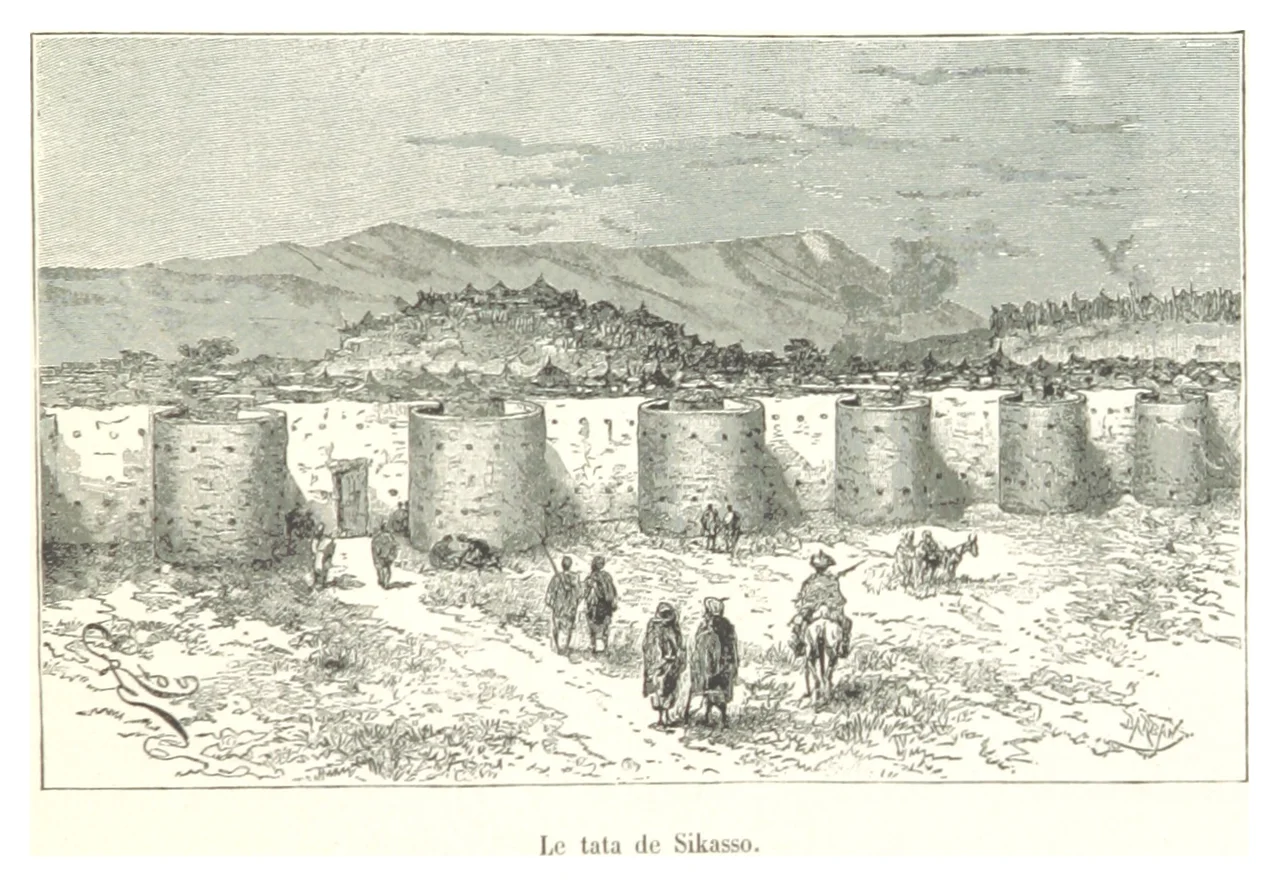
Tieba Traoré chose Sikasso for reasons both political and personal. His mother was from here, and the land held a sacred hill known as the Mamelon, long believed to be home to spirits. On its summit he set his palace; around his growing capital he raised a tata, a massive defensive wall of rammed earth. Kénédougou sat in a dangerous neighborhood. To the west loomed the Malinke conqueror Samori Touré, carving out an empire by the sword. From the north came the French colonial army, expanding its reach across the Sudan. Tieba's wall was meant to hold off both. For a time, it did exactly that, making Sikasso the most heavily fortified city the region had known.
Fifteen Months Behind the Wall
Between 1887 and 1888, Samori Touré laid siege to Sikasso. His army camped before the tata for fifteen months, launching assault after assault against the earthen ramparts. The walls held. The defenders held. Touré, who had broken cities across the savanna, could not break this one. It was the French, then nominal allies of Kénédougou against their common rival, who finally helped relieve the siege. The kingdom had survived its greatest test. Yet the friendship that saved Sikasso would prove far more dangerous than the enemy it had repelled. Within a decade, the relief column's descendants would turn their guns on the same walls they had once helped to defend.
The Fall and a Last Defiance
In 1898 the French manufactured a diplomatic pretext and attacked. On April 15 their artillery opened a sustained barrage against the tata, and on May 1 the city fell after furious house-to-house fighting. Babemba Traoré, Tieba's brother and successor as Faama, refused to be taken alive. He ordered his own bodyguards to kill him rather than surrender to the French, honoring the Bambara saying "Saya ka fisa ni maloya ye" — death is preferable to shame. The aftermath was brutal. Roughly four thousand captives were seized in the sack of the city and parceled out as enslaved people among the French and their auxiliaries, then marched west toward the Niger. Many, too weak or starved to continue, died or were killed along the road. They were not statistics; they were the people of a kingdom that had refused to kneel.
The City Today
Modern Sikasso is Mali's second-largest city, home to more than 225,000 people and a thriving hub of trade in the country's fertile south. It remains the capital of both the Sikasso Cercle and the wider Sikasso Region. Mosques dominate its skyline, joined by Catholic and evangelical churches that mark the city's religious mix. The sacred Mamelon still rises at its heart, though it now wears a water tower where a palace once stood. Sikasso even keeps a sister city across the old colonial divide: Brive-la-Gaillarde, in France. The wars are long past, but the memory of the great tata, and of the kings who would not be shamed, endures in the streets that grew up around it.
From the Air
Sikasso sits at roughly 11.32°N, 5.67°W in the well-watered hills of southern Mali, near the borders with Burkina Faso and Côte d'Ivoire. The nearest airfield is Sikasso (Dignangan) Airport, ICAO GASK, just outside the city; Bamako-Sénou International (GABS) lies about 300 km to the northwest. From altitude, look for the dense urban core set among green farmland; the Mamelon rises near the city center, now crowned by a water tower. Best viewing in the dry season (November–April) when haze from the harmattan thins and visibility over the southern plateau is clearest.
Nearby Stories
- Morila Gold Mine 58 km away
- Sudanese Style Mosques in Northern Cote d'Ivoire 66 km away
- Kenedougou Kingdom 89 km away
- Koutiala 94 km away
- Grand Mosque of Bobo-Dioulasso 108 km away
- Battle of the Sama Forest 124 km away
- Mare aux Hippopotames 124 km away
- Ruins of Loropéni 205 km away