![Photo: Marco Schmidt [1] | CC BY-SA 3.0](https://commons.wikimedia.org/wiki/File:Mare_aux_hippos_MS_2068.jpg)
Mare aux Hippopotames
At dusk the water begins to move. What looked like smooth gray boulders along the lake's surface lift, exhale, and resolve into the broad backs and twitching ears of hippopotamuses - perhaps a hundred of them, dividing into family groups as the day's heat releases its grip. This is the Mare aux Hippopotames, the Lake of Hippopotamuses, a sheet of fresh water cradled in the floodplain of the Black Volta in southwestern Burkina Faso. It is the only place in the entire country that UNESCO has named a Biosphere Reserve, and the hippos are the reason its name endures.
A Lake That Breathes With the Seasons
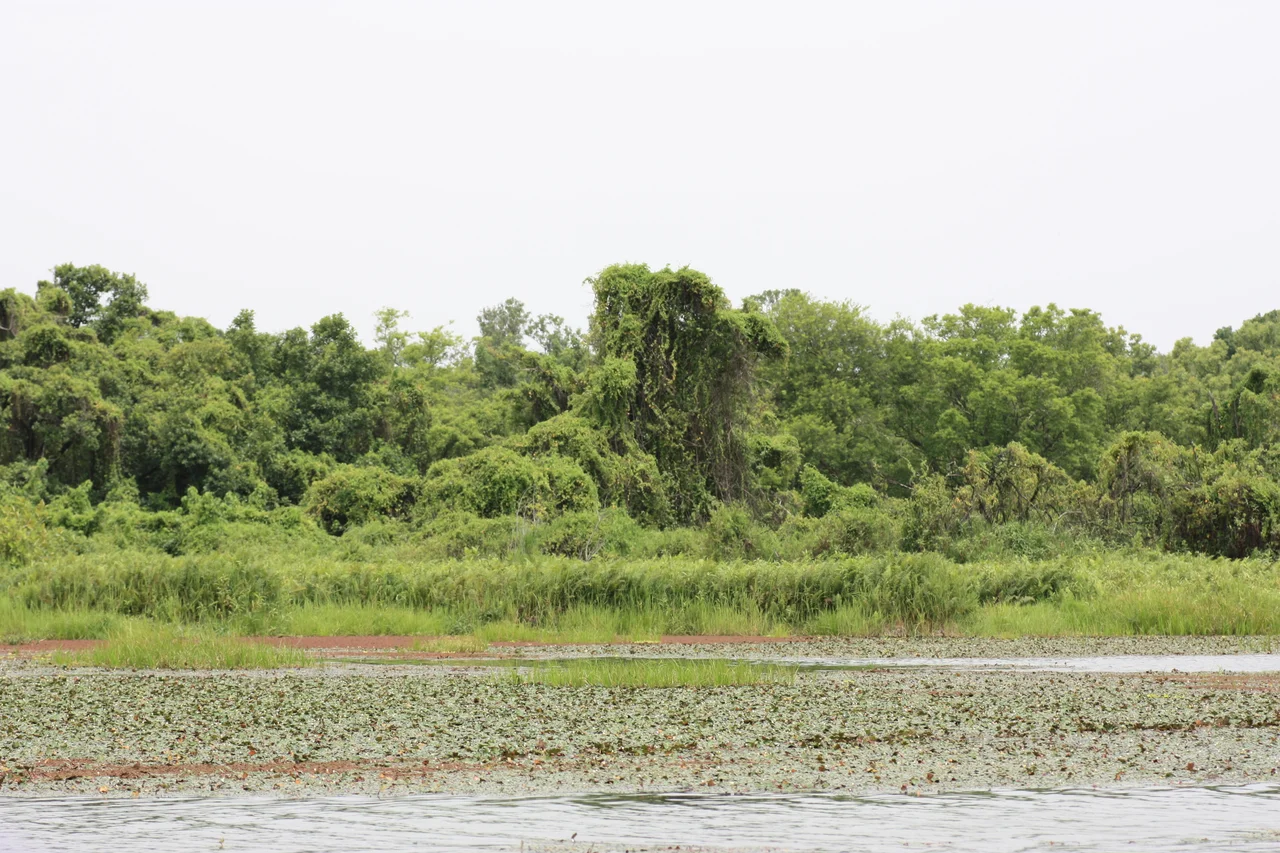
The Mare is not a fixed thing. It swells and shrinks with the floodwaters of the Black Volta, which the French call the Volta Noire, fed by a Sudanese climate of two blunt seasons: eight dry months, four wet ones. When the rains come, the lake spreads into a maze of pools and marshes; when they retreat, the water draws back into its deeper heart. Around it stand gallery forests, wooded savannah, and reed-fringed flats - a layered landscape of roughly 163 square kilometres. Protected since 1937 and named a Biosphere Reserve in 1977, it is also recognized internationally as a Ramsar wetland, one of those rare watery places the world has agreed are too important to lose.
More Than Hippos
The hippopotamuses give the lake its name, but they share it with a remarkable cast. West African crocodiles glide the shallows. Sable antelope and other large antelope move through the savannah, patas monkeys race across open ground on their long legs, and warthogs root in the margins. Elephants pass through. Overhead and along the shore, the reserve hums with birds - around 160 species of waterfowl, from jewel-bright kingfishers to white-faced whistling ducks and the long-toed jacana that walks delicately across floating leaves. For a single lake on the edge of the Sahel, it is an astonishing concentration of life, which is precisely why it draws the roughly thousand eco-tourists who find their way here each year.
Living With Giants
A hippopotamus is not the placid creature of cartoons. They are among the most formidable animals in Africa, fiercely territorial in water and capable of moving with startling speed. For the communities who live around the Mare, coexistence is a daily negotiation: shared water, shared fishing grounds, and a healthy respect for animals that can weigh as much as a small car. That the herd has survived here, protected for the better part of a century while so many of West Africa's wild places have been lost, speaks to a long local relationship with this lake - one of caution, use, and a measure of reverence for the great gray bodies that surface each evening as the light goes gold.
From the Air
The Mare aux Hippopotames lies at 11.62°N, 4.13°W in southwestern Burkina Faso, on the floodplain of the Black Volta River, about 60 km north of Bobo-Dioulasso. From the air it appears as a dark, irregular lake fringed by greener gallery forest amid drier savannah - a clear water feature useful for navigation, especially in the wet season when the surrounding marshes flood. The nearest major airport is Bobo-Dioulasso (DFOO); Ouagadougou (DFFD) lies farther east. Best viewed in good light during the dry season, when the open water contrasts sharply against the tawny landscape.
Nearby Stories
- Grand Mosque of Bobo-Dioulasso 39 km away
- Volta-Bani War 57 km away
- Dédougou 85 km away
- Kirikongo 98 km away
- Koutiala 109 km away
- Mamelon of Sikasso 120 km away
- Sikasso 126 km away
- Gwollu Defence Wall 150 km away