Tominian
Tominian barely registers on a map of Mali, a town of a few thousand people on the dry eastern edge of the Ségou Region. But maps measure the wrong thing. What gathers at Tominian is not population but tradition, for this is the country of the Bwa, a farming people whose carved and woven masks are among the most striking in all of West Africa. To understand Tominian, watch what comes out to dance when the harvest is in or a boy becomes a man.
The People of the Bush
The Bwa, sometimes called Bobo-Wule in older accounts, live across central Burkina Faso and southeastern Mali, and Tominian sits near the western edge of their homeland. They are farmers, bound to the rhythm of planting and harvest, and their spiritual life is woven into that rhythm. The masks they make are not decoration. They are how the community speaks with the spirits of the bush, the wild powers that lie just beyond the cultivated fields and must be honored, appeased, and renewed each year if the rains are to come and the crops to grow. To the Bwa the line between the village and the wilderness is sacred ground, and the masks patrol it.
Leaf and Plank
The Bwa make two very different kinds of mask, and the difference matters. The oldest are masks of leaves, bundled fresh from the bush, worn so that the dancer seems to vanish into a moving thicket of greenery. They represent nature itself, raw and unshaped, summoned at the most important rites of renewal. The other kind is carved from wood: the great plank masks called nwantantay, towering above the dancer's head in a tall rectangular board painted in bold geometric bands of black, white, and red. Those patterns are not random. The Bwa read them as the scarification marks of initiated adults and as a code carrying the myths and moral lessons that the young must learn. The masks appear at burials, at planting and harvest rites, and above all at the initiations where boys cross into adulthood and learn, at last, what the patterns mean.
A Gathering of Neighbors
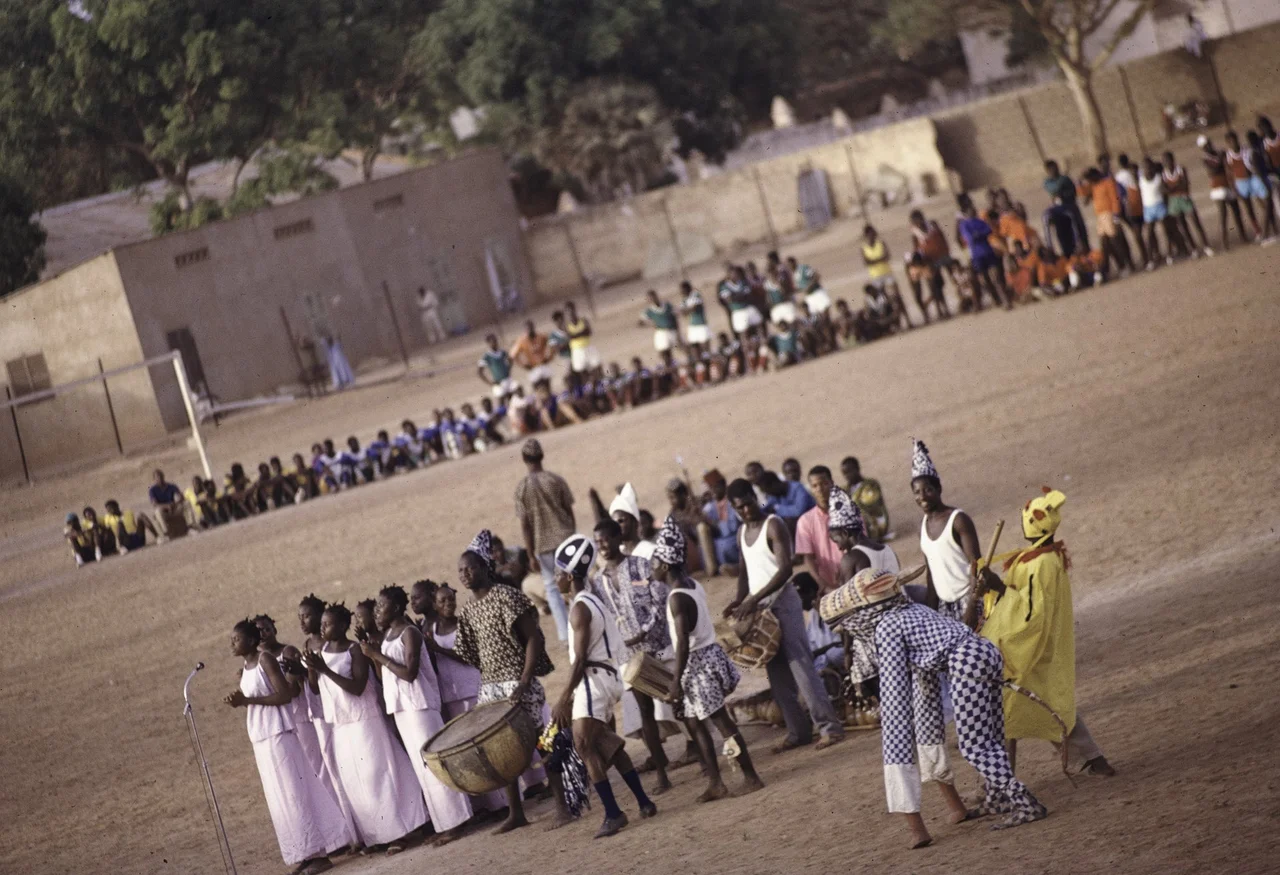
Tominian's culture is performed, not displayed in a case. A festival photographed here in 1972 captured how it works: troupes of dancers, singers, and musicians arrived to represent not only Tominian but the surrounding communities, the group from neighboring Ké-Macina in white robes, another standing in for the regional capital of Ségou, each with its own costumes, songs, and bearing. The town becomes a stage where neighbors present themselves to one another through movement and music. It is a reminder that in this corner of Mali, identity is something you dance, and the smallest town can hold a very large world.
From the Air
Tominian lies at 13.29°N, 4.59°W in eastern Ségou Region, Mali, in the dry savanna that marks the edge of Bwa country toward the Burkina Faso frontier. From the air it is a modest town on a flat, sparsely wooded plain, with the Bani River and the inland delta lying to the north and west. Nearest airports: Mopti / Ambodédjo (GAMB) to the northwest; Bamako-Sénou (GABS) is the international gateway far to the southwest. Recommended viewing altitude 4,000-6,000 ft AGL. Best visibility November through February in the dry season, before harmattan dust thickens the haze toward spring.
Nearby Stories
- Battle of Jenné 46 km away
- Bozo language 55 km away
- Koutiala 73 km away
- Hamdullahi 90 km away
- Sansanding 94 km away
- Dédougou 101 km away
- Volta-Bani War 122 km away
- Kirikongo 158 km away