
22nd Division (South Vietnam)
In early April 1975, Republic of Vietnam Navy craft loaded roughly seven thousand men off Qui Nhơn — two regiments of the 22nd Division and the Bình Định territorial troops who had fought alongside them — and sailed for Vũng Tàu. Colonel Nguyễn Hữu Thông of the 42nd Regiment had just brought his men out of a fighting withdrawal along Route 19. He refused to board, stayed on the shore, and took his own life. His division had held the ground between the Central Highlands and the coast for sixteen years, and its war ended at the water's edge.
Assembled, Not Founded
The 22nd was put together rather than raised: the 2nd Light and 4th Light Divisions of 1955 — the 4th Light briefly renamed the 14th Light in 1956 — folded into a 4th Infantry Division that was retitled the 22nd in 1959. Its headquarters sat at Ba Gi, inland from the coast in Bình Định province, and it answered to II Corps, whose map ran from the paddy along Highway 1 up onto the red basalt plateau around Pleiku and Kon Tum. Four infantry regiments — the 40th, 41st, 42nd and 47th — with an armored cavalry squadron, four artillery battalions and a battalion of sappers gave it the outline of a conventional division. The ground was not conventional at all: a coastal province thick with Viet Cong local forces, and a highland frontier North Vietnamese regiments crossed at will.
Nhong Pass and the New Rifles
On 8 February 1965, two companies of the 40th Infantry and a troop of M113 carriers drove north up Highway 1 to relieve Gia Huu and were ambushed in the Nhong Pass, five kilometres above Phú Mỹ. Recoilless rifle fire destroyed two carriers; the armored troop pulled back, then ran out of ammunition and left. Airstrikes could not keep the Viet Cong off the infantry, and four American advisers escaped to Phú Mỹ. The regiment counted 280 casualties and afterwards had 522 men present for duty — a regiment in name only. Two weeks later, between Đăk Tô and the Cambodian border, a battalion of the 42nd met troops carrying weapons nobody on the government side had seen: AK-47s and RPG-2s. Lieutenant Colonel Lai Van Chu led a second battalion back the next day and captured some, identifying the enemy as the People's Army of Vietnam 101st Regiment — but MACV's rules demanded further confirmation before it would enter the unit in its order of battle.
What the Evaluator Wrote Down
In February 1968 a Marine lieutenant colonel named William A. Donald, evaluating for MACV's pacification program CORDS, spent time inside one of the division's regiments. He found the commander astute, with "an impressive grasp of VC/PAVN tactics and the military significance of terrain," and also "a supreme practitioner of caution." Below him the picture darkened: staff officers serving as bodyguards, commanders running informant networks out of their own pockets, discipline enforced by whippings or by confinement in makeshift cages the Americans called tiger cages. Advisers described an inside clique "armed with an uncanny flair for mediocrity," decorated "with awesome regularity" while spending their nights at home and their troops' nights in the field. The soldiers in that report are the part easiest to skim past. They were conscripts patrolling their own provinces, and after dark those provinces belonged to someone else.
Tân Cảnh, 24 April 1972
By the spring of 1972 the division held the northern Highlands from Tân Cảnh Base Camp, and shelling had climbed from fifty rounds a day in March to a thousand by mid-April. On 23 April the PAVN 2nd Division opened with AT-3 wire-guided missiles, destroying all five M-41 light tanks inside the base by midday and putting a round into the 42nd Regiment's command bunker, which wounded the senior American adviser and badly shook Colonel Lê Đức Đạt. That night an Air Force AC-130 gunship disabled three T-54s in a column of eighteen. At dawn the rest came through the gate and nine hundred support troops broke. John Paul Vann, the senior American adviser in the Highlands, flew in on an OH-58 and lifted six advisers out while frightened soldiers hung from the skids; he went back for the last three and the helicopter was swarmed and crashed on takeoff. Lieutenant Colonel Robert Brownlee vanished at the Dak Poko river crossing.
The Road Back to the Sea
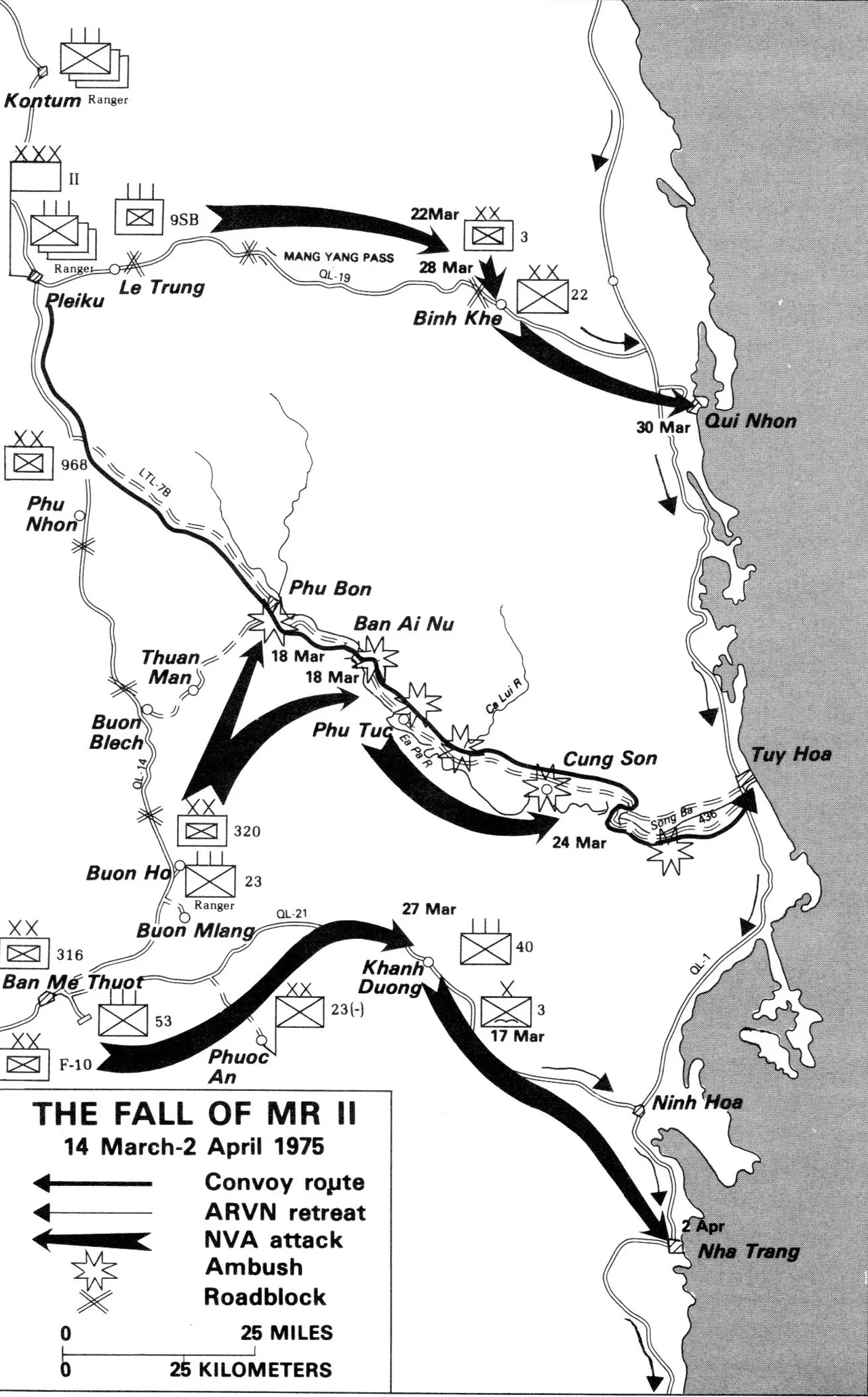
The last offensive opened along Route 19 early on 4 March 1975 and closed the highway from the Mang Yang Pass to the coast. The 2nd Battalion of the 47th Regiment lost four commanders killed in succession inside two weeks and came out under a captain at half strength. On 17 March Brigadier General Phan Đình Niệm accepted that he could not force the An Khê Pass and told his battalions to hold. On 27 March the 41st and 42nd Regiments broke out eastward toward Qui Nhơn, carrying more than four hundred territorial troops lifted by helicopter from An Khê the day before. The 47th was ambushed near Phu Cat and lost half its men; its commander, Colonel Lê Cầu, was captured on the road. What reached Vũng Tàu refitted at the Van Kiep training centre — about 4,600 men, a third of them territorials, with gunners enough for three artillery battalions and not one howitzer to give them. On 12 April the division was ordered to Long An, and its 41st and 42nd Regiments were still fighting on Route 4 around Bến Lức and Tân An when Saigon fell.
From the Air
The article's map point, 13.617°N 107.917°E, falls at Plei Me in Gia Lai, roughly 41 km south-southwest of Pleiku on the western plateau the division defended after December 1970 — in August 1974 its 42nd Regiment was pushed forward to Firebase 711 here against the PAVN 320th Division. The division's own home station lay far to the east at Ba Gi, inland from Qui Nhơn. Fly the two together and you trace II Corps in miniature: 800-1,200 m of rolling red-earth plateau, then the An Khê and Mang Yang passes on Route 19, then the coastal delta. Best viewed at 5,000-8,000 ft AGL; Route 19 and Highway 1 are unmistakable line features. Nearest fields are Pleiku (VVPK) about 41 km north and Phu Cat (VVPC) near Qui Nhơn on the coast. Highland mornings bring valley fog that burns off by mid-morning; the May-October monsoon brings low cloud on the ridgelines.
Nearby Stories
- Plei Djereng Camp 15 km away
- Lake Yeak Laom 26 km away
- Camp Radcliff 41 km away
- Buôn Đôn 51 km away
- Virachey National Park 55 km away
- Chư Yang Sin National Park 56 km away
- Tây Sơn District 76 km away
- Sen Monorom 101 km away