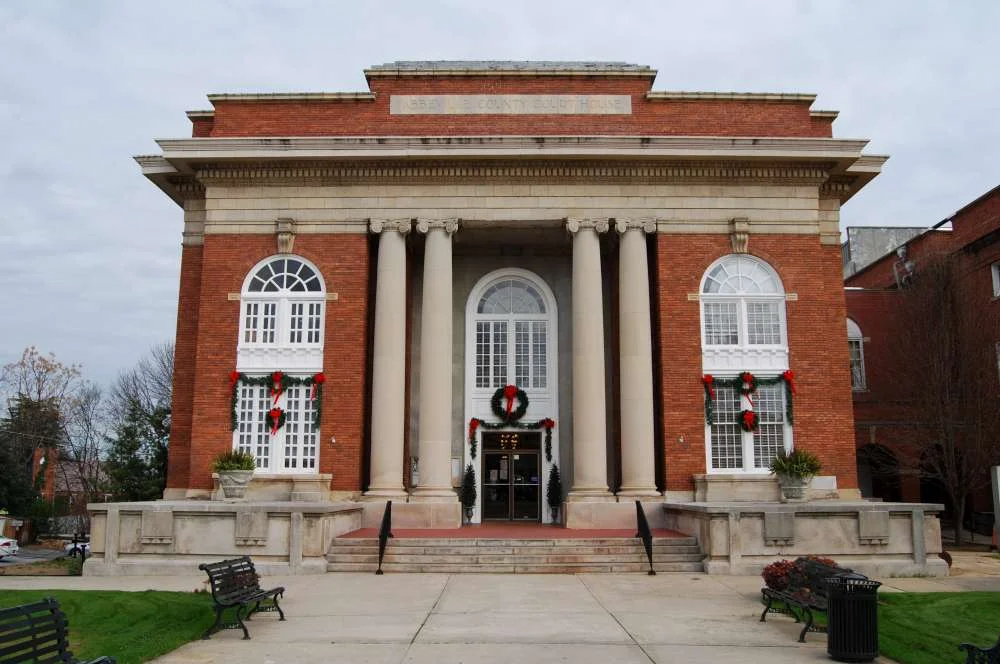

Abbeville County Courthouse
The Abbeville County Courthouse you see today is the sixth one. The fifth was simply replaced after standing for three decades. The fourth burned in 1872. The third, designed by Robert Mills during a residency in town, kept sinking into the South Carolina clay and had to be condemned. The second was torn down after someone discovered the workmen had used kaolin instead of lime in the mortar. The first was a wooden frame pulled down in 1825. To stand on Court Square in Abbeville is to stand on a piece of ground that has been rebuilding itself for two centuries.
A Beaux Arts Survivor
William Augustus Edwards, a Darlington native who eventually designed academic buildings at twelve institutions across Florida, Georgia, and South Carolina, drew the 1908 plans. He worked in the Beaux Arts vocabulary then sweeping American civic architecture: symmetrical mass, classical detailing, a measured monumentality intended to telegraph permanence after the previous courthouse went up in flames. Edwards also designed the adjoining Abbeville Opera House and Municipal Center, and an arcade still connects the two buildings, knitting the east corner of Court Square into a single architectural composition. A 1964 renovation by the Columbia firm Lyles, Bissett, Carlisle, and Wolff modernized the interior. On October 30, 1981, the courthouse joined the National Register of Historic Places as a contributing structure within the Abbeville Historic District.
The Calhoun Portrait
Inside the central hallway hangs a portrait of John C. Calhoun, twice Vice President of the United States and one of the most consequential and divisive senators South Carolina ever sent to Washington. Calhoun was born southwest of Abbeville on his father's plantation, and he practiced law for a short time on this very square. The courthouse stands on land that once housed the firm where the young Calhoun read law. His ideas about nullification and states' rights, hammered out in the years before the Civil War, would echo from this country square all the way to Fort Sumter. The portrait keeps that history physically present: a building that has burned and sunk and been rebuilt, with the architect of secession's intellectual scaffolding watching from the wall.
Court Square Today
Court Square remains the social and visual heart of Abbeville, the kind of intact small-town civic core that Southern preservation movements spend decades trying to save. The courthouse anchors the east corner; the Opera House its neighbor; the Burt-Stark Mansion, where Jefferson Davis convened the last full meeting of his war council in May 1865, sits a few blocks away. Together they make Abbeville a place where the Confederacy arguably began (at Secession Hill, November 1860) and effectively ended (at Burt-Stark, May 1865). The 1908 courthouse, with its quietly assured Beaux Arts facade, presides over that long and uncomfortable history, hosting weekday dockets the way it has for more than a century.
From the Air
Court Square sits at 34.178 N, 82.378 W in west-central South Carolina's Piedmont. Cruise at 2,500 to 3,500 feet for a clean look at the dense brick downtown. Nearest field is KIRO (Abbeville Municipal, 4 nm south); KGRD (Greenwood County) is 18 nm east-southeast, KAND (Anderson Regional) 28 nm north, KGMU (Greenville Downtown) 50 nm north. Visual landmarks include the white dome of the Beaux Arts courthouse, the dark mass of the connected Opera House, and the green Town Square surrounded by brick storefronts.
Nearby Stories
- Battle of Musgrove Mill 17 km away
- Anderson County, South Carolina 20 km away
- Battle of Hammond's Store 26 km away
- Graniteville Train Crash: The Night Invisible Death Came to a Mill Town 42 km away
- Stumphouse Mountain Tunnel 42 km away
- Tree That Owns Itself 46 km away
- Edgefield County, South Carolina 47 km away
- Andalusia 93 km away