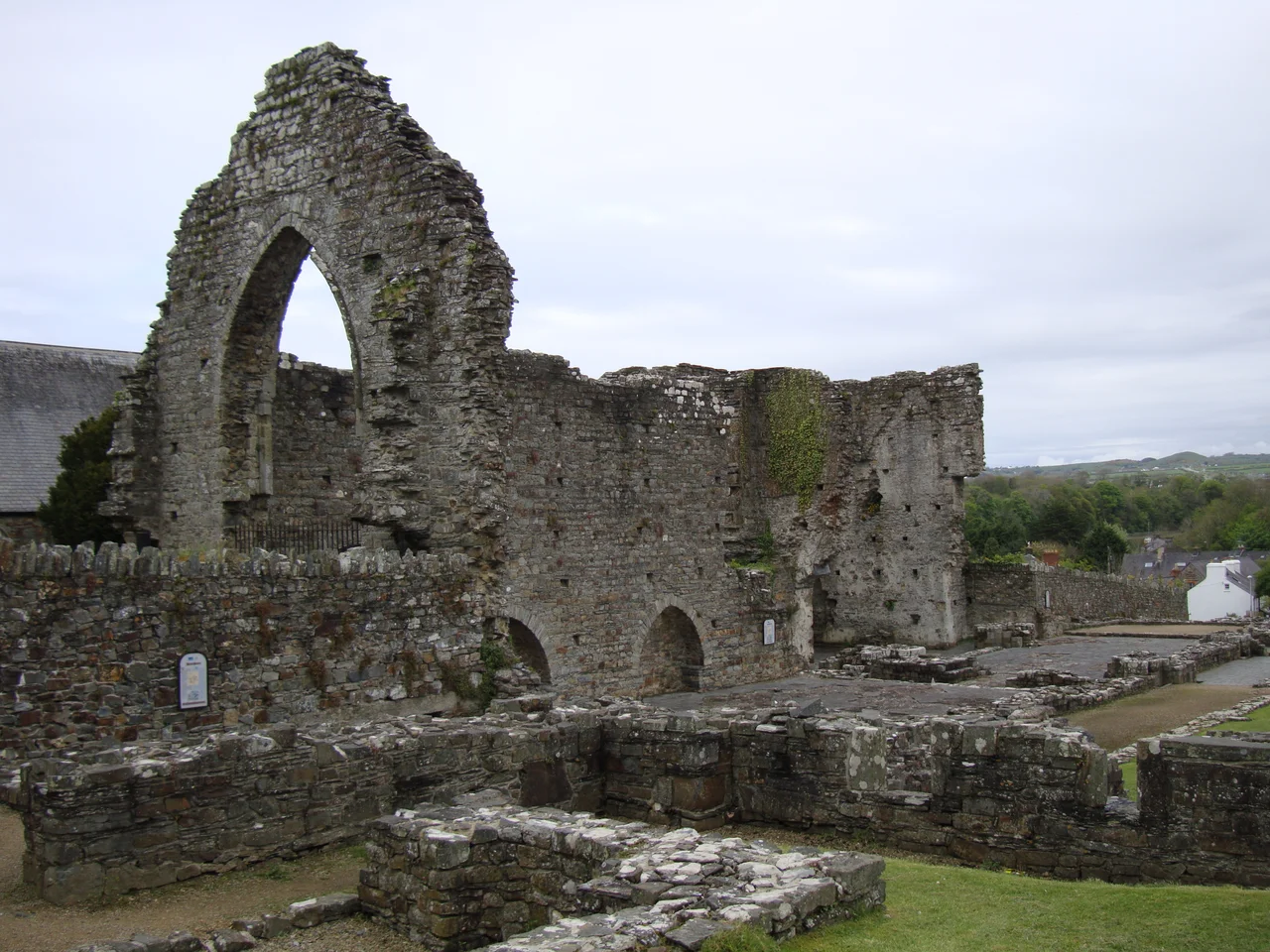

Abbey of St Mary, St Dogmaels
The Sagranus Stone sits in the parish church of St Thomas the Martyr in St Dogmaels, a few yards from the abbey ruins. It is a piece of dressed pillar, about five feet tall, inscribed on one face in Latin and on its edge in another script — a series of cut notches that for a long time nobody could read. In 1848, an Anglican clergyman named John Westwood compared the Latin and the notches, realised that one was a translation of the other, and produced the key that finally unlocked Ogham — the alphabet the early Christian Celts had carved into the edges of standing stones. The key was here, in this village, beside this abbey, on the south bank of the Teifi.
Before the Normans
The site of the abbey was holy ground long before there was an abbey. Welsh tradition places a sixth-century clas — a Celtic monastery — here, founded by Dogmael, said to be the son of Ithel ap Ceredig ap Cunedda Wledig and a cousin of Saint David, the patron saint of Wales. The Sagranus Stone, carved around the year 500 with the bilingual inscription that would later make it famous, was already standing somewhere on the site when Dogmael's monks were chanting their office in their wattle huts. The clas survived the Viking raids, however imperfectly, and remained an active religious community when the Normans arrived in West Wales in the early twelfth century. They built on top of it.
The Tironensian Foundation
The Norman lord Robert FitzMartin of Cemais, with his wife Maud Peverel, founded the present abbey in 1115. He brought thirteen monks of the Order of Tiron from the order's mother house in Normandy. Tiron was a Benedictine reform order, less famous than Cluny or Cîteaux but influential in its own way; St Dogmaels would be one of only three Tironensian houses in Wales and the head of the order in Britain. In 1118 FitzMartin received thirteen more monks and won permission from Pope Calixtus II to upgrade the priory to abbey status. The formal elevation took place on 10 September 1121, with Bishop Bernard of St David's installing one Fulchard as the first abbot. Twenty years later, in 1138, the village and abbey were sacked by the sons of the great Welsh prince Gruffudd ap Cynan — Owain Gwynedd and Cadwaladr, with Danish mercenaries — in the long Welsh resistance to the Norman conquest of Ceredigion. The monks rebuilt.
Four Centuries of Stone
The abbey grew slowly and was rebuilt in stages. The earliest surviving fabric dates from the first half of the twelfth century — parts of the nave, the choir, and the square-ended sanctuary built over a vaulted crypt that may have held relics of St Dogmael himself. The thirteenth century finished the nave, enlarged the cloister, and rebuilt the cloister arcades in stone. The fourteenth century added a new infirmary and chapter house. The crowning addition came in the early sixteenth century, just before the Dissolution: the north transept was rebuilt with an elaborate fan-vaulted roof, the kind of late-Perpendicular ceiling that was a Tudor speciality. The lavishness suggests it was meant as a memorial chapel for the FitzMartins, the lords of Cemais, whose ancestor had founded the place. They did not have long to enjoy it.
Dissolved, Lived In, Forgotten
St Dogmaels was dissolved on 6 February 1536 under Henry VIII's first act of suppression, which closed houses with annual income under £200. By that point there were only eight monks and an abbot left. The abbey's properties were leased to John Bradshaw of Presteigne, who built a mansion inside the abbey precinct — recycling the cut stone, the way most Tudor-era new builds did — and lived there with his descendants for over a century. After Bradshaw's death the estate passed through a long succession of heirs and resales, and the abbey gradually became a ruin used as a quarry by the surrounding village. Only in 1934, when the Representative Body of the Church in Wales gave the site into the care of the Commission of Works, did serious preservation begin. Excavation followed in 1947. A visitor centre opened in the former Coach House in June 2008. The abbey today is in the care of Cadw, the Welsh heritage agency, and is Grade I listed.
What the Stones Still Hold
Substantial parts of the abbey remain: the west wall, the north wall, the north transept with its surviving fan vault, and the east walls of the crypt. Monastic buildings survive to the south, and the detached thirteenth-century infirmary stands a short walk further. Fragments of carved Romanesque stonework have been gathered in the infirmary; incised early-medieval stones from the parish church have been collected against the south wall. The whole site sits in a green dish of land sloping down to the Teifi estuary, with Poppit Sands at the rivermouth and Cardigan town a mile across the water. Walk through the nave at evening, when the light comes in low through the empty window arches, and the layered history reads itself: the sixth-century saint, the Norman lord and his Tironensian monks, the Tudor renovators, the modern conservators — and somewhere underfoot, the Ogham stone that opened up the language of the people who started it all.
From the Air
Coordinates 52.080°N, 4.681°W mark the abbey ruins at St Dogmaels, on the south bank of the River Teifi opposite Cardigan town. Best viewed from 1,000-2,000 ft AGL along the Teifi estuary; the abbey footprint is clearly legible from above and Poppit Sands at the river mouth provides a navigation reference 1 nm west. Nearest airport: Haverfordwest (EGFE) approximately 20 nm south; Welshpool (EGCW) approximately 70 nm east. The town of Cardigan (Aberteifi) sits immediately across the river.
Nearby Stories
- HMS H47 4.6 km away
- National Botanic Garden of Wales 5 km away
- Narberth 6.3 km away
- Aberystwyth Lifeboat Station 9.3 km away
- Skomer 13 km away
- Diamond (1823 ship) 21 km away
- Talley Abbey 22 km away
- HMS Tyler 32 km away