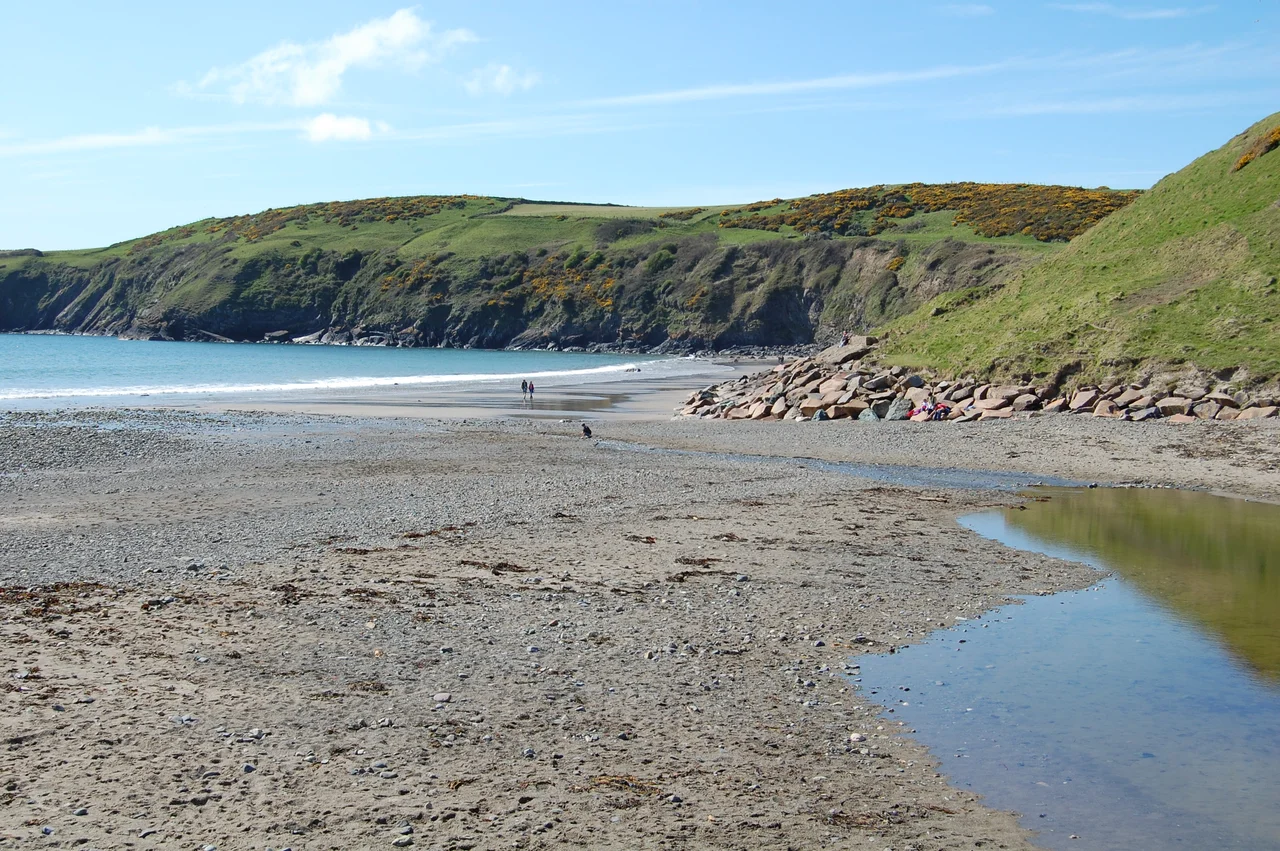

Aberdaron
Before Bardsey, you came to Aberdaron. The road across the Llyn Peninsula in the Middle Ages did not really end here - it ended at the water, two miles further on, where boats took pilgrims across the dangerous current of the sound to the holy island of Ynys Enlli. But Aberdaron was the last village. The last bed. The last meal cooked at Y Gegin Fawr, the Great Kitchen built beside the parish church to feed pilgrims who sometimes had to wait weeks for a sea calm enough to cross. Three visits to Bardsey, the medieval church reckoned, equalled one to Rome. Whether or not you crossed, this is where you sat and waited for God to grant you weather.
The River and the Bay
Aberdaron means mouth of the Daron - and Daron, in old Welsh, was a Celtic goddess of oak trees. Dar is the archaic Welsh word for oak. The river slips down through a narrow valley at the western tip of the Llyn Peninsula and meets the sea at Aberdaron Bay, between two headlands and a pair of small islands called Ynysoedd Gwylanod - the gull islands. The village curls along the shore in stone-built terraces, a beach of fine sand spreading in front of them. Behind, the hills run east in a hog-back ridge of igneous rock that rises to nearly 1,000 feet at Mynydd Rhiw. The Llyn is a peninsula of marine-eroded platforms with a complex Precambrian geology - the same ancient rocks that make up parts of Anglesey to the north - and the coast around the village is littered with the kind of shipwrecks this exposed corner of the Irish Sea has always produced. A great storm on 26 October 1859 - the Royal Charter Storm - wrecked nine ships at nearby Porthor, seven of them with complete loss of life.
Sanctuary
The parish church of St Hywyn stands right on the beach, almost in the surf. It had the ancient privilege of sanctuary - meaning that fugitives who reached it could not be touched. In 1094, Gruffudd ap Cynan, the exiled king of Gwynedd, sought refuge here while trying to win back his throne; he escaped to Ireland in the monastic community's boat. Catholicism held on here longer than in most of Wales after the Reformation, the western tip of the peninsula being remote enough that the Protestant authorities did not reach easily. In 1657, Gwen Griffiths of nearby Y Rhiw was summoned to the Quarter Sessions as a papist - the persecution by the Cromwellian regime extending all the way out to the edge. The Catholic recusants of the Llyn were stubborn. The peninsula was far enough away from London that you could be stubborn here for a long time.
The Mining Years
Aberdaron was a working village before it was a holiday one. Sheep have been raised on the Llyn for more than a thousand years; the field boundaries you can still see, marked with cloddiau and hedgerows, are centuries old. There were fulling mills on the Daron, three corn mills, shipbuilding at Porth Neigwl and Porthor, and after 1827 a substantial manganese mining industry at Y Rhiw to the east, where the First World War brought sudden demand for ore as a steel-strengthening agent. Limestone, lead and granite came out of small quarries. Most of it stopped by the mid-twentieth century - manganese mining ended after the war - and the village shifted slowly to tourism. The first published guide to Aberdaron appeared in 1910, extolling 'the salubrious sea and mountain breezes.' That has been the pitch ever since.
R.S. Thomas
From 1967 to 1978, the vicar of St Hywyn's was Ronald Stuart Thomas - one of the great Welsh poets of the twentieth century, an ardent Welsh nationalist who had learned the language as an adult, nominated for the Nobel Prize in Literature in 1996. His poetry was severe, religious, rooted in landscape and the difficult relationship between God and the Welsh hill country. He chose Aberdaron for the end of his ministry - the most remote and beautiful parish in his diocese - and after retirement he stayed in the area, living for some years in Y Rhiw. A festival devoted to his work and to that of his wife, the artist Mildred Eldridge, takes place in the village every June. Another local figure of the literary tradition is older and stranger - Richard Robert Jones, born in Aberdaron in 1780 and known as Dic Aberdaron, who despite almost no formal education was reputed to speak fourteen languages, and travelled the country with his books and his cat. He became the subject of one of Thomas's own poems. The village is small. Its poets keep finding each other across the centuries.
From the Air
Aberdaron is at 52.81 degrees north, 4.71 degrees west, at the very western tip of the Llyn Peninsula in Gwynedd. From the air it appears as a small cluster of slate-roofed buildings around a curve of sandy beach, with the gull islands (Ynysoedd Gwylanod) sitting just offshore. Bardsey Island lies 2 miles to the south-southwest. The peninsula's hog-back ridge runs east from the village, culminating at Mynydd Rhiw (997 ft) about 4 miles away. Nearest airports: Caernarfon (EGCK) 30 nm northeast, Valley (EGOV) on Anglesey 30 nm north-northeast, and Hawarden (EGNR) 80 nm east. Cruise altitude 2,500 to 4,000 feet AGL on a clear day offers spectacular views of the entire Llyn coast, Bardsey Sound and the islands. Note Bardsey Sound currents are fierce and the seas often rough - in light aircraft, give the headland clearance for turbulence.
Nearby Stories
- HMS H5 3.2 km away
- Llanberis 7.2 km away
- Aberdyfi 12 km away
- Portmeirion 13 km away
- Diamond (1823 ship) 15 km away
- HMS Tyler 19 km away
- German Submarine U-1302 28 km away
- Greystones 54 km away