
Absecon Lighthouse
The Absecon Lighthouse was designed by Major George G. Meade in 1854. Nine years later, the same Meade would command the Union Army of the Potomac at Gettysburg and stop Robert E. Lee's invasion of Pennsylvania. Before he was a Civil War general, Meade was an engineer in the United States Army Corps of Engineers, building lighthouses up and down the East Coast. The Absecon light was one of his late-career commissions, and it is one of his most enduring. The brick tower stands 171 feet high - the tallest lighthouse in New Jersey, the third-tallest masonry lighthouse in the entire United States, and the only place from which a visitor today can see what George Meade was thinking about before the war that made him famous.
Why It Was Built
Absecon Inlet, where the lighthouse stands, was one of the most dangerous stretches of shoreline on the Atlantic seaboard in the early nineteenth century. The shoals shifted constantly. Sailing ships running south past New York for Philadelphia or Baltimore frequently misjudged the New Jersey coast in fog or storms and ran aground. The casualties accumulated: dozens of wrecks, hundreds of deaths, an entire stretch of beach known to coastal mariners as the Graveyard of the Atlantic. By the early 1850s, Congress had heard enough. Construction on the Absecon light began in 1854. Three years later, on January 15, 1857, the light was lit for the first time. From that night forward, the wreck rate along the inlet dropped sharply. The lighthouse had saved its first ship before anyone knew it.
The Fresnel Lens
Inside the watch room at the top of the tower sits the original first-order Fresnel lens - the largest size of Fresnel lens manufactured. It weighs 12,800 pounds. It is made of lead glass cut into thousands of precisely-angled prisms that bend and concentrate the light from a single source into a powerful beam visible for nineteen nautical miles. Augustin-Jean Fresnel, the French physicist who invented the design in 1822, made the entire modern lighthouse possible. The Absecon lens is a fixed lens, not a flashing one - meaning the light burned steady rather than rotating. As a result, the lens has no landward segment, and visitors today can stand directly underneath it and look up into the prism structure where the keepers once climbed to clean the glass and trim the wicks. Most Fresnel lenses this size have been replaced by smaller modern beacons. The Absecon lens is one of the few still in its original location.
George Meade's Tower
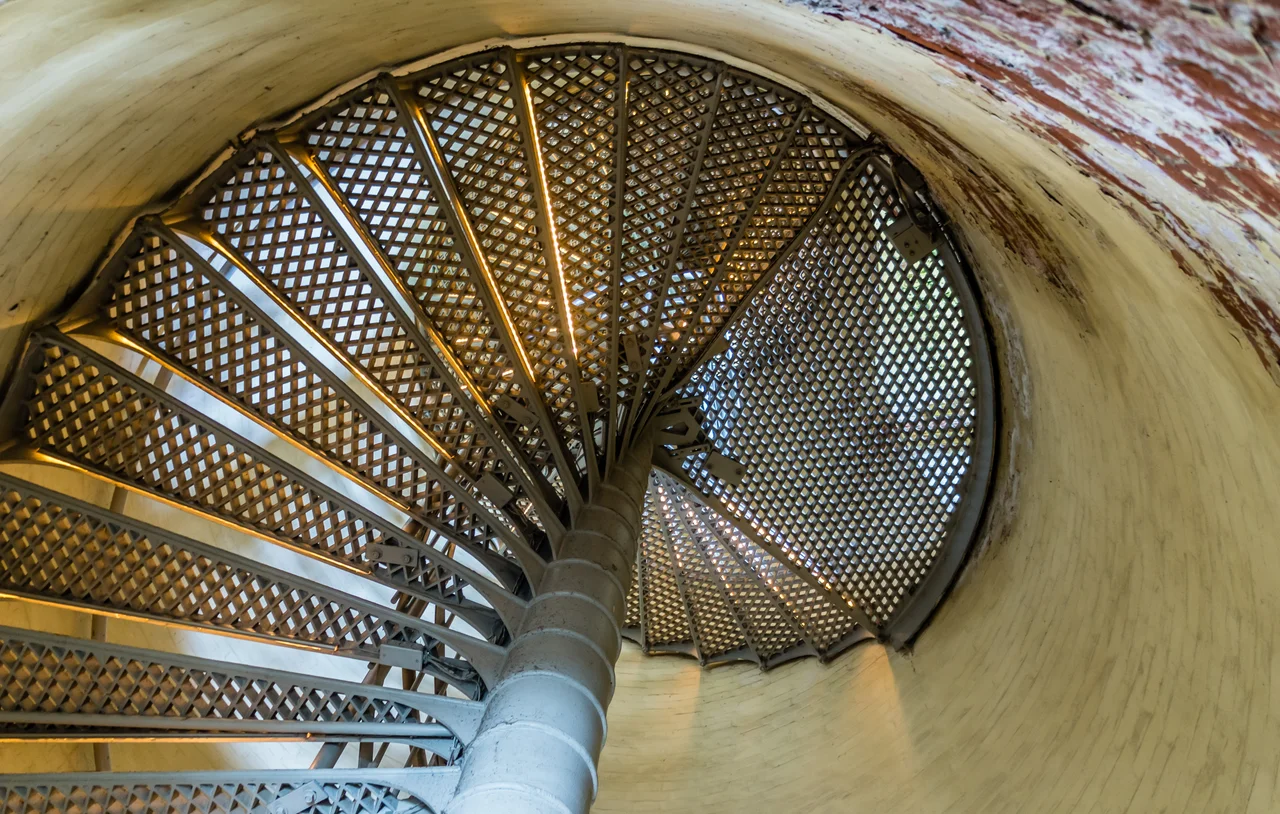
George Gordon Meade joined the Corps of Topographical Engineers in 1842 and spent the next two decades working on coastal infrastructure - jetties, sea walls, lighthouses. He designed Barnegat Light to the north and Absecon Light to the south, and the structural similarities between the two are visible to anyone who climbs both. The Absecon tower is a tapering brick cone, built with a double-wall construction that allowed it to flex slightly in high winds without cracking. The spiral staircase inside has 228 steps. The keeper's quarters originally stood at the base; the current keeper's house is a 2002 reconstruction. Meade left the Engineering Corps when the Civil War began in 1861. He commanded the Army of the Potomac for the last two years of the war. He died in 1872. His towers outlasted him.
Decommissioned, Then Saved
By 1933 the lighthouse was deactivated. The growth of Atlantic City and the proliferation of automated coastal navigation aids had made the Absecon Light redundant. The tower sat dark for several decades, weathered, vandalized, and threatened with demolition. In 1964, the photographer Jack E. Boucher - then working for the Historic American Buildings Survey - mounted a preservation campaign. Boucher had documented hundreds of historic buildings for the federal survey program, and he understood what was about to be lost. His advocacy led to the lighthouse being preserved, restored, and eventually opened to the public. The light shines every night now - relit ceremonially though no longer an official aid to navigation - and the building is listed on the National Register of Historic Places, the Historic American Buildings Survey, and the New Jersey Register of Historic Places.
228 Steps
The lighthouse is open to the public. For a small donation, visitors climb the 228 steps from the base to the watch room and walk out onto the exterior gallery that rings the lantern. The view from the top is one of the broadest in New Jersey: the Atlantic Ocean to the east, the marshes of Absecon Bay to the west, the boardwalk and casino towers of Atlantic City stretching south, and the long sand strip of Brigantine extending north across the inlet. The original oil house at the base, which once stored the whale oil and later the kerosene that fueled the light, now houses a Fresnel lens exhibit. The 2002 keeper's house reconstruction holds a small museum of shipwrecks, lighthouse keepers' lives, and the building's own history. Overnight programs run for Scout groups. The view from the gallery has not changed essentially since George Meade approved the final drawings in 1856.
From the Air
The Absecon Lighthouse stands at 39.37 degrees north, 74.41 degrees west, at the north end of Atlantic City on the south shore of Absecon Inlet. From cruising altitude, look for the distinctive tall lighthouse rising from the urban grid at the north end of the Atlantic City boardwalk. Atlantic City International (KACY) lies about 6 nautical miles northwest. The 171-foot brick tower is visible from the air on clear days against the boardwalk and the casino skyline. The inlet to the north separates Atlantic City from Brigantine; the lighthouse marks the south side of that inlet.
Nearby Stories
- Cape May 8.1 km away
- A. J. Meerwald 14 km away
- The Pine Barrens: Home of America's Oldest Monster 25 km away
- Hereford Inlet Lighthouse 38 km away
- Constitutional Convention (United States) 50 km away
- PS General Slocum 143 km away
- Wardenclyffe Tower 201 km away
- USS Atik 493 km away