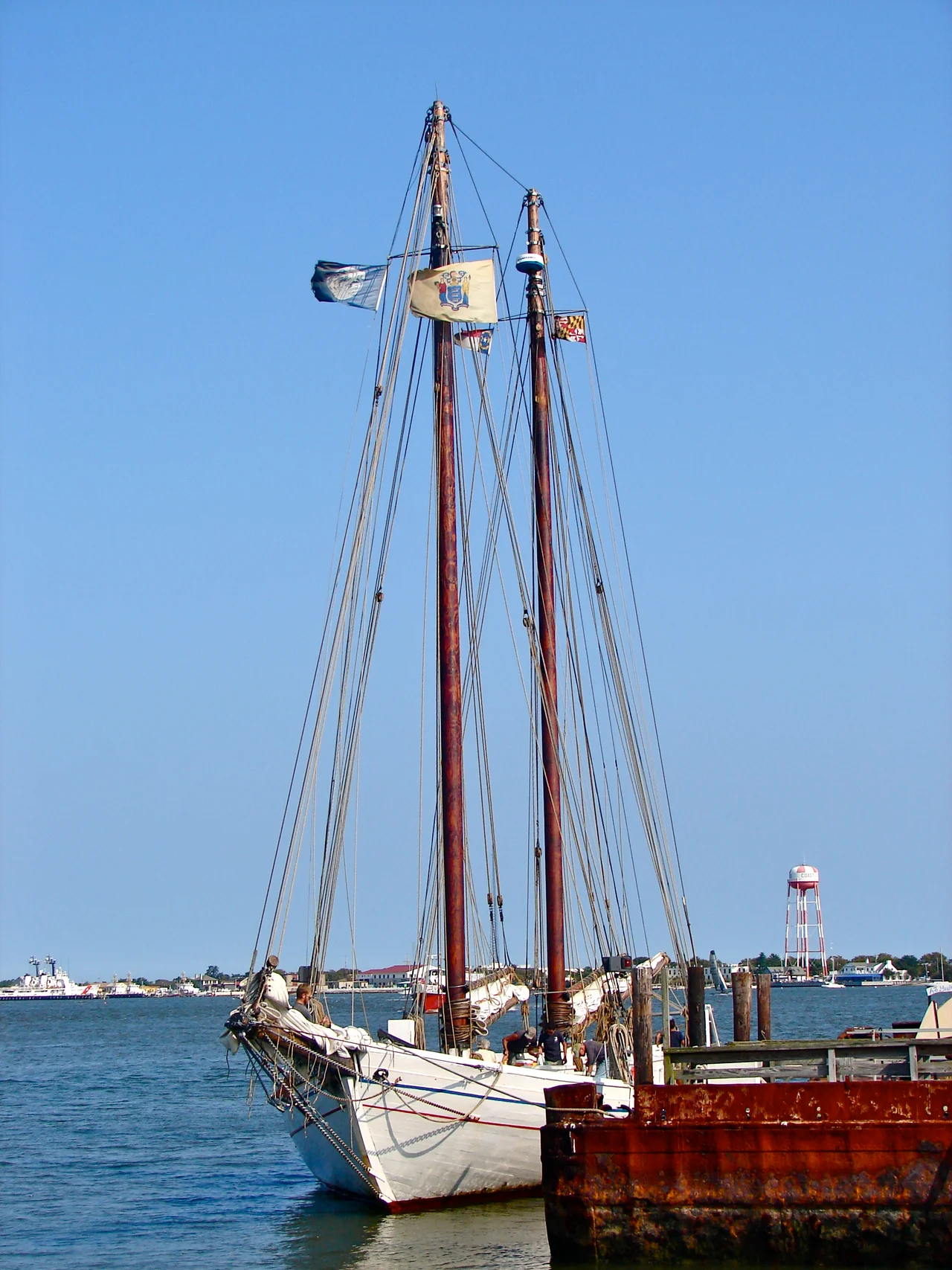

A. J. Meerwald
The schooner was built on September 7, 1928 - a workboat, plain and pragmatic, ordered from Charles H. Stowman & Sons at the small shipyard in Dorchester, New Jersey, by a Delaware Bay oysterman named A.J. Meerwald. She was a tool. Her job was to spend her days bouncing across the chop of Delaware Bay, hauling iron dredges across underwater oyster beds, and her nights tied up in Bivalve, New Jersey - a hamlet whose name says it all. What no one in Dorchester could have known on launch day was that her career would carry her through three Americas: the late-Prohibition oyster fleet, the post-Prohibition decline, and a third act as a school ship and the state symbol of New Jersey.
The Oyster Capital
By the time the Meerwald slid down the ways, the Delaware Bay oyster industry was already past its peak but still enormous. The little settlement called Bivalve - on Maurice River Cove in Cumberland County - had once been the busiest oyster port in the world. Hundreds of similar schooners worked the bay, and the catch moved by rail directly to Philadelphia, New York, and Boston markets. The bay's oysters were prized for their salinity and size. The work was brutal: long hours under sail, heavy dredges hauled by hand or steam winch, decks slick with mud and shell, and the constant exposure of life on the open bay. The Meerwald was built for exactly that - a sturdy gaff-rigged schooner around eighty-five feet long on deck, with enough deck space to handle the gear and enough hold to bring home the catch.
Prohibition Cargo
In 1928 Prohibition still had five years to run, and any sailing vessel that knew the bay's deep channels and shallow marsh creeks was potentially useful for something other than oysters. The Meerwald has long carried a local legend that she ran liquor during Prohibition - taking on cases of Canadian whiskey from offshore rum ships and delivering them to discreet landings in the marshes. The story is plausible. The bay's bayshore communities had a long tradition of polite indifference to maritime customs law. Whether the schooner herself smuggled or whether the stories grew up around her later is now hard to know. The bay is studded with stories like these, and the people who would have known the truth are gone.
Clyde A. Phillips
Over the decades, the schooner changed hands and changed names. She was rerigged. She was rebuilt. By the postwar period, the Delaware Bay oyster industry was collapsing under the pressure of overfishing and a series of devastating parasites - first MSX in 1957, then Dermo - that wiped out most of the bay's mature oyster populations. The schooner that had once been the Meerwald was now the Clyde A. Phillips, working steadily through a vanishing fishery. By the 1980s she was tied up and slowly rotting in a back creek. The shipworms were at her. The fastenings were rusting through. Without intervention she would have followed the rest of the bay's oyster schooners into the mud.
Rebuilt to Sail
In the late 1980s a community in Bivalve formed around the idea of saving her. The Delaware Bay Schooner Project rebuilt the schooner over years - hull, deck, rig, interior - and relaunched her under her original name. She was added to the National Register of Historic Places on November 7, 1995, for her significance in architecture, commerce, and maritime history. In 1998 the New Jersey legislature designated her the official state tall ship. The choice was deliberate. New Jersey could have picked something flashier, a multi-masted square-rigger, an Atlantic clipper, anything more dramatic. They picked a working oyster schooner from a bayshore town few outside the area had ever heard of. The choice honored the dredgers themselves - the people who actually did the work that built South Jersey.
A Floating Classroom
Today the A.J. Meerwald is the flagship of the Bayshore Center at Bivalve. She sails out of her home port for the entire warm season and visits ports throughout the Delaware Bay region - New Jersey, Pennsylvania, Delaware. School groups come aboard for half-day sails that mix sailing instruction with hands-on marine biology and history lessons. Students haul on lines, set sail, and pull nets through the bay water to see what comes up. Adults come aboard for evening sails and educational cruises. The schooner that was once a tool for taking oysters out of the bay now teaches children why those oysters mattered, what happened to them, and what the bay is trying to recover. A working museum that still goes to work, every season, the way her builders intended.
From the Air
The A.J. Meerwald is based at the Bayshore Center at Bivalve, on Maurice River Cove on the New Jersey side of Delaware Bay, at approximately 39.23 degrees north, 75.03 degrees west. From cruising altitude, look for the irregular salt marshes and tidal creeks of the Cumberland County bayshore - a flat, water-laced landscape between the Maurice River mouth and the Cohansey. Millville Municipal Airport (KMIV) lies about fifteen nautical miles north. Atlantic City International (KACY) is about thirty-five nautical miles northeast. When sailing, the schooner can be found anywhere within the Delaware Bay or in nearby ports along the New Jersey and Delaware coasts.
Nearby Stories
- Longport, New Jersey 2.8 km away
- Battle of the Delaware Capes 9.9 km away
- The Pine Barrens: Home of America's Oldest Monster 22 km away
- Adkins Arboretum 31 km away
- The Brandywine Valley: Where Three Generations Painted America 36 km away
- Baldwin Locomotive Works: The Engine That Built America 41 km away
- USS General G. W. Goethals 66 km away
- Battle of North Point 74 km away