
Battle of North Point
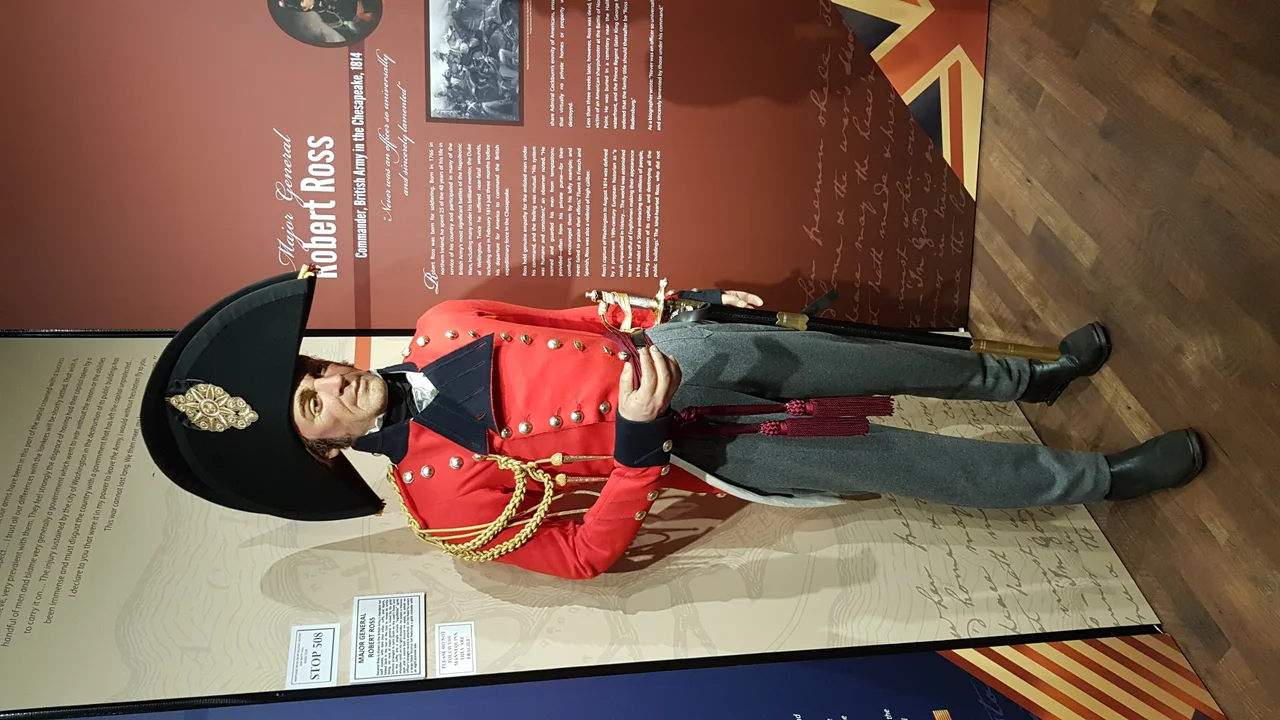
Three weeks after he had burned the White House and the Capitol, Major General Robert Ross was dead. He was killed by a Maryland militia rifleman somewhere on the wooded peninsula between the Patapsco and Back Rivers on the morning of September 12, 1814, near the small road his army was marching up toward Baltimore. The men who fired the shot may have been Daniel Wells and Henry McComas, two teenage privates from a Baltimore militia company, who were themselves killed in the same opening skirmish. The Americans were eventually driven from the field. They retreated in good order back toward the main defenses on Hampstead Hill. But they had killed Ross, demoralized his veterans of Wellington's Peninsular Army, and delayed the British advance by a critical day. The Battle of North Point did not, on its face, look like an American victory. Without it, the British would have taken Baltimore.
After Washington
Ross had been sent to the Chesapeake early in 1814 with a brigade of veterans pulled from the Duke of Wellington's army in Europe, reinforced by a battalion of Royal Marines. His mission was to harass the American coast and pressure the U.S. government in any way that might force it to the negotiating table. On August 24, he routed a hastily assembled American force at Bladensburg, then marched on Washington and burned the public buildings - the Capitol, the White House, the Treasury, the State, War, and Navy Departments. President James Madison and his cabinet fled. Dolley Madison rescued the famous Stuart portrait of George Washington from the White House the day before the British arrived. Having symbolically humiliated the American government, Ross's force withdrew to the Royal Navy ships at the mouth of the Patuxent and sailed further up the Chesapeake toward Baltimore - a port whose privateers had been a constant maritime nuisance to British shipping.
Smith's Defenses
Major General Samuel Smith of the Maryland militia, who had been preparing Baltimore's defenses for months, anticipated the British landing. He dispatched Brigadier General John Stricker with five regiments of militia, a small cavalry contingent, three rifle companies, and a six-gun battery of 4-pounders. Stricker deployed his men halfway between Hampstead Hill, just east of Baltimore where Smith had built earthworks and artillery emplacements, and North Point at the end of the peninsula. At Stricker's chosen position, tidal creeks pinched the peninsula to about a mile wide. It was, by the standards of land that anyone might have to defend, almost ideal ground. The British landed about 3,700 troops and 1,000 marines at North Point on the morning of September 12 and began marching northwest toward the city.
The Skirmish That Killed Ross
Around midday Stricker learned that the British had halted for a meal. Some sailors attached to the column were plundering nearby farms. He decided to provoke a fight rather than wait for a possible British night attack. At 1 p.m. he sent Major Richard Heath with 250 men and one cannon to draw the British forward. The skirmish that followed was small and bloody. Somewhere in the woods, Wells and McComas - both teenagers from the 5th Maryland - fired at a British officer riding ahead of his column. The officer was Ross. He fell from his horse, mortally wounded, and died on the road before reaching his ship. Wells and McComas were killed in the next exchange of fire. Their bodies were carried back to Baltimore. They are now buried beneath the monument at Aisquith and Monument Streets that honors them. Ross's body was carried to Halifax; a separate marker at North Point commemorates the site where he fell. Colonel Arthur Brooke took command of the British force.
The Main Engagement
Brooke reorganized the column and assaulted Stricker's main line at 3 p.m. The fighting lasted about an hour. The British had superior numbers and superior discipline; the Americans had earthworks, terrain, and one cannon they refused to lose. Casualties were heavy on both sides. The official British Army report listed 39 killed and 251 wounded, though subsequent accounting put the actual losses higher - at least 43 killed and possibly 46, with 279 to 295 wounded depending on which casualty return is trusted. American losses were 24 killed, 139 wounded, and 50 taken prisoner. Corporal John McHenry of the 5th Regiment wrote afterward that his unit was the last to leave the ground and that, had they retreated even a moment later, they would have been cut off in two minutes. Stricker withdrew in good order back toward Hampstead Hill, bringing his guns with him. Brooke, having lost Ross and a significant portion of his vanguard, decided to camp for the night.
Defenders Day
The delay was decisive. By the next morning, September 13, Stricker's withdrawn force had reinforced the main defenses on Hampstead Hill. The British saw the earthworks, the artillery, and the American formations behind them, and decided not to attack. Brooke turned to look at Fort McHenry, which guarded the harbor entrance, and waited for the Royal Navy to do its work. The bombardment that followed - twenty-five hours of mortar and rocket fire against the fort - failed to reduce it. Francis Scott Key, watching from a British truce ship, wrote the verses that would become the national anthem. The British re-embarked at North Point on September 14 and sailed away. Baltimore was saved. Maryland's state holiday of Defenders Day on September 12 commemorates the battle. The 175th Infantry Regiment of the Maryland Army National Guard carries the lineage of the 5th Maryland Regiment - the unit that lost the most men at North Point and held the line longest. Wells and McComas, the teenage riflemen, are still honored in Baltimore as the boys who killed the British general.
From the Air
The Battle of North Point was fought on the peninsula between the Patapsco River and the Back River in what is now Dundalk, Maryland, at approximately 39.1982 N, 76.4415 W. The battlefield core is about 7 miles southeast of downtown Baltimore. North Point State Park and the Aquila Randall monument mark the site. The area lies just outside the FAA's Class B around BWI Marshall (KBWI), which is 12 miles southwest. Martin State Airport (KMTN) is 4 miles north. From altitude, the peninsula and the narrow tidal creeks that funneled both armies are still visible in the present-day road and shoreline patterns.
Nearby Stories
- Fort Greble 3 km away
- Murders of Katherine and Sheila Lyon 9.9 km away
- Adkins Arboretum 18 km away
- Columbia Air Center 24 km away
- Punkin Chunkin 38 km away
- Fort Delaware: The Island Prison Where 33,000 Confederates Waited Out the War 39 km away
- Camp David: Where Presidents Escape and History Gets Made 51 km away
- Battle of Gettysburg 81 km away