
Adkins Arboretum
Most arboreta show off the world. Adkins shows off the Delmarva Peninsula. The 400 acres tucked into Tuckahoe State Park near Ridgely, Maryland, started in the 1970s with the ambitious mission of displaying every Maryland forest type - oak-hickory, pine-mixed hardwood, bottomland swamp, the whole catalog of the state's wooded ecosystems. By the 1990s, the mission had narrowed and deepened. The arboretum decided that instead of trying to represent all of Maryland, it would represent the Delmarva specifically - the peninsula's indigenous plant communities, the species that grew here before European agriculture remade the landscape. The new mission was smaller, and far more useful.
Five Miles of Paths
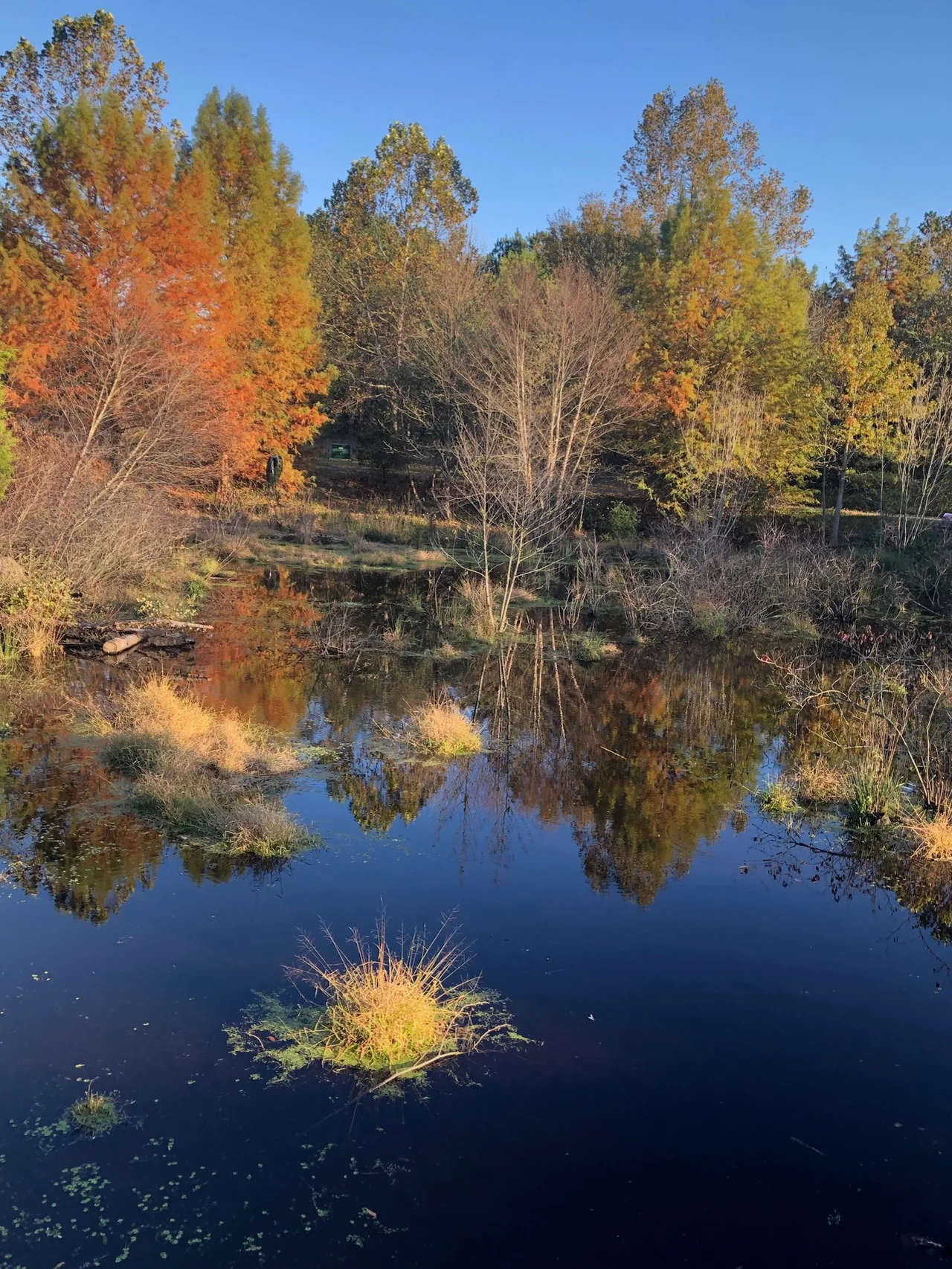
The arboretum's grounds contain five miles of looping paths through meadows, woodlands, and native plant gardens. The trails wind through habitats ranging from upland forest to wet meadow to floodplain. The Tuckahoe Creek, which runs through the larger state park, defines the western edge of the arboretum and gives the place its hydrology - a slow Eastern Shore tidal river that drains the surrounding farmland into the Choptank and ultimately the Chesapeake. Springwood Pond, a small constructed wetland near the visitor center, draws wood ducks, herons, and the occasional river otter. The longer trails through the upland forest pass groves of beech, tulip poplar, and sweetgum. The shorter loops along the meadow edges open onto wildflower fields planted in native species - butterfly weed, bee balm, switchgrass, and the goldenrod that turns the autumn fields the color of late afternoon sun. The paths are gentle. The discoveries are subtle. A visitor learning to recognize Joe-Pye weed by its tall lavender clusters is the kind of small revelation the place specializes in.
The Public-Private Partnership
In 1998, the State of Maryland converted the arboretum's operations to a public-private partnership. The state granted a 50-year lease to the nonprofit Friends of Adkins Arboretum, which now runs the place day-to-day under the broader umbrella of Tuckahoe State Park. The arrangement allows the arboretum to fundraise independently, hire its own naturalists and educators, and build the kind of donor base that pure state parks rarely develop. The arboretum is supported by grants, individual donations, and a membership program. The state retains ownership of the land but lets the friends group steer the educational mission. The model has worked. The arboretum runs an active program of public lectures, school field trips, native-plant workshops, and seasonal events tied to the migrations and bloom cycles of the peninsula. The 50-year lease comes up for renewal in 2048. By the schedule of native ecology - oak trees take centuries to mature - that is the day after tomorrow.
Why Native Plants Matter
The shift from displaying all Maryland forest types to focusing on Delmarva native species reflected a larger change in conservation science during the 1990s. Native plants evolved alongside the insects, birds, and mammals of the region. They support pollinator populations that imported ornamentals cannot. Doug Tallamy's research at the University of Delaware - documenting that native oaks support over 500 species of caterpillars, while imported ornamental trees support a handful - reshaped how botanical gardens thought about their educational mission. Adkins was an early adopter of the native-plant message. The arboretum runs a native plant nursery, sells seeds and starts to home gardeners, and operates a certification program for native-plant landscapes. Walking the paths in summer, the dense insect life is visible - bees on the bee balm, monarchs on the milkweed, dragonflies over the wetland. The arboretum demonstrates by example what a properly assembled Delmarva ecosystem looks like, and it works.
Tuckahoe State Park and Caroline County
Adkins Arboretum sits inside Tuckahoe State Park, the larger Maryland state park that covers about 4,000 acres along the Tuckahoe Creek in Caroline and Queen Anne's counties. The state park has the campgrounds, the boat ramps for canoes and kayaks, the hiking trails that extend beyond the arboretum boundaries. Caroline County, where Adkins sits, is one of Maryland's most rural counties - more cropland than the Eastern Shore average, more low-density villages, a county population under 35,000. The county was the only Maryland county without a navigable connection to the Chesapeake Bay; everything had to be hauled overland to the bigger river ports of Cambridge or Easton. The agricultural pattern that resulted - tobacco then mixed farming then poultry - shaped the surrounding landscape. Adkins represents what was here before that pattern took hold. A visitor walking the trails sees the future as much as the past: what the lower Eastern Shore could look like if its agricultural margins were restored to native plants and habitat.
The Quiet Education
Adkins is not a destination arboretum. It does not have the size of Longwood Gardens in Pennsylvania or the global fame of the New York Botanical Garden. What it has is a focused mission, a generous landscape, and a stewardship model that has held together for almost three decades. The arboretum draws about 50,000 visitors a year - enough to support the educational programs and not so many that the trails feel crowded. Most of the visitors come from within a hundred miles - the Baltimore-Washington corridor, the Eastern Shore, the Delaware beaches. School buses arrive on weekday mornings during the academic year. The summer programs serve children with day camps focused on native plants and animals. The fall is the busiest season for visitor traffic, when the meadows turn gold and the leaves on the oaks blaze. The winter is the quietest. The arboretum stays open year-round, and the same paths that bustle with summer butterflies offer their own kind of education in February - the architecture of the leafless trees, the rust-colored remains of the meadow grasses, the patient calm of a landscape doing what it has done since long before the first European stepped onto Delmarva.
From the Air
Adkins Arboretum sits at 38.95 degrees north, 75.93 degrees west, in Caroline County on the Eastern Shore. The closest airports are Easton/Newnam Field (KESN) about 14 nautical miles southwest and Sussex County (KGED) 24 east. From the air the arboretum shows as a 400-acre patch of mixed woodland and meadow inside the larger Tuckahoe State Park footprint, with the Tuckahoe Creek meandering west. The surrounding agricultural patchwork of cornfields and chicken houses provides clear contrast against the wooded park boundary. Pattern altitude of 1,500 feet AGL gives a good view of the trail system. Watch for migratory waterfowl in the fall along the Tuckahoe Creek corridor.
Nearby Stories
- Delaware Bay 16 km away
- A. J. Meerwald 18 km away
- Annapolis Convention (1786) 18 km away
- Francis Scott Key Bridge Collapse 21 km away
- Bethany Beach 21 km away
- Bombay Hook National Wildlife Refuge 26 km away
- Wicomico County, Maryland 35 km away
- St. Mary's City, Maryland 55 km away