
Delaware Bay
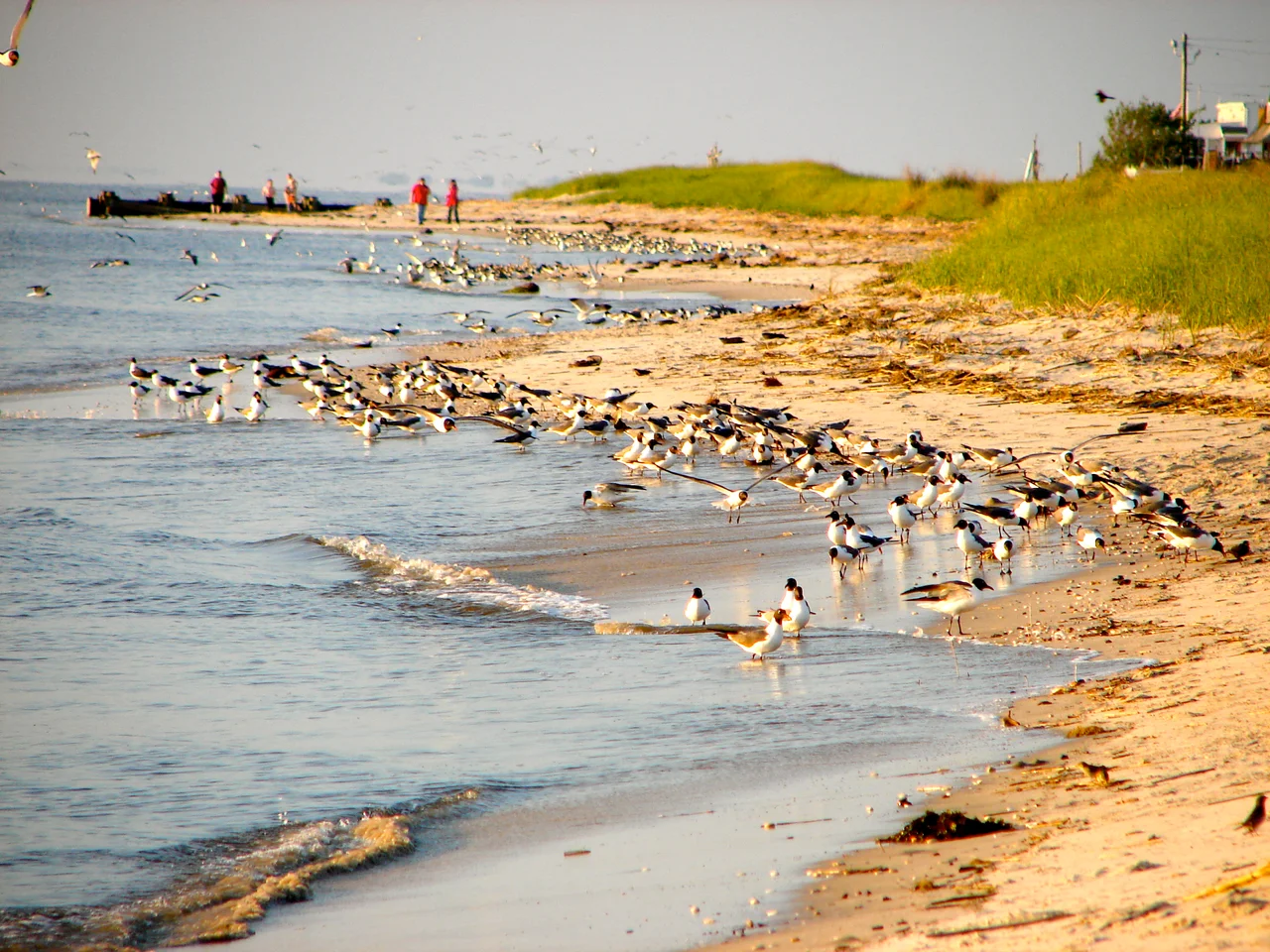
On a single May night, by the dim light of a high spring tide, the largest population of horseshoe crabs on the planet crawls onto the beaches of Delaware Bay. The crabs are older than the dinosaurs - their body plan unchanged for roughly 450 million years - and they have come to lay eggs in the wet sand. Within hours, exhausted red knots will be feeding on those eggs. The red knots have just flown from Tierra del Fuego, at the very tip of South America, and are halfway through one of the longest migrations of any bird on Earth, with thousands of miles still to go before they reach the Arctic. They will eat horseshoe crab eggs by the millions and then keep flying. Without this particular bay, on this particular week, the entire migration collapses. There is nothing else like Delaware Bay anywhere.
A Drowned River
Delaware Bay is a ria - geological shorthand for a river valley that the rising sea has invaded. During the last ice age, when so much of the planet's water was locked in continental glaciers, sea levels were hundreds of feet lower, and the Delaware River cut a wide alluvial plain that extended far out onto what is now the continental shelf. As the ice melted, the Atlantic rose, the river mouth flooded inland, and the bay was born. Today it covers about 782 square miles between Delaware to the west and New Jersey to the east. Its mouth is framed by Cape Henlopen and Cape May. The Cape May-Lewes Ferry crosses it daily in about seventy-five minutes, and from the deck of that ferry you can see why the geographers call it an estuary - the freshwater of the Delaware River mixes with the Atlantic salt for miles in both directions, creating one of the most biologically productive boundary zones on the continent.
The Crab and the Bird
The horseshoe crab is technically a chelicerate - more closely related to spiders than to true crabs. Its bronze blood, copper-based rather than iron-based, has saved more human lives than perhaps any other compound in modern medicine: a clotting agent extracted from horseshoe crab blood is used worldwide to test injectable drugs and medical implants for bacterial contamination. The Delaware Bay population is the largest in the world. Every full and new moon in May and June, the crabs come ashore in numbers that turn the beach into a slow-moving carpet. The red knots arrive almost on cue. They have flown from Patagonia and the Yucatan and need to double their body weight in two weeks to make it to their Arctic breeding grounds. Studies have shown that red knot populations track horseshoe crab populations almost exactly. Crash the crab, you crash the bird.
Lenape Waters
The Lenape people lived along these shores when the first Europeans arrived in the early 1600s. They called the river the Lenape Wihittuck - the rapid stream of the Lenape. The bay itself they called Poutaxat, meaning roughly near the falls, a reference to the head of navigation upstream at what is now Trenton. The Spanish explorer Pedro de Quejo briefly named the bay Saint Christopher's Bay in 1525, but the name did not stick. The Dutch arrived in 1610 and called it variously the South River and Niew Port May, after Captain Cornelius May, whose family name still marks Cape May on the New Jersey side. The English took the bay in 1667 after the Treaty of Breda and renamed it for Thomas West, the 3rd Baron De La Warr, who had been the new governor of Virginia. He never set foot on the bay that now carries his name. Naming has often been an English habit.
Zwaanendael and the First Settlement
The Dutch tried to settle the bay shore in 1631 at a small outpost called Zwaanendael, near what is now Lewes, Delaware. Thirty-two colonists came over to build a whaling station. Within a year they were all dead - killed in a confrontation with the local Lenape over a dispute that the surviving Dutch accounts attribute, perhaps too conveniently, to a misunderstanding involving a tin coat of arms. In 1638 a Swedish-sponsored expedition led by Peter Minuit, the former Dutch director of New Netherland who had famously purchased Manhattan, established New Sweden on the same shore. The Dutch finally returned in force in 1655 under Petrus Stuyvesant and absorbed the Swedish colony. The English absorbed all of it twelve years later. The early colonial story of Delaware Bay is a sequence of small footholds, most of them brief, most of them violent, and most of them ending in someone else's flag going up.
The Largest Shore-Bird Stopover
In 1986 the bay was designated the inaugural site of the Western Hemisphere Shorebird Reserve Network, and in 1992 it was also designated a Ramsar Wetland of International Importance. More than thirty species of migrating shorebirds use Delaware Bay as a critical refueling stop each spring. The salt marshes that ring its shores are nurseries for striped bass, weakfish, and blue crabs. Its oyster grounds were once among the richest on the East Coast and are now slowly recovering after a century of decline. The 1899 Rivers and Harbors Act authorized a thirty-foot shipping channel from Philadelphia to the deep water of the bay, and that channel remains the artery that connects one of America's busiest port complexes to the world. Container ships pass overhead while horseshoe crabs spawn below. The bay carries it all - the migrations, the oysters, the freighters, the ferries, the marshes - in the same wide, shallow basin where a drowned river once flowed to a more distant sea.
From the Air
Delaware Bay forms a distinct triangular water body between New Jersey and Delaware, centered at approximately 39.07 degrees north, 75.17 degrees west. From cruising altitude, the bay's wide mouth between Cape May (northeast) and Cape Henlopen (southwest) is unmistakable - the cape-to-cape opening is about ten nautical miles wide. The shipping channel runs from the southwest corner of the bay up to Philadelphia. Cape May County Airport (KWWD) lies on the New Jersey side near the mouth; Sussex County Airport (KGED) is on the Delaware side. Philadelphia International (KPHL) sits at the head of the bay about eighty nautical miles upriver.
Nearby Stories
- Harbor of Refuge Light 4.7 km away
- Ocean Wind 1 18 km away
- Adkins Arboretum 35 km away
- The Pine Barrens: Home of America's Oldest Monster 42 km away
- Fort Delaware: The Island Prison Where 33,000 Confederates Waited Out the War 50 km away
- Wicomico County, Maryland 54 km away
- USS General G. W. Goethals 54 km away
- The Brandywine Valley: Where Three Generations Painted America 55 km away