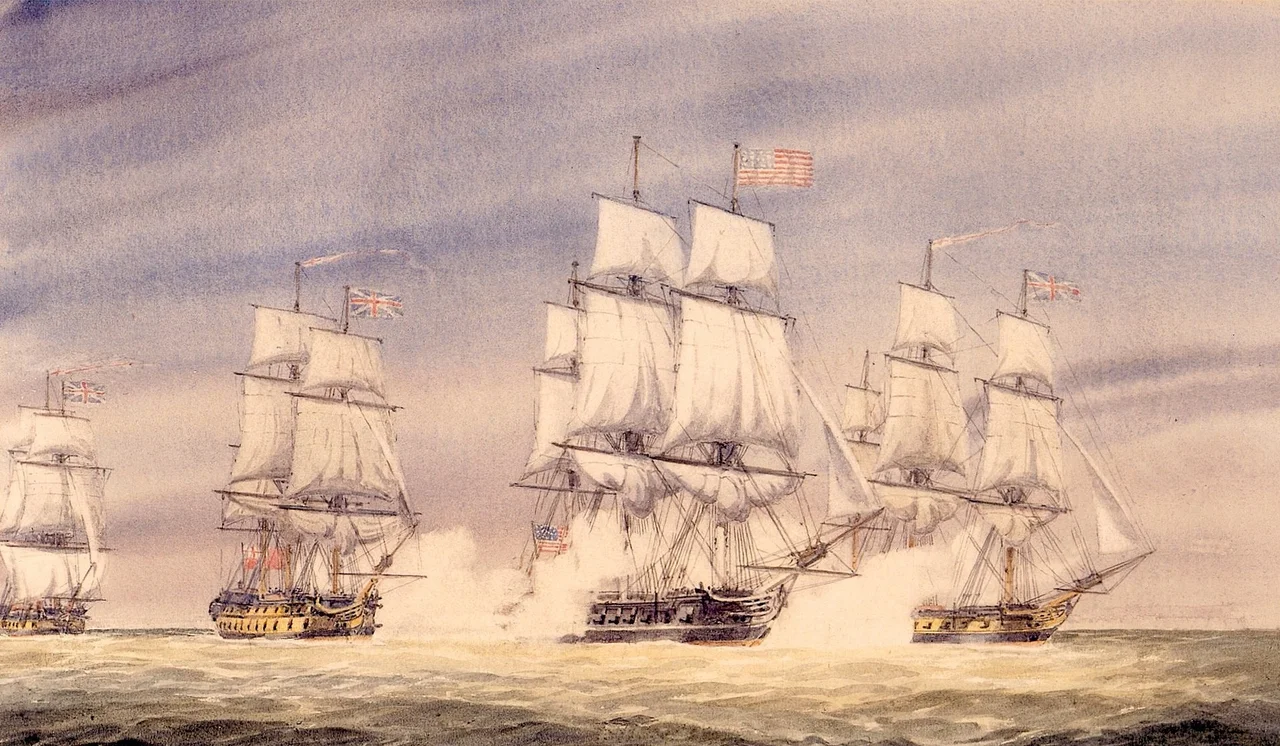

Battle of the Delaware Capes
On November 30, 1782, in Paris, British and American commissioners signed the preliminary articles of peace ending the American Revolutionary War. The official news of the agreement had not yet reached the captains patrolling the Delaware Bay. Three British Royal Navy frigates - HMS Diomede under Captain Thomas Frederick, HMS Quebec under Captain Christopher Mason, and HMS Astraea under Captain Matthew Squires - continued blockading American trade out of Philadelphia. They had received no recall order. On December 20, 1782, they intercepted four American vessels attempting to escape the bay and run for open ocean. The action that followed lasted two days. It was the Battle of the Delaware Capes - one of the very last naval engagements of a war that, on paper, had already ended.
The Most Heavily Armed American Ship
The American flagship in the Delaware was a strange and impressive vessel. The frigate South Carolina, under Captain John Joyner, was the most heavily armed American warship of the entire Revolutionary War - 40 guns, larger and more powerful than anything in the Continental Navy. The ship had a complicated history. She was built at Amsterdam in 1777 as the Indien, originally intended for France. She was sold to the South Carolina State Navy, becoming one of the few American state-level navies to acquire a true warship rather than smaller privateers. The state of South Carolina was, in effect, fielding its own oceangoing navy. South Carolina sailed to Philadelphia in 1782 to refit and to escort a small fleet of merchant vessels back south. Three privateer ships had joined her for protection - the 10-gun brig Hope carrying tobacco and flour under John Prole, the brig Constance under Jesse Harding, and the 6-gun schooner Seagrove under Benjamin Bradhurst. The combined American force was four ships against three British. The British ships were faster and more maneuverable. The American flagship was outgunned only in the sense that she was outnumbered.
The Race for the Cape May Channel
On December 19, 1782, the Seagrove hailed a merchant vessel entering Delaware Bay and learned from her master that three large sail had been spotted off the Cape May Channel - the route to the north of Delaware Bay. The British squadron was waiting. Captain Joyner of the South Carolina decided not to take the obvious northern channel toward Cape May, which the British were blockading. Instead, he chose to go down the main channel between the capes - past the future site of Lewes on the south, past Cape Henlopen, and out into the Atlantic. The decision was tactical: by going south of the British position, Joyner hoped to slip past them in the darkness of the December evening and use the headland of Cape May to mask his exit. In the early evening of December 20, the four American vessels sailed down the channel and out into the Atlantic. The British, watching the channel, sighted the Americans almost immediately and gave chase. The pursuit lasted through the night.
The Engagement
The action began before dawn on December 21, 1782, about thirty miles southeast of Cape May. The Astraea, the fastest of the British frigates, caught the rearmost American ship - the Seagrove - and engaged her briefly. Seagrove cut free of the engagement and escaped southward. The other British frigates pursued the slower brigs Hope and Constance, both of which were captured after brief resistance. South Carolina, with her superior armament, attempted to make a stand against the combined British force, but the Diomede and Quebec brought their broadsides to bear simultaneously. Captain Joyner had to choose between continuing the engagement and trying to save his crew. After several hours of running fire, the frigate's rigging was damaged enough that escape was impossible. Joyner, in a final tactical gesture, fired his guns one last time so as not to surrender with cannon still loaded. Then he struck the colors - the standard act of surrender at sea. The largest American warship in the Revolutionary War had been captured.
The Prisoners and the Released Hessians
The British took nearly 530 prisoners from the three captured American vessels. South Carolina's crew alone numbered over 450 men - a remarkable concentration of seasoned Continental and South Carolina sailors. Hope had 42 crewmen. Constance had 30. The British released fifty German and eight British prisoners that the Americans had recruited out of captivity in Philadelphia, since these men had once served as soldiers in General John Burgoyne's army before being captured at Saratoga in 1777. The Americans had recruited them as crew rather than feed and house them as prisoners; the British recognized them as British subjects entitled to release. The remaining American prisoners were taken to British-held ports - many to New York City, where they were held in the notorious prison ships in Wallabout Bay or in the converted Sugar House prison on Liberty Street. The war had effectively ended. The prisoners would be released over the following months as the formal peace was ratified and exchanged. Most of the South Carolina crew were home before the autumn of 1783.
The Ship That Did Not Become Royal Navy
The British did not purchase South Carolina for Royal Navy service. The war was ending and the British strategic need for additional frigates was disappearing. The ship's Dutch-French-American design had structural flaws that British naval architects had already identified - the Indien had been a problematic vessel for the French as well. Instead, the captured ship was sold for service as a merchantman, ending the brief career of the largest American warship of the Revolution. Prize money for the captured vessels was awarded by the British Admiralty in 1784, distributed among the officers and crews of the three British frigates that had participated in the action. The Battle of the Delaware Capes is the last significant naval engagement of the American Revolutionary War involving American forces. It was fought after the war was officially over in everything but the formal exchange of ratification documents. The action's outcome did not affect the war's result, but it did affect 530 American sailors who spent the early months of peace in British custody, and it ended the career of South Carolina, the most ambitious American naval acquisition of the war.
From the Air
The Battle of the Delaware Capes was fought about 30 nautical miles southeast of Cape May, at approximately 38.97 degrees north, 74.97 degrees west, in open Atlantic water. Cape May Airport (KWWD) is the closest land airfield, on the New Jersey shore. Cape Henlopen, the Delaware headland, is the southern landmark of the Delaware Bay entrance. The Cape May-Lewes Ferry crosses this same water today - a 70-minute run from Cape May to Lewes that traces almost exactly the route the 1782 British frigates patrolled. From altitude in clear weather, the Bay entrance is unmistakable: the wide opening of the Delaware between the two capes, the shipping lanes still active with bulk carriers and container ships, and the lighthouses (the Cape May Light, the Delaware Breakwater East End Light, the Harbor of Refuge Light) marking the approaches that the South Carolina and her brigs tried unsuccessfully to escape.
Nearby Stories
- A. J. Meerwald 4.6 km away
- Longport, New Jersey 13 km away
- Bethany Beach 15 km away
- Ocean Wind 1 19 km away
- Adkins Arboretum 30 km away
- Wicomico County, Maryland 34 km away
- USS General G. W. Goethals 47 km away
- The Brandywine Valley: Where Three Generations Painted America 75 km away