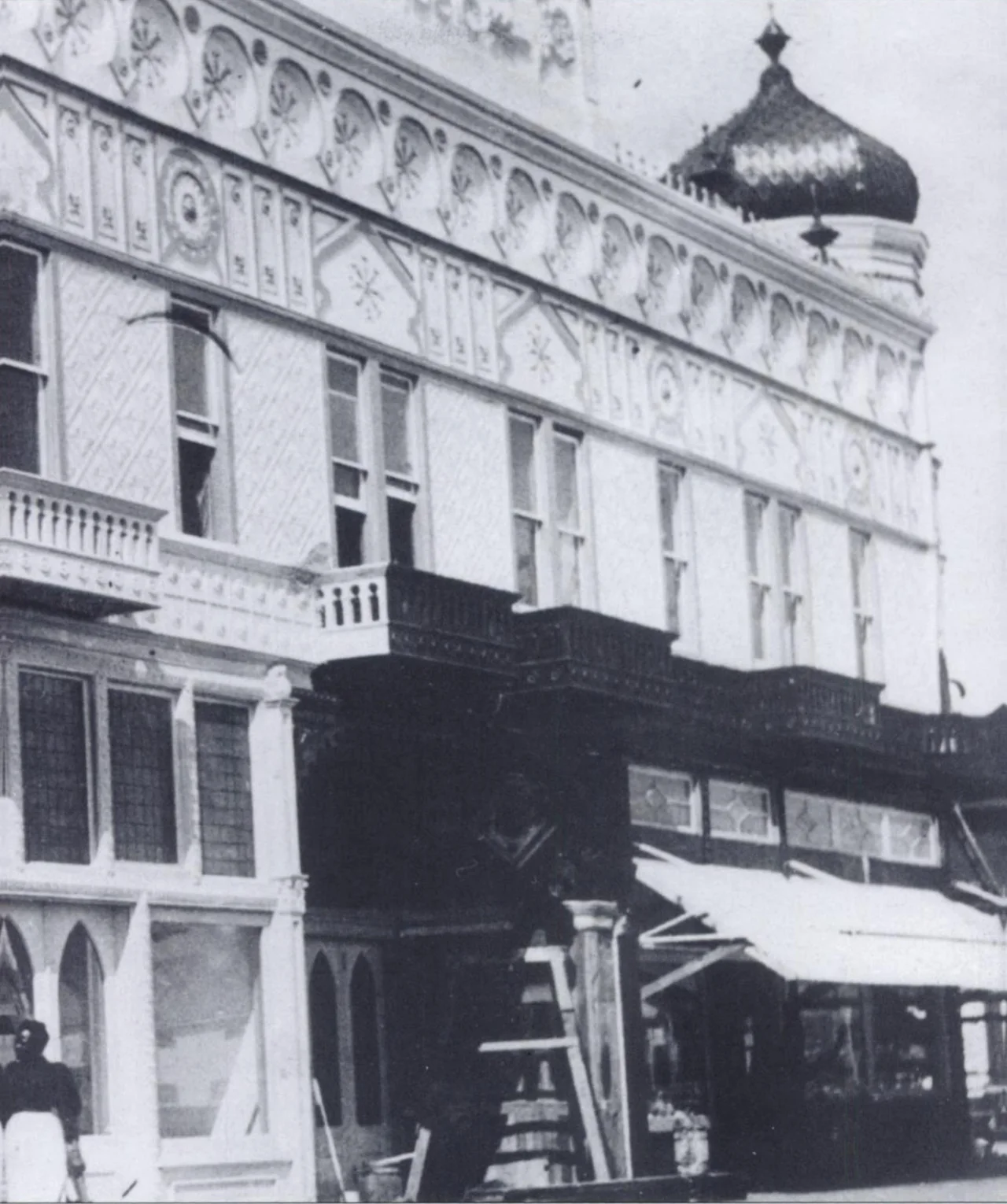

Academy of Music (Atlantic City, New Jersey)
Joseph Fralinger believed he was unlucky. He built three theaters in the same place on the Atlantic City boardwalk, and three different fires destroyed all three of them. The first burned down in June 1892, a few days before its scheduled grand opening. The second burned down in February 1898 along with fifty other businesses on the same city block. The third burned down on April 3, 1902, in a fire so large that it destroyed two entire boardwalk blocks and forced people fleeing the flames to be rescued by boat. Three buildings. Three fires. Three rebuilds. None of the fires actually started inside the theater - they all began in adjacent buildings and spread - but the outcome was the same each time, and after a while a pattern is a pattern. Fralinger is now mostly remembered as the man who popularized salt water taffy. The fact that he also built and lost three Atlantic City theaters is the harder story.
Fralinger and the Taffy Empire
Joseph Fralinger is the man who made salt water taffy a national candy. He did not invent the recipe - that origin story is contested and probably belongs to David Bradley, also of Atlantic City - but he commercialized it brilliantly in the 1880s, packaged it in distinctive blue-and-white boxes, and built a candy empire that financed his other ventures. By 1892 he had partnered with two associates, John Lake Young and Stewart McShea, to build a theater on the boardwalk at 180 South New York Avenue. They named it the Academy of Music after the famous Philadelphia opera house. Fralinger was Philadelphia-born. The choice of name was an act of homesickness as much as marketing. The new theater was scheduled to open in late June 1892 with rehearsals already underway.
The First Fire
On June 22, 1892, a fire broke out in an adjacent building and spread to the Academy of Music before it had hosted a single paying performance. The theater burned to the ground. The rehearsals were interrupted. The opening was cancelled. Fralinger, Young, and McShea decided immediately to rebuild. Less than a week after the fire, construction crews were back on the site. Less than four weeks after the fire, the rebuilt theater opened to the public on July 16, 1892. The opening attraction was Bartholomew's Equine Paradox - a precision horse show featuring twenty-two trained horses performing tricks. The theater operated for the next six years, hosting opera, vaudeville, plays, minstrel shows, and lectures. Sissieretta Jones, the celebrated African American soprano sometimes called the Black Patti, gave a concert there in 1894. Edward Harrigan's plays were staged. The Academy of Music became one of the boardwalk's central entertainment venues.
The Second and Third Fires
In February 1898 the theater burned again - this time as part of a much larger boardwalk fire that destroyed roughly fifty businesses on the same block. Fralinger rebuilt for a third time, alone, having bought out his partners. The new theater opened July 25, 1898, built entirely of brick and iron in an attempt to prevent another fire. It sat 1,600 people. It ran successfully for less than four years. On April 3, 1902, the worst boardwalk fire in Atlantic City history began at the empty Tarlton Hotel and spread rapidly across two full blocks from Illinois Avenue to South Carolina Avenue. The Academy of Music was destroyed. Young's Pier was severely damaged. The New York Times reported that people fleeing the fire had to be evacuated by boat from the boardwalk. Fralinger watched a third theater burn. After this, he decided the venture needed financial partners. He brought in the Philadelphia theater magnate Samuel F. Nixon, signed a ten-year lease, and began building a fourth structure - this one renamed the Apollo Theatre.
The Apollo and the Ziegfeld Follies
The Apollo Theatre opened April 13, 1908. Under Nixon and later his son Fred G. Nixon-Nirdlinger, it became one of Atlantic City's premier venues. It was known throughout the theatrical industry as a tryout house - the kind of out-of-town stage where Broadway-bound shows could be tested in front of paying audiences before opening in New York. Ten different editions of the Ziegfeld Follies tried out at the Apollo. The biggest stars of early-twentieth-century American theater appeared on its stage: Otis Skinner, Richard Carle, and the parade of vaudeville and legitimate-theater names that defined the era. The Apollo Theatre business model worked beautifully until 1931, when Fred Nixon-Nirdlinger was murdered by his wife in a sensational case that made national headlines. The theater fell into receivership. The Great Depression finished the job. By 1934 the Apollo had been converted to a movie theater.
Burlesque and Demolition
The Apollo ran as a movie theater for nearly forty years. In 1974 it was purchased by Al Baker Jr., renovated for $50,000, and reopened as the Apollo Burlesque Theatre. The opening show was titled Burlesque is My Thing and starred a performer billed as Hope Diamond. By 1976 the theater was running X-rated films along with the burlesque acts. By 1977 it was still operating that way. The legitimate-theater roots of the building were long gone. In 1978 it briefly operated as Charlie's Picture Palace before three teenage boys set an arson fire in September 1978 that closed the building for good. It sat abandoned for seven years. In 1985 it was demolished. Volunteers from the newly created Atlantic City Historical Museum salvaged what they could in April 1985, days before the wrecking ball arrived. The Atlantic Palace Condominium now occupies the site at 180 South New York Avenue. There is no plaque. There is no marker. The location of the theater is undocumented except in the historical archives of the city it helped build.
From the Air
The site of the former Academy of Music and Apollo Theatre is in central Atlantic City at approximately 39.36 degrees north, 74.43 degrees west, near the boardwalk at South New York Avenue. From cruising altitude, the site appears as part of the dense urban development of Atlantic City between the casinos and the boardwalk. Atlantic City International (KACY) lies about 7 nautical miles northwest. The Atlantic Palace Condominium now stands on the site. Nothing of the original theater complex remains.
Nearby Stories
- Cape May 8.1 km away
- A. J. Meerwald 14 km away
- The Pine Barrens: Home of America's Oldest Monster 25 km away
- Hereford Inlet Lighthouse 38 km away
- Constitutional Convention (United States) 50 km away
- PS General Slocum 143 km away
- Wardenclyffe Tower 201 km away
- USS Atik 493 km away