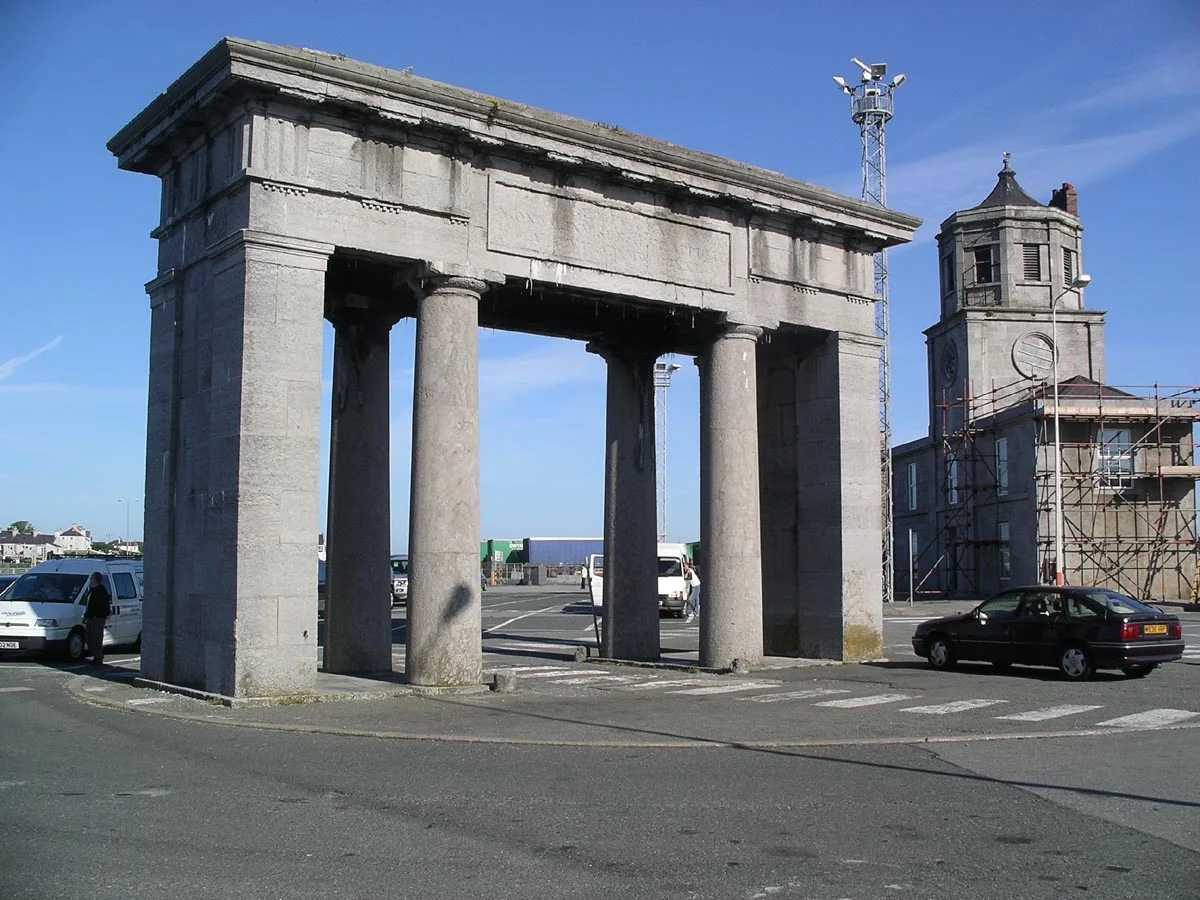

Admiralty Arch, Holyhead
On 7 August 1821, the new King of England, George IV, stepped ashore at Holyhead from the royal yacht Royal George. He had come for a state visit to Ireland -- the first by a British monarch in centuries -- and the planned itinerary called for him to spend a night at Plas Newydd, the marquess's house on the Menai Strait, then return to his yacht and sail to Dublin. The weather, in the way of Welsh August weather, intervened. The Royal George could not sail. After several days of delay the King made a different decision. He boarded the Lightning -- the world's first Royal Mail steam packet -- and steamed across to Howth, near Dublin, on 12 August. The change to the new technology was met, by an Irish public hungry for any sign that modernity was reaching their island, with widespread approval. Three years later, the citizens of Holyhead opened a public subscription, hired the architect Thomas Harrison, and built an arch to remember the visit.
Thomas Telford's Road
The arch sits where Thomas Telford's Holyhead Road -- the route now known as the A5 -- meets the sea. Telford had spent the previous fifteen years redesigning the road from London to the Irish ferry port, blasting through mountains, throwing his suspension bridge across the Menai Strait, and making the journey from the capital to Dublin a matter of forty hours by mail coach instead of forty by the older roads. The Holyhead Road was the engineering of its age. The arch at the end of it was the ceremonial punctuation -- the formal terminus of a transformative piece of infrastructure that made Britain and Ireland a single political and commercial unit for the next century. Harrison, who had also designed Chester Castle and Lyceum buildings of the Greek Revival, gave Holyhead a Doric arch in pale stone -- a triumphal gateway in the Roman manner, built to last.
Red Wharf Bay Stone
The construction took two years. The arch was funded by public subscription -- the people of Holyhead and the wider Anglesey gentry putting up the money themselves, which is why it is also sometimes called the Triumphal Arch or the George IV Arch. The stone came from Red Wharf Bay on the eastern side of Anglesey, hauled across the island and shaped on site. Harrison's design used Greek Doric columns and a cleanly proportioned entablature. The whole arch reads as classical rather than monumental -- elegant rather than overbearing -- which is in character for the period and for the architect. It is now Grade II* listed. The Royal Commission on the Ancient and Historical Monuments of Wales refers to it formally as the George IV Arch.
The Lighthouse Beyond
Beyond the arch, at the seaward end of the Admiralty Pier, stands the Holyhead Mail Pier Lighthouse -- a slim white tower completed in 1821, the same year as George's visit, and designed by the engineer John Rennie the Elder. Rennie was working at the same time on the wider improvements to Holyhead Harbour, which had been transformed in the early nineteenth century into the dominant port for traffic between Britain and Ireland. The lighthouse was lit during the King's visit, and the bay would have been crowded with shipping -- merchant vessels, packet boats, the new steam ferries, the royal yacht. Both the arch and the lighthouse survive. Both are Grade II or II* listed. Both are surrounded today by the working machinery of a modern port -- the Stena Line ferries, the freight terminals, the breakwater that holds back the Irish Sea -- and neither is generally accessible to the public, for safety reasons.
Where to Stand to See It
The arch is on Ynys Halen -- Salt Island -- inside the port estate. The public cannot reach it directly. The best view today is from the churchyard of St Cybi's Church, the medieval parish church of Holyhead, which sits on the high ground inside the Roman walls of Caer Gybi. From the churchyard you look down across the harbour, past the buildings and cranes, to the arch on its pier and the lighthouse beyond. In 2017, proposals were floated to move the arch to a more open location, where it could be approached on foot and properly seen. Nothing has come of them yet. The arch is where Harrison put it, where George IV stepped ashore -- between the Welsh stone of Telford's road and the steam packet that opened a new century of Irish travel. The view from St Cybi's churchyard is the one to take if you want to understand why it was built.
From the Air
Located at 53.31N, 4.62W on Salt Island (Ynys Halen) at the inner harbour of Holyhead, Anglesey. The arch is small but visible from above against the working dockland; the Holyhead Mail Pier Lighthouse stands beyond it at the seaward end of Admiralty Pier. Nearest airport: Valley (EGOV) about 5 nm southeast. Best viewed at 1,500-2,500 ft AGL on approach to or departure from Holyhead. The breakwater enclosing the port -- one of the longest in Britain at 1.7 miles -- is the dominant landmark; the arch sits well inside it on the inner harbour. St Cybi's Church, on the high ground above the port, is the other prominent landmark.
Nearby Stories
- Snowdon Mountain Railway 8 km away
- German submarine U-1051 8.3 km away
- German submarine U-246 11 km away
- Trwyn Du Lighthouse 13 km away
- Irish Sea Bridge 20 km away
- HMS Manners (K568) 34 km away
- HMS Tyler 47 km away
- Birkdale Palace Hotel 79 km away