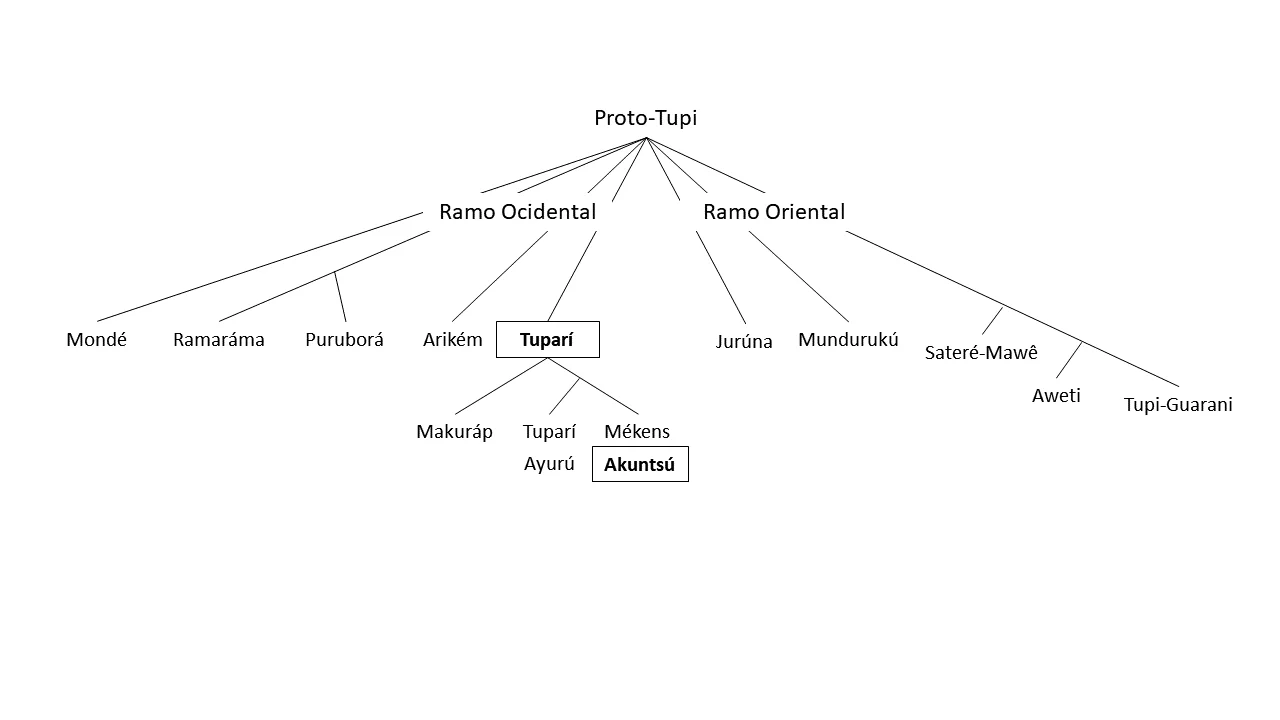

Akuntsú language
There is a language in the forests of Rondônia that almost no one alive can speak. Its speakers can be counted on one hand, and when they are gone, Akuntsú will be gone with them, every word, every story, every name. This is not the slow fading of a tongue overtaken by a larger neighbor. It is the aftermath of murder. The Akuntsú once called themselves Babawro, the Woodpeckers, for the way they painted their hair red with urucum and danced until dawn at the new moon, the way those birds do. Most of the people who knew that dance were killed around 1990 by cattle ranchers clearing their land, and the few who lived have spent the decades since as the last of their world.
A People Reduced to Survivors
When government agents from Brazil's Indigenous affairs bureau made peaceful contact in 1995, only seven Akuntsú remained. They told of an attack by armed ranchers, who had bulldozed their village, home to around thirty people, in an effort to bury the evidence. At least fifteen were killed. The motive was real estate: if the Akuntsú were officially recognized, their forest would become a protected reserve, off-limits to logging and cattle. So the men with guns tried to make sure there would be no one left to recognize. Because the Akuntsú will not survive the deaths of their last members, observers and human rights groups do not soften what happened. They call it genocide, and they are right to.
The Women and Their Birds
With nearly all their relatives dead, the surviving Akuntsú women did something that says more about grief than any statistic could. They raised animals as their children, the jacu and the macaw and the small creatures of the forest, giving them kinship names and the love that had nowhere else to go. This is not folklore. It is recorded in the very grammar of their language, where a phrase like 'the jacu is the son of Txarúi' uses the ordinary word for 'a woman's son.' A people who lost their children rebuilt a family from the living things around them. Their shaman and leader, Konibú, died in his sleep in 2016, and the count of the living fell again.
A Whole World in a Few Words
Akuntsú belongs to the Tupari branch of the great Tupian family, related to languages like Mekéns, with which it shares roughly four-fifths of its vocabulary. It is a complete and intricate human achievement. It counts to only two, kite and tɨɾɨ, one and two, and builds larger numbers by doubling, so that four is simply 'two two.' That same word for one, kite, can also mean 'alone,' as in oɾẽbõ kite, 'I am alone,' a phrase that lands differently when so few are left to say it. Every grammar describing Akuntsú is, in part, a record of something irreplaceable being lost in real time, the structure of a mind shaped by a forest, written down by linguists racing the clock.
Not the Only Ones
The Akuntsú are not alone in their fate, and that is the hardest part. Their neighbors the Kanoê were ground down to almost nothing by the same advancing frontier. Nearby in the Omerê reserve lived a man who survived the destruction of his entire people and chose to live in isolation until his death, known to the outside world only as the Man of the Hole, the last speaker of a language no one else will ever hear. These are not curiosities of the deep Amazon. They are people, recent and real, whose worlds were taken so that cattle could graze. The few remaining Akuntsú still speak, still dance when they can, still carry the Woodpeckers' name. For now.
From the Air
The Akuntsú live in the Rio Omerê (Igarapé Omerê) Indigenous Territory in the state of Rondônia, southwestern Brazilian Amazon, near 12.83°S, 60.97°W. This is protected, off-limits land that exists precisely because of what was done to its people; it is to be respected from a distance, not approached. From altitude the region reads as a patchwork: an island of intact forest set within the heavily cleared agricultural and ranching country of central Rondônia, with the line between standing forest and cattle pasture often shockingly sharp. The nearest airfields are in Rondônia's interior, including Vilhena (ICAO SBVH) to the southeast and Pimenta Bueno to the north. Recommended viewing altitude is 6,000 to 10,000 feet, high enough to take in the contrast between the green reserve and the surrounding deforestation that tells the whole story without a word. Clearest skies come in the dry season from May to September; the wet season brings dense cloud and the smoke of agricultural burning.
Nearby Stories
- Tanaru Indigenous Territory 40 km away
- Noel Kempff Mercado National Park 118 km away
- Guapore Biological Reserve 150 km away
- Serra Ricardo Franco State Park 159 km away
- Chiquitano Dry Forests 208 km away
- Vila Bela da Santíssima Trindade 239 km away
- Forte Príncipe da Beira 319 km away
- Sucunduri State Park 518 km away