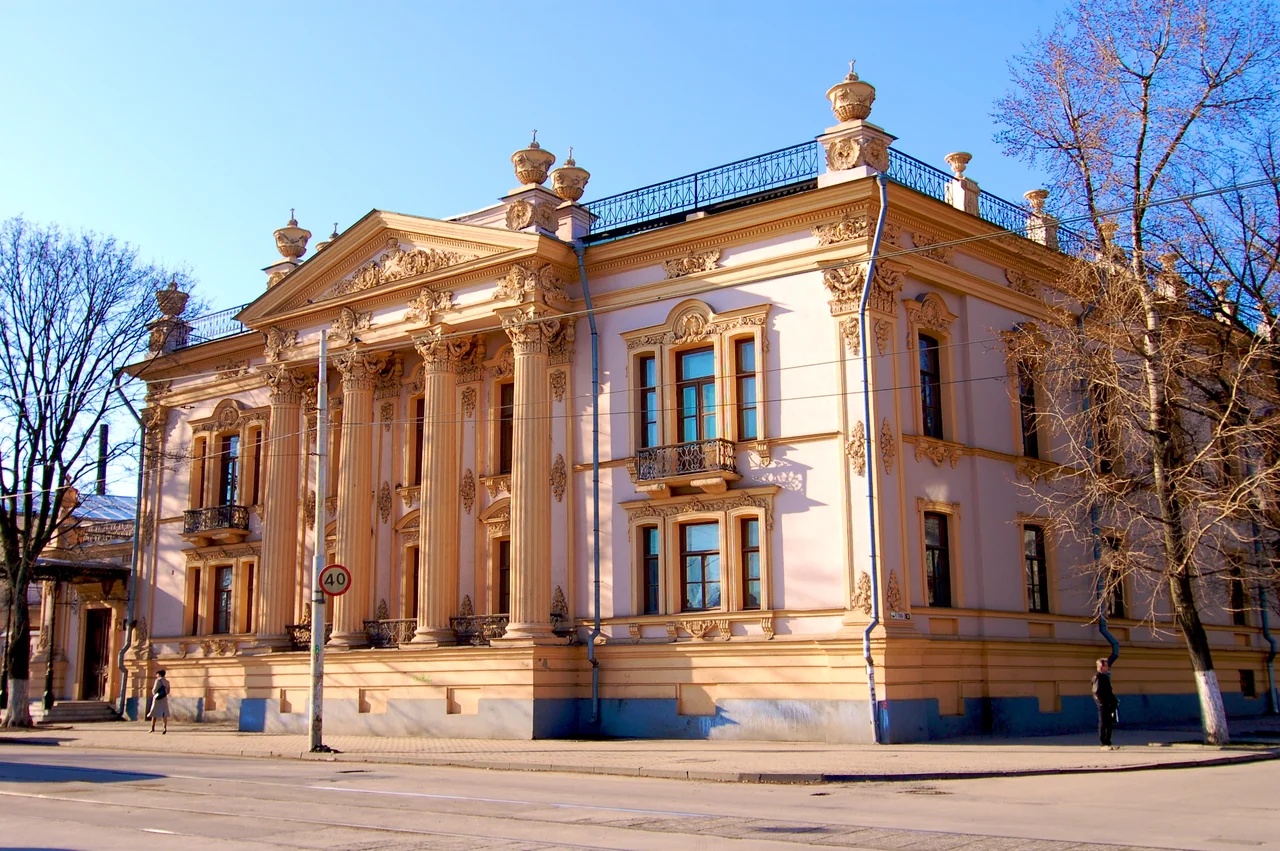

Alferaki Palace
In a city of merchant houses, one building outshines them all. The Alferaki Palace rises from a Taganrog street in ornate splendor, its facade a confection of Baroque Revival columns and moldings that announced, unmistakably, that its owners had money and meant everyone to know it. Built in 1848 for the Greek merchant Nikolay Alferaki, it was the showpiece of a family and a symbol of the cosmopolitan wealth that flowed through this Sea of Azov port. Anton Chekhov, who grew up in the same town, knew it well enough to weave it into his fiction. Behind its grand exterior lies a century and a half of fortune, ruin, war, and rescue.
A Palace for a Merchant Prince
The mansion was the work of Andrei Stackenschneider, one of imperial Russia's most fashionable architects, whose commissions ran to actual royal palaces. That such a figure designed a private home in a provincial port speaks to the ambitions of the Alferaki family, Taganrog Greeks who had grown rich in the Black Sea trade. Completed in 1848 on what was then Katolicheskaya Street, the palace wore its wealth openly - a Baroque Revival exterior of columns, pediments, and lavish ornament, with grand reception rooms within. It was less a house than a statement, the built expression of a merchant dynasty at its height, dominating its street with an elegance the rest of the town could only admire.
From Fortune to Assembly Hall
Wealth is rarely permanent, and the Alferakis learned as much. In the 1870s, after the family went bankrupt, the palace passed to another Greek merchant, Negroponte, while its garden was sold off to the local merchant community. The building reopened as the Commercial Assembly, a social and business club for Taganrog's trading class - and it was in this incarnation that it entered literature. A young Anton Chekhov, then a gymnasium student in the town, later referenced the palace in his stories Ionych, The Mask, and My Life, folding the grand hall into his unsparing portraits of provincial society. The house that had housed one family's pride became a stage for the whole merchant world Chekhov would spend his career observing.
A Building Caught in History
The turbulent twentieth century passed straight through the palace's rooms. In early 1918 the mansion briefly became the headquarters of Taganrog's Soviet workers' council; later that same year, under occupation, it served as a German war hospital; and in 1919 it housed the staff of the White general Anton Denikin during the civil war. After Soviet power was established, from 1927 the building took on the role it still holds, becoming the Museum of Regional Studies. Then came the deepest wound: during the German occupation of Taganrog in the Second World War, the museum's entire collection of Russian art - along with more than three hundred other objects - was looted by the occupying authorities and lost. A treasure house was emptied by force.
Restored to the Public
The palace endured, as fine buildings sometimes do, outlasting every regime that used it. Between 1991 and 1996 it was carefully renovated, and today it is open to visitors as the Museum of Regional Studies - though nearly everyone still calls it by its founder's name, the Alferaki Palace. Its halls now tell the story of Taganrog itself, gathering portraits of the city's governors and mayors, relics of its Greek merchant past, and the threads of the many lives that shaped the town. There is a quiet justice in the arc: a house built to flaunt one family's riches now belongs to the whole city, its grand rooms preserving not private glory but a shared history - including the memory of what was taken from it.
From the Air
The Alferaki Palace stands in central Taganrog near 47.21°N, 38.93°E, best appreciated from low altitude, where its ornate roofline stands out among the old-town blocks on Taganrog's cape above the Sea of Azov. The nearest major airport is Rostov-on-Don's Platov International (URRP), about 40 kilometers to the northeast.
Nearby Stories
- Battle of the Kalka River 63 km away
- Klivazh 84 km away
- Yunkom Coal Mine 95 km away
- Temryuk 199 km away
- Kepoi 231 km away
- Abkhazia 455 km away
- Tbilisi 748 km away
- Cathedral of the Nativity of the Theotokos, Suzdal 999 km away