
Anlong Veng
There is a casino now, directly across the road from where Pol Pot was cremated. The locals note the irony without much surprise. Anlong Veng has always been a place where contradictions coexist uneasily — a town that was once so remote and inaccessible that genocidal fugitives found it the perfect hideout, now sitting at the hub of four paved highways connecting Cambodia, Thailand, Siem Reap, and the disputed temples of Preah Vihear. The town of roughly 70,000 people in Oddar Meanchey Province might have remained a footnote in anyone's map if not for the men who chose to die here.
The Last Refuge
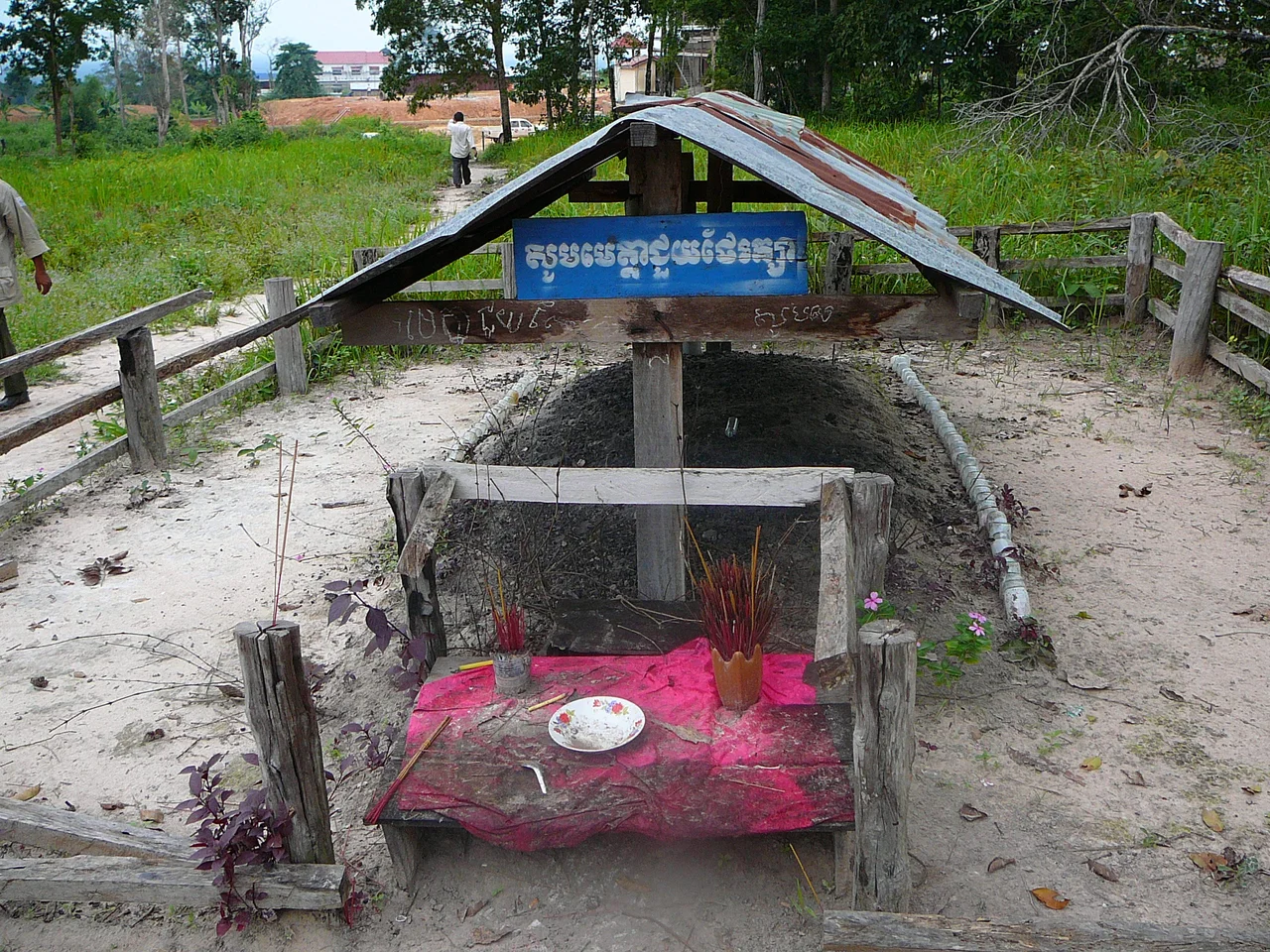
In the late 1990s, as the Khmer Rouge movement finally collapsed after two decades of guerrilla warfare, its surviving leaders retreated to Anlong Veng. The regime that had presided over the deaths of an estimated 1.7 to 2.5 million Cambodians between 1975 and 1979 — through execution, starvation, forced labor, and the calculated destruction of urban life — found its last refuge in these forested hills near the Thai border. Pol Pot, the movement's architect, died here in April 1998 and was cremated on a pyre of tires and wood. His grave sits in a modest plot near Choam, marked without ceremony. Ta Mok — known as "The Butcher" for his particular role in the violence — lived here until his arrest in 1999 and died in custody in 2006 before his war crimes trial concluded. Khieu Samphan, the regime's head of state, also had a home in Anlong Veng; he was later convicted of crimes against humanity and genocide by the Extraordinary Chambers in the Courts of Cambodia. The houses of these men still stand. Some have been converted into guesthouses or local attractions.
Ta Mok's Lake
The most visually striking remnant of the Khmer Rouge's time in Anlong Veng is a large artificial lake on the town's northern edge, built on Ta Mok's orders using forced labor. The lake reflects the surrounding hills with a stillness that feels unearned given the circumstances of its creation. Moto-taxi drivers bring visitors here as part of the standard local itinerary — the lake, the graves, the hilltop structures, the remnants of the structure where Pol Pot was put on trial by his own movement in 1997 before his death. That trial, held in a jungle clearing, was itself a piece of Khmer Rouge theater: Pol Pot was condemned by a faction of his own organization, then placed under house arrest. The building that served as his prison has largely returned to the forest. What remains of it is concrete and memory.
A Crossroads Transformed
The same inaccessibility that made Anlong Veng attractive to Khmer Rouge fugitives is now gone. Four sealed highways converge on the town's central roundabout, connecting it to Siem Reap two hours south, Samraong an hour west, the Thai border at Choam 13 kilometers north, and the ancient Preah Vihear temple complex to the east. Buses run twice daily to Siem Reap. Traders cross from Thailand at the Choam checkpoint. The town itself is functional rather than picturesque — a market selling clothing and motorcycle parts, a few pharmacies, the usual concrete shophouses of a Cambodian provincial center. The mountain scenery surrounding it is genuinely beautiful, the Dângrêk escarpment rising to the north, forested ridges catching cloud in the morning hours. Visitors who come for the history tend to stay for the landscape.
What Memory Requires
Anlong Veng occupies a particular place in the geography of historical reckoning. It is not a formal memorial, not a museum with guided interpretation, not a carefully managed site like the Tuol Sleng Genocide Museum in Phnom Penh. It is simply a town that the leaders of one of the twentieth century's most destructive regimes chose to end their lives in, and whose residents now live alongside the physical evidence of that fact. The graves are visited. The houses are pointed out. The lake is photographed. Cambodians who lost family members to the regime come here, and so do travelers who are trying to understand what happened in this country between 1975 and 1979. The Extraordinary Chambers — the UN-backed tribunal that tried the surviving leaders — rendered its genocide verdict in 2018, more than forty years after the events it adjudicated. Justice moved slowly. Anlong Veng waited.
From the Air
Anlong Veng sits at 14.23°N, 104.08°E in Oddar Meanchey Province, northwestern Cambodia, approximately 13 km south of the Thai border at Choam. The Dângrêk Mountain escarpment runs east-west just north of town, marking the natural border with Thailand — a steep forested ridge visible from considerable altitude. Ta Mok's artificial lake is identifiable on the town's northern edge. The highway network radiating from Anlong Veng's central roundabout is visible from the air. Nearest airports: Siem Reap International (SAI/REP), approximately 130 km south; on the Thai side, Surin (NAW) is the nearest significant airport. Terrain in the area rises abruptly at the Dângrêk escarpment — maintain safe altitude when approaching from the north.
Nearby Stories
- Preah Vihear province 25 km away
- Wat Pa Maha Chedi Kaew 30 km away
- Mahendraparvata 33 km away
- Phnom Tbeng Natural Heritage Park 52 km away
- Phu Chong–Na Yoi National Park 68 km away
- Killing Caves of Phnom Sampeau 117 km away
- Scam Centers in Cambodia 135 km away
- Si Thep Historical Park 299 km away