.jpg)
Wat Pa Maha Chedi Kaew
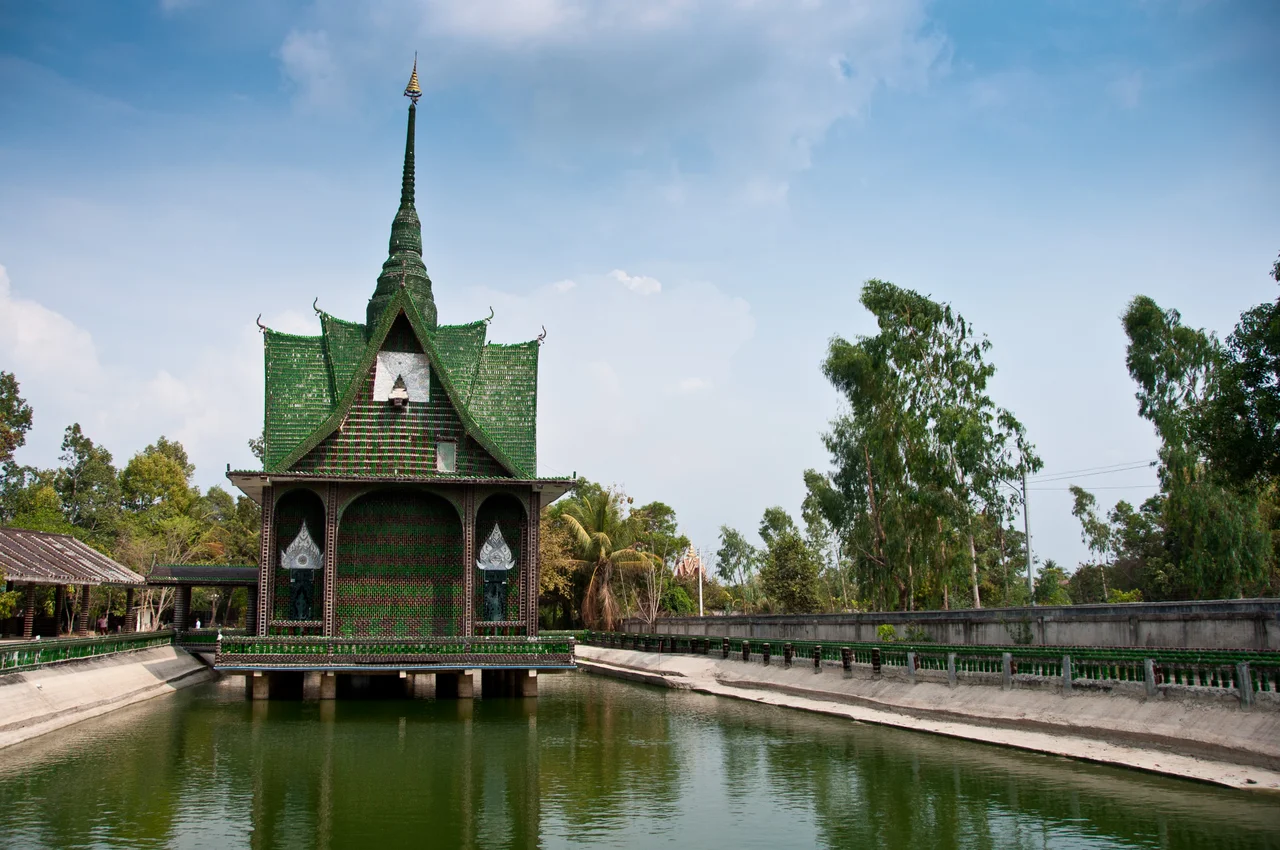
Monks at Wat Pa Maha Chedi Kaew had a problem familiar to anyone living near a road: people kept leaving their empty beer bottles behind. Rather than haul them to a dump, the monks started stacking them. That decision, made sometime around 1984, eventually produced one of the most unusual religious complexes in Thailand — twenty buildings and counting, all built from glass. The main temple glows green and brown in the afternoon light, its walls made of empty Heineken and Chang bottles pressed into concrete, their bases facing outward like a mosaic of circular seals. The locals call it the Temple of a Million Bottles. By 2009, it had more than earned the name.
A Building Material Nobody Ordered
The monks began collecting bottles in 1984 with practical intent: they needed building materials and the bottles were available. The local government, hearing what the monks were doing, began sending additional bottles to supplement what was already being gathered from the area around the temple.
The main structure has a concrete core, but the exterior walls are formed almost entirely of glass bottles — specifically two types. Green Heineken bottles and brown Chang beer bottles make up the bulk of the material. The two colours were not chosen for aesthetic reasons; they were simply the most common discarded bottles in the region. The resulting pattern — alternating green and brown circles, row upon row — turned out to be striking anyway. Beyond the bottle walls, the monks also incorporated bottle caps into mosaics that decorate surfaces throughout the complex. Nothing useful was wasted.
What Two Years of Stacking Built
The main temple took approximately two years to complete. When it was finished, the monks kept going. The same logic that applied to the temple — why not use what is freely available? — applied to every structure the complex needed. By the time international media started reporting on the project, Wat Pa Maha Chedi Kaew had grown to include a crematorium, a series of prayer rooms, the local water tower, bathrooms for visitors, and several raised bungalows housing the monks themselves.
All twenty buildings use the same basic method. Bottles are set into concrete in rows, creating walls that are structurally sound, naturally insulating, and surprisingly elegant up close. The glass catches and filters light differently than stone or brick. Interiors have a quality of illumination that is particular to this place — diffused and coloured, slightly marine.
The Idea Heineken Almost Had
There is an odd footnote to the story. About twenty years before the monks started their project, the Heineken brewing company had actually investigated whether their bottles could be redesigned for use as building blocks — a project sometimes called the WOBO, or World Bottle. Alfred Heineken developed the idea around 1963 after visiting Curaçao and observing both the beaches littered with beer bottles and the shortage of affordable building materials for the local population. The redesigned bottle prototype was developed but Heineken ultimately shelved the concept, deciding it was not compatible with their brand image.
The monks at Wat Pa Maha Chedi Kaew never knew about the Heineken experiment. They arrived at essentially the same idea independently, working with the standard round-bottomed bottle rather than a specially designed brick-shaped one, and they succeeded where the corporate project did not. The temple complex stands as proof that the underlying idea was sound.
Reaching Nirvana Through Recycling
The China Daily once described Wat Pa Maha Chedi Kaew as a temple that found an environmentally friendly way to use discarded bottles to reach nirvana. The characterization is half playful, but it captures something real about the place. The monks were not making an environmental statement when they started collecting bottles in 1984; they were solving a local problem with locally available materials, in a tradition of resourcefulness that has always been part of monastic life.
The temple now draws visitors from across Thailand and abroad, people who come specifically to see what a million and a half glass bottles look like when they become a working religious complex. The monks who live there continue to maintain the buildings, repair cracked sections, and expand where the community has need. The bottles keep coming. The temple keeps growing. The candles inside, unlike the famous ones paraded through Ubon Ratchathani to the north, are the kind that actually get burned.
From the Air
Wat Pa Maha Chedi Kaew lies at approximately 14.618°N, 104.419°E in Khun Han district, Sisaket province, northeastern Thailand. The temple complex is not a prominent aerial landmark on its own — it sits within forested lowland terrain — but the surrounding Sisaket province agricultural patchwork is visible from altitude. Recommended viewing altitude: 1,500–3,000 feet for general area orientation. Nearest airports: Sisaket does not have a scheduled commercial airport; the nearest significant facility is Ubon Ratchathani Airport (UBP) approximately 90 km to the east-northeast.
Nearby Stories
- Preah Vihear 10 km away
- Emerald Triangle (Southeast Asia) 14 km away
- Wat Pah Nanachat 32 km away
- Phu Chong–Na Yoi National Park 33 km away
- Pak Mun Dam 53 km away
- Cambodian Landmine Museum 98 km away
- Angkor Thom 139 km away
- Ban Chiang 300 km away