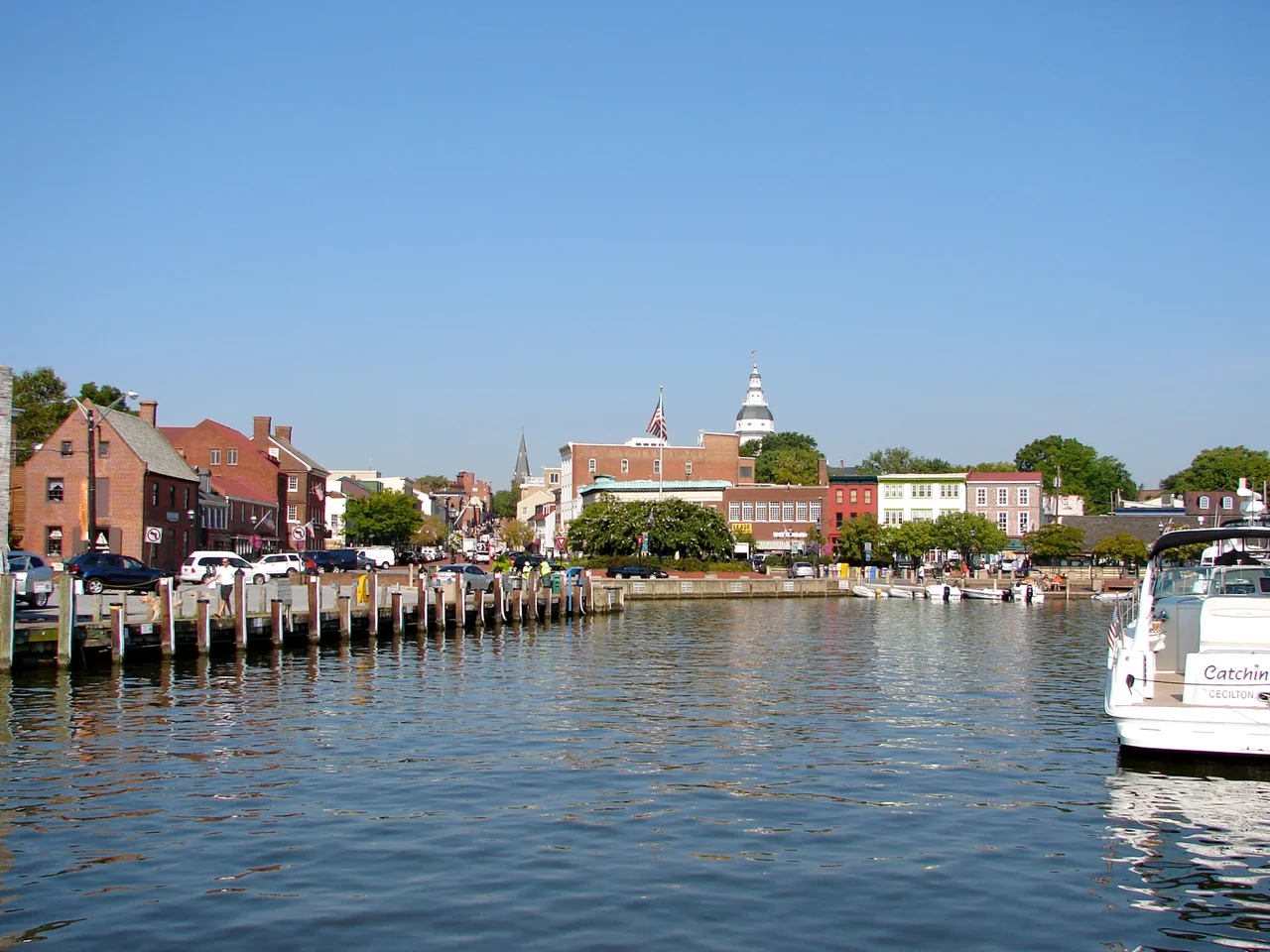

Annapolis
On December 23, 1783, in the Maryland State House on a hill above the Annapolis harbor, George Washington stood before the Confederation Congress and resigned his commission as commander-in-chief of the Continental Army. He had won the war. He could have, by most assessments of the day, taken nearly any office he wanted. Instead he handed his commission back to the elected civilian government and went home to Mount Vernon. The room where Washington stood is preserved in the state house, with markers showing where he and the delegates stood. A month later, on January 14, 1784, the Congress meeting in that same building ratified the Treaty of Paris ending the Revolutionary War. For nine months, between November 1783 and August 1784, Annapolis was the temporary capital of the United States. The Maryland State House, completed in 1772, is still in continuous legislative use - the oldest state capitol building in the country still serving its original purpose.
Providence Becomes Annapolis
Puritan exiles from Virginia, led by William Stone, established a settlement called Providence on the north shore of the Severn River in 1649. They moved to a better-protected harbor on the south shore not long after. In 1655, in what is called the Battle of the Severn, Parliamentary forces under Stone fought a Cavalier royalist force loyal to Charles II - the first naval battle in colonial North America. Stone was defeated and taken prisoner. The town that grew up on the south shore was called, variously, Town at Proctor's, Town at the Severn, and from 1683, Anne Arundel's Towne - named for Lady Anne Arundell, the late wife of the second Lord Baltimore. In 1694, Governor Francis Nicholson moved the colonial capital from St. Mary's City to Anne Arundel's Towne and renamed it Annapolis, for Princess Anne of Denmark and Norway, who would become Queen Anne of Great Britain in 1702. The city was incorporated by royal charter in 1708.
Capital of Slave Ships and Senators
Annapolis spent the 18th century as a political and administrative capital, a port of entry, and a major center of the Atlantic slave trade. Ships bringing enslaved Africans landed at the City Dock, the same harbor where George Washington's resignation was witnessed by townspeople. Kunta Kinte, the Mandinka man whose abduction Alex Haley traced in Roots, arrived in Annapolis aboard the Lord Ligonier in September 1767. A memorial at the City Dock now marks Kinte's arrival point. The Maryland Gazette, founded by Jonas Green in 1745, became one of the colonies' most influential newspapers. A theater opened in 1769. The city's growth as a port of entry slowed sharply after 1780, when Baltimore - with its deeper harbor - took over most of the region's commercial traffic. Annapolis turned to water trades it could still support: oyster packing, boat building, sail making. Today recreational boats fill the same harbor where slave ships once docked, and the seafood industry has shrunk to a handful of working watermen.
Anchor's Aweigh
The United States Naval Academy was established on the grounds of Fort Severn in 1845. Today the academy occupies 338 acres at the mouth of the Severn River, immediately adjacent to the historic district. Roughly 4,500 midshipmen attend at any given time. The Bancroft Hall dormitory - a single building housing the entire brigade - is one of the largest dorms by floor area in the world. The academy's chapel holds the crypt of John Paul Jones, the Revolutionary War naval commander whose remains were exhumed from a Paris cemetery in 1905 and returned to Annapolis. The Navy-Marine Corps Memorial Stadium, on the campus's western edge, hosted soccer matches at the 1984 Summer Olympics. The Naval Academy provides the city of about 40,000 with a continuous infusion of military traffic - the morning formation, the noon meal, the sound of the band practicing - that makes Annapolis feel, at any hour of the day, like a town with a job to do.
The Dome and the Conferences
The Maryland State House is topped by the largest wooden dome built without nails in the United States. The current dome, designed by Joseph Clark and built between 1785 and 1797, replaced an earlier inadequate one. The structure is held together by wooden pegs and iron straps. Beneath that dome, in addition to Washington's resignation and the ratification of the Treaty of Paris, the 1786 Annapolis Convention - meant to discuss commercial regulation among the states - issued a call for what became the Constitutional Convention in Philadelphia the following year. The state house has continued to be a venue for high-profile diplomatic gatherings. In November 2007, Secretary of State Condoleezza Rice hosted the Annapolis Conference at the Naval Academy with Israeli Prime Minister Ehud Olmert, Palestinian President Mahmoud Abbas, and representatives from across the Middle East. The conference produced a joint declaration but no lasting agreement. Annapolis has hosted important meetings for nearly 250 years; the city has learned to receive them and let history sort the consequences.
Sunny Day Floods
Annapolis sits on the Atlantic Coastal Plain at an average elevation of about 50 feet above sea level. The historic downtown - the City Dock area - is barely above the water at all. Hurricane Isabel in September 2003 produced a storm surge of 7.58 feet, flooding much of downtown and breaking the previous record of 6.35 feet from a 1933 storm. Tidal flooding - sometimes called sunny day flooding because it happens without rain - has become a regular feature of the historic district. A 2017 Stanford University study found that flooding cost Annapolis businesses about 3,000 visits and $172,000 in revenue that year alone. A tornado spun out of Hurricane Ida on September 1, 2021, hit the western edge of the city with estimated 125 mph winds, damaging homes and businesses along Maryland Route 450. On June 28, 2018, a gunman attacked the offices of the Capital Gazette newspaper, killing five journalists. The paper continued to publish without interruption. The city responds to disaster, climatic and otherwise, in much the way it has since the 17th century - by absorbing the damage and continuing the work, in the same buildings where Washington stood, on the same harbor where Kunta Kinte arrived.
From the Air
Annapolis is located at 38.978611 N, 76.491944 W on the Chesapeake Bay at the mouth of the Severn River. The city is 25 miles south of Baltimore and about 30 miles east of Washington, D.C. The U.S. Naval Academy occupies 338 acres at the mouth of the Severn, immediately adjacent to the historic district. The Annapolis area sits within the FAA's Mode-C veil but outside the Special Flight Rules Area. The nearest commercial airport is BWI Marshall (KBWI), 30 miles northwest. Lee Airport (KANP), a public general aviation field, is 4 miles southwest of downtown at 38.943 N, 76.567 W. From altitude, the Maryland State House dome and the City Dock are clearly visible at the eastern edge of the peninsula.
Nearby Stories
- United States Conference of Catholic Bishops 0.6 km away
- Adkins Arboretum 2 km away
- Francis Scott Key Bridge Collapse 5.9 km away
- Gunston Hall 15 km away
- Harriet Tubman Underground Railroad 38 km away
- Monocacy Aqueduct 40 km away
- Bombay Hook National Wildlife Refuge 41 km away
- Wicomico County, Maryland 41 km away