
United States Conference of Catholic Bishops
In April 1917, six days after Congress declared war on Germany, a meeting of American Catholic bishops at Catholic University of America in Washington reached a practical decision: the war effort would need Catholic chaplains, and the church needed an organization to recruit, fund, and coordinate them. The National Catholic War Council was founded on the spot. Archbishop Edward Hanna of San Francisco was named the first committee chair. The headquarters moved to Washington. The bishops continued to meet annually. After the war they renamed themselves the National Catholic Welfare Council and continued the work; in 1966 they reorganized again as the National Conference of Catholic Bishops; in 2001 they merged with the parallel United States Catholic Conference to become the USCCB. The wartime organization that began with sending chaplains overseas became, by the twenty-first century, the church's principal national institution - and the one that had to confront what the bishops gradually came to recognize was the worst institutional crisis in American Catholic history.
From Baltimore to Washington
Before 1917, American bishops met formally only at the great Plenary Councils of Baltimore - in 1852, 1866, and 1884 - to set policy for what was then still a missionary church. The Third Plenary Council in 1884 produced the Baltimore Catechism, the standard religious-education text used by American Catholics for the next eighty years. It also commissioned the parish school system that became the largest non-public school network in the United States. As the country grew and the Catholic population swelled with immigrants from Italy, Poland, Ireland, and elsewhere, the need for more regular national coordination became obvious. The wartime War Council provided the organizational template. The bishops moved their permanent headquarters to Washington in 1919 and have been a Washington institution ever since. The USCCB today includes all active and retired Catholic bishops in the fifty states and the U.S. Virgin Islands - typically around 450 men - and operates from a headquarters on Fourth Street NE within sight of the Catholic University campus where the original 1917 meeting was held.
Dallas, 2002
Decades of revelations of clergy sexual abuse - which had emerged in scattered ways since the 1980s but reached national attention with the Boston Globe's Spotlight investigation in January 2002 - forced the bishops to meet in Dallas that June for what became the most consequential conference assembly in the organization's history. The bishops voted unanimously to adopt the Charter for the Protection of Children and Young People, known as the Dallas Charter, which committed every U.S. diocese to background checks, safe-environment training, mandatory reporting of accusations to civil authorities, and zero tolerance for clergy with substantiated abuse complaints. In 2004 the USCCB commissioned the John Jay College of Criminal Justice in New York to produce an independent investigation of the scale of abuse from 1950 to 2002. The John Jay Report documented credible allegations against 4,392 priests and accusations from 10,667 victims. Subsequent settlements have totaled approximately four billion dollars. Dozens of American dioceses have filed for bankruptcy under the weight of civil claims. In November 2020, USCCB President Jose Gomez issued a formal apology on behalf of the conference to the victims of former cardinal Theodore McCarrick - whose abuse had been credibly reported to bishops for decades before he was publicly removed from ministry in 2018.
The Politics Question
American Catholic bishops have argued for over a century about how to engage with electoral politics, and the question has only grown harder. The conference has been a principal sponsor of the National Right to Life Committee since its founding in the late 1960s. In 1990 the USCCB hired the public relations firm Hill and Knowlton to coordinate Catholic opposition to abortion-rights advocacy. The 2010 Affordable Care Act's contraception mandate prompted the USCCB to organize the Fortnight for Freedom campaign from 2012 to 2018 in opposition to what the bishops described as government incursions on religious liberty. In 2017 the conference condemned the Trump administration's cancellation of DACA. In 2018, then-USCCB president Cardinal Daniel DiNardo publicly criticized family separation at the southern border. In 2020 the conference's response to the election of Joe Biden, a practicing Catholic, exposed deep divisions: a working group debated whether Catholic politicians who support legal abortion should be denied communion, while Cardinal Blase Cupich of Chicago publicly criticized a presidential inauguration day letter from USCCB president Gomez as an institutional failure. The USCCB's 2023 plenary assembly reiterated that abortion was the preeminent priority of the American Catholic Church.
Fifteen Regions
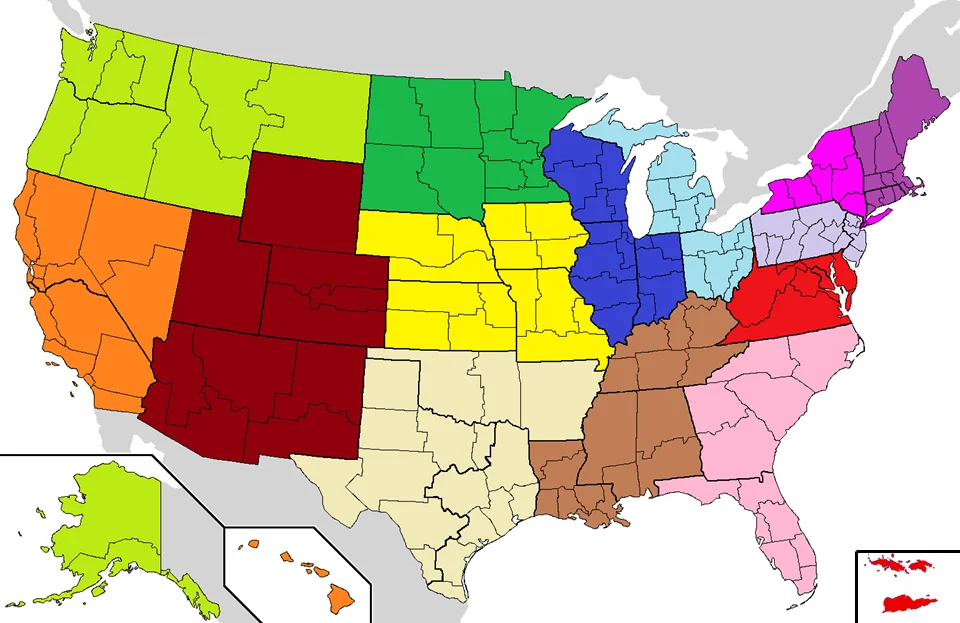
The American Catholic Church is divided into 15 USCCB regions. Regions I through XIV contain the Latin-rite dioceses; Region XV contains the Eastern Catholic eparchies (Ruthenian, Ukrainian, Maronite, Syriac, Chaldean, Melkite, Armenian, Romanian, and others). The non-territorial Personal Ordinariate of the Chair of St. Peter - which serves former Anglicans who entered into communion with Rome under Pope Benedict XVI's 2009 apostolic constitution - is part of Region X. The conference's 19 standing committees handle education, ecumenical relations, doctrine, divine worship, ethnic and cultural diversity, evangelization, child and youth protection, communications, government relations, international justice and peace, laity and family life, vocations, and pro-life activities. Each chair is elected by the full conference to a three-year term. The general secretary - currently Reverend Michael J. K. Fuller - runs the day-to-day operations from the Washington office and supervises the conference's roughly 350 employees.
What the Conference Does
Behind the political controversies, the USCCB performs a great deal of unglamorous administrative work. It coordinates Catholic Relief Services, the largest American Catholic international aid organization, which operates in over 100 countries. It runs Catholic News Service, the country's largest Catholic wire-service news organization (announced for closure in 2022 but partially reorganized in 2023). It publishes the New American Bible, the standard English-language translation used in U.S. Catholic liturgy. It coordinates ecumenical dialogue with the Pentecostal/Charismatic Churches of North America and other Christian bodies. It approves liturgical translations and sends them to Rome for recognitio. It maintains the official Catholic directory of every diocese and parish in the country. It speaks on behalf of the bishops on national policy questions - immigration, healthcare, education, capital punishment, racism, religious liberty. The conference president, elected in November 2025, is Archbishop Paul S. Coakley of Oklahoma City. The vice president is Bishop Daniel E. Flores of Brownsville. The conference's headquarters at 3211 Fourth Street NE sits a few blocks from Catholic University, in the corner of Washington where the American Catholic Church's national institutional life has been concentrated for over a century.
From the Air
The USCCB headquarters sits at 38.9335 degrees N, 76.9989 degrees W, at 3211 Fourth Street NE in Brookland - the neighborhood often called Little Rome for its concentration of Catholic institutions including The Catholic University of America, the Basilica of the National Shrine of the Immaculate Conception, the Dominican House of Studies, and multiple religious order generalates. From the air the conference building reads as a modest mid-rise office structure across from the much larger Basilica dome. Best viewed at 1,500 to 2,500 feet AGL; the site lies within the Washington FRZ. Nearest airports are College Park (KCGS) 4 nm east, Ronald Reagan Washington National (KDCA) 5 nm south, and Washington Dulles (KIAD) 23 nm west.
Nearby Stories
- Gunston Hall 1.1 km away
- 2023 Baltimore Shooting 4.9 km away
- Battle of Middleburg 6.6 km away
- Crownsville Hospital Center 10 km away
- Battle of Loudoun Heights 13 km away
- First Battle of Rappahannock Station 20 km away
- Howard County, Maryland 21 km away
- Harriet Tubman Underground Railroad 50 km away