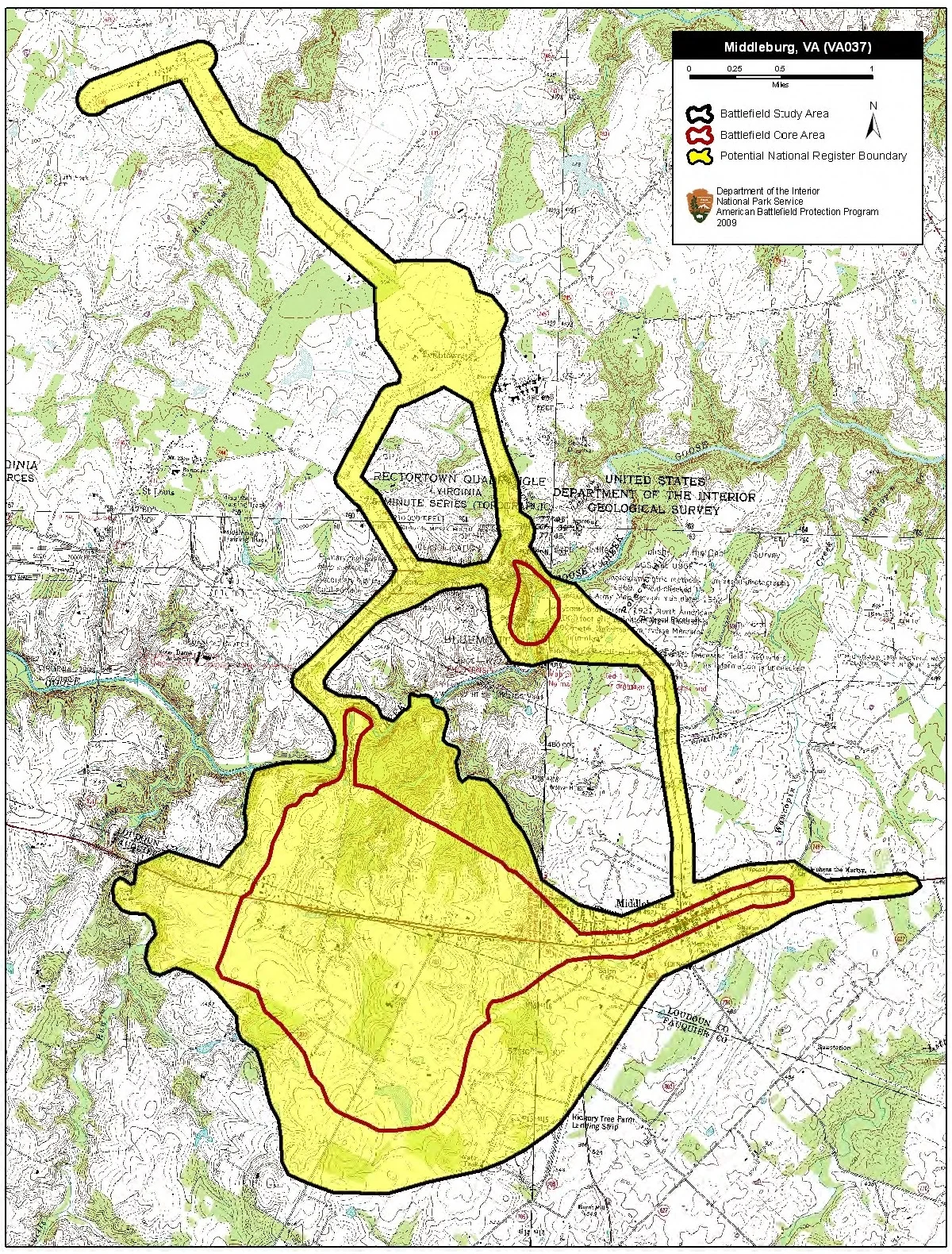

Battle of Middleburg
Colonel Alfred Duffie of the 1st Rhode Island Cavalry was French-born, French-accented, and according to the Confederate cavalry he interrupted in Middleburg on the afternoon of June 17, 1863, suicidally bold. He rode 280 troopers into the town where J.E.B. Stuart had his headquarters, scattered the Confederate pickets, and barricaded the streets. By 7 p.m. Stuart's reinforcements had returned. Duffie barricaded harder. By morning he was riding back to Centreville with 4 officers and 27 men. The remainder of his regiment - more than 250 troopers - was dead, wounded, or captured. Duffie never commanded with the Army of the Potomac again.
Stuart's Screen
By mid-June 1863, Robert E. Lee was moving his Army of Northern Virginia north toward Pennsylvania for what would become the Gettysburg campaign. J.E.B. Stuart's cavalry had the job of screening the movement - keeping the Union army from finding out where Lee was going by holding the eastern passes of the Blue Ridge Mountains. Stuart made his headquarters at Middleburg in the Loudoun Valley, midway between the Bull Run Mountains and the Blue Ridge, and scattered his brigades across the valley to watch the roads. Union General Alfred Pleasonton, commanding the Army of the Potomac's cavalry, was pushing west to find out exactly what Stuart was hiding. The series of small but bloody cavalry fights at Aldie on June 17, at Middleburg on June 17-19, and at Upperville on June 21 became the cavalry prelude to Gettysburg - what historians have called the largest cavalry battles of the entire war.
Duffie's Charge
Alfred Napoleon Alexander Duffie was born in Paris in 1833 and had served in the French army in the Crimean War and in Africa before crossing the Atlantic in 1859. By 1863 he was colonel of the 1st Rhode Island Cavalry. On the morning of June 17, Pleasonton sent him out from Centreville with orders to camp at Middleburg that evening and then push west toward Snickersville. The order was tactically bewildering - it asked a single small regiment to march thirty miles deep into territory that everyone knew was full of Confederate cavalry. Confederate Brigadier John R. Chambliss could not believe a Union regiment would dare to come so far without a much larger force behind it, so he let Duffie pass through Thoroughfare Gap with only a few skirmishers. Duffie reached Middleburg at 4 p.m. and drove in the few Confederate pickets in the town. Stuart and his staff, who had been socializing with local women, scrambled out the back doors. Duffie barricaded the streets and dismounted half his regiment behind stone walls.
The Trap Closes
Stuart sent for Beverly Robertson's brigade. By 7 p.m. Robertson's Confederate cavalry was in the streets of Middleburg and Duffie's small regiment was outnumbered ten to one. The Rhode Islanders fought house to house. Stuart's troopers eventually pushed them out. Many of Duffie's men were captured the next morning when Chambliss's brigade swung around to cut off the line of retreat. The Parisian colonel made it back to Centreville with only 31 men - the rest, 250 troopers, were lost. Total Union casualties for June 17 in Middleburg came to 250. Duffie was relieved from the Army of the Potomac. He commanded cavalry in other Union armies for the rest of the war but never again served with the main eastern army. Pleasonton's original order had asked the impossible. Duffie had tried it anyway.
The Fight on the 19th
Two days later, on June 19, Union cavalry returned to Middleburg in force. David McM. Gregg's division and John Buford's division both moved against Stuart, who had withdrawn to a commanding ridge just west of the town. Colonel J. Irvin Gregg, David's first cousin, led the lead Union brigade through the streets of Middleburg and against the ridge. The temperature hovered around 98 degrees Fahrenheit through the afternoon, exhausting men and horses on both sides. Repeated Union charges finally drove Stuart's horse artillery off the ridge and then his cavalry. Late in the day Buford's reserve brigade seized a contested hill south of Millville and the Confederate position became untenable. Stuart fell back along the turnpike to a second ridge behind a ravine on Kirk's Branch. Pleasonton, still cautious, did not press the pursuit. Union casualties on June 19 came to 99 - 16 killed, 46 wounded, 37 missing. Confederate losses were about 40, including Stuart's chief of staff Heros von Borcke.
The Bullet That Took Thirty-Two Years
Johann August Heinrich Heros von Borcke was a Prussian cavalry officer, six and a half feet tall, who had crossed the Atlantic in 1862 to volunteer for the Confederacy. He had become Stuart's chief of staff and his closest friend. On June 19, during the fight at Middleburg, von Borcke was struck in the neck by a bullet. He survived. He was nursed back to health and returned to active service the following spring, though never again at full strength. The bullet remained lodged in his neck for the rest of his life. He went home to Prussia after the war, served briefly in the Franco-Prussian War, and lived as a country gentleman on his family's estate. In 1895, thirty-two years after Middleburg, the old wound finally became septic. He died at age 59 - the last casualty of the cavalry fight at Middleburg. Middleburg itself is now one of the most picturesque towns in Northern Virginia, the heart of the Mosby Heritage Area, with many of the buildings used as field hospitals still standing along Washington Street. The Civil War Trust has preserved 5 acres of the battlefield.
From the Air
The Battle of Middleburg battlefield sits at 38.968 N, 77.760 W, in and around the town of Middleburg in Loudoun County, Virginia. Recommended viewing altitude is 2,500 to 4,000 feet AGL for the best look at the small historic town, the Loudoun Valley rolling country around it, and the ridges to the west where Stuart held his last positions. The nearest airport is Leesburg Executive (KJYO), about 13 nautical miles north. Manassas Regional (KHEF) lies 15 nm southeast. The Blue Ridge rises about 10 nm west. Middleburg sits along U.S. Route 50 in the heart of Northern Virginia's horse country - expect rolling green pasture and stone fence lines from above. Best light is mid-morning for the historic buildings on Washington Street.
Nearby Stories
- Luray Caverns: The Cave Where Rocks Make Music 7.2 km away
- Great Falls, Virginia 7.6 km away
- Gunston Hall 16 km away
- First Battle of Rappahannock Station 17 km away
- Bolivar Heights Battlefield 17 km away
- Great Stalacpipe Organ 31 km away
- Literary Hall 35 km away
- Howard County, Maryland 36 km away