.jpg)
Howard County, Maryland
Howard County is a paradox of American local government: a place with 332,317 residents, a $124,000 median household income, and not a single incorporated city or town within its boundaries. The county seat is the unincorporated community of Ellicott City, on the Patapsco River where John, Andrew, and Joseph Ellicott built a grain mill in 1772. The largest population center is Columbia, the planned community James Rouse began carving out of farmland in 1967 with the express intention of building a place where Americans of every race and income could live as neighbors. As of the 2020 census, Howard County is 47.9 percent white, 19.9 percent Asian, 19.6 percent Black, and 8.2 percent Hispanic - a majority-minority county where one in four households earns more than $200,000 a year. It is a difficult county to summarize. It is also one of the most studied experiments in deliberate American place-making.
From Howard District to County
The county is named for John Eager Howard, a Continental Army officer who fought at the Battle of Cowpens in January 1781 and later served as the fifth governor of Maryland. The territory that would become Howard County started as part of Anne Arundel County. In 1838, Dr. William Watkins of Richland Manor proposed creating a Howard District within Anne Arundel, and the General Assembly approved the new district in 1839. The first courthouse went up in Ellicott City in 1841. Thomas Beale Dorsey pushed at the 1851 Maryland constitutional convention to make the district a full county, and on July 4, 1851, after Maryland voters approved a new state constitution, Howard County was officially created. The plantations of the new county had used enslaved labor since at least 1690. Maryland was exempt from the Emancipation Proclamation, finally abolishing slavery itself in the new state constitution of November 1864.
James Rouse's Idea
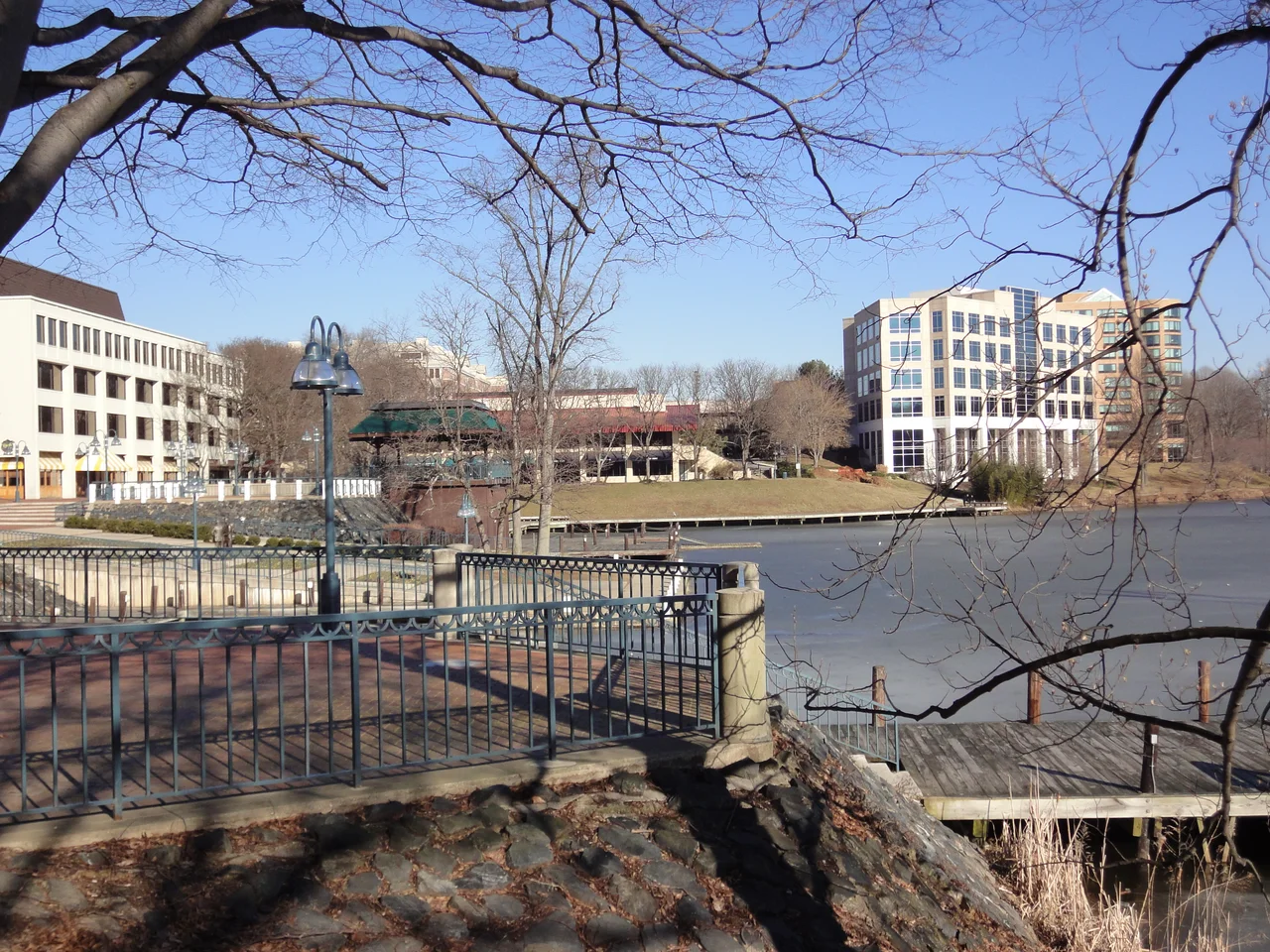
In 1963 the developer James Rouse began quietly buying up farmland in central Howard County through a network of shell companies, accumulating about 14,000 acres by 1966. Rouse, who already operated shopping centers around the East Coast, wanted to build something more ambitious: a planned city where Americans of different races, religions, and income levels would live, work, shop, and go to school together. Columbia opened in 1967 with a downtown lakefront and ten residential villages, each centered on its own elementary school, swimming pool, and modest commercial strip. The Merriweather Post Pavilion outdoor concert venue, designed by Frank Gehry early in his career, opened the same year. By 2025 Columbia had a population of about 105,000. Rouse's idea drew steady criticism for whether it had actually achieved the radical integration it promised. But the demographic outcomes are unusual: among American suburbs founded in the 1960s, Columbia is one of very few that ended up genuinely mixed by race and roughly mixed by income.
The Education Engine
Howard County ranks fourth in the United States for educational attainment - 63.6 percent of residents 25 and older hold a bachelor's degree or higher. The Howard County Public School System, ranked the best district in Maryland in 2022, manages 71 schools serving about 49,000 students. The 2009 graduation rate was 90.4 percent. The Howard County Library System was named Library of the Year by Library Journal in 2013, with editor John Berry describing it as a 21st-century library model worthy of study by every library in America. The county houses the Johns Hopkins University Applied Physics Laboratory in Laurel, a major NASA contractor and the source of much of the technical work behind missions like the New Horizons probe to Pluto. The pattern - excellent schools, libraries, and federal-adjacent technical employment - creates a self-reinforcing cycle that has drawn highly educated families for forty years.
Ellicott City and the Patapsco
Ellicott City, the unincorporated county seat, was founded in 1772 by John, Andrew, and Joseph Ellicott - three Quaker brothers from Bucks County, Pennsylvania, who built a flour mill on the Patapsco River. The town that grew up around them became the western terminus of the Baltimore and Ohio Railroad's first thirteen-mile line, the oldest surviving railroad station in the United States. The historic Main Street threads down through stone-and-brick storefronts to the river. The Patapsco has flooded the historic district catastrophically multiple times in the past decade - in July 2016 and again in May 2018, killing two people and destroying dozens of businesses. The 2018 flood led to a multi-year flood mitigation plan that included demolishing several historic buildings to widen the channel. The decision was painful and openly contested in town meetings. Ellicott City sits in the path of climate change in a way most American towns don't quite have to think about yet, and the conversations about how to keep the historic district viable are difficult ones.
The Bellwether
Howard County has voted for the winning Maryland gubernatorial candidate in every election since 1998, choosing Republican Bob Ehrlich in 2002, Democrat Martin O'Malley in 2006 and 2010, Republican Larry Hogan in 2014 and 2018, and Democrat Wes Moore in 2022. It has voted for the winning U.S. presidential candidate in every election since 1984, a streak of ten in a row. The western and northern parts of the county lean Republican; the more populated southern and eastern parts vote heavily Democratic. The state-level returns balance the two halves with surprising regularity. The county council adopts ordinances and has all the county's legislative powers, with five council districts each electing one member. The county executive is Calvin Ball III, a Democrat first elected in November 2018. Howard County has acted as a small-scale predictor of Maryland's political mood for forty years, in part because it is one of the few places in the state where rural and suburban Maryland - and white, Black, Asian, and Latino Maryland - all coexist within the same county lines.
From the Air
Howard County is centered at approximately 39.250 N, 76.928 W in central Maryland, between the Baltimore and Washington metropolitan areas. The county covers 253 square miles, bordered by Carroll County to the north, Baltimore County to the northeast, Anne Arundel County to the east and southeast, Prince George's County to the south, and Montgomery County to the west. BWI Marshall (KBWI) is 10 miles east of Columbia; Tipton Airport (KFME), used by general aviation, sits at the eastern edge of the county. The county is well outside the Washington Flight Restricted Zone but partially inside the Special Flight Rules Area. From altitude, Columbia is visible as a cluster of village centers around Lake Kittamaqundi, with Merriweather Post Pavilion's distinctive amphitheater roof visible in the city's downtown.
Nearby Stories
- Second Battle of Dranesville 2.7 km away
- Washington, Baltimore and Annapolis Trail 7.3 km away
- Monocacy Aqueduct 12 km away
- Camp David: Where Presidents Escape and History Gets Made 15 km away
- Adkins Arboretum 32 km away
- Battle of Gettysburg 46 km away
- Fort Delaware: The Island Prison Where 33,000 Confederates Waited Out the War 62 km away
- Memorial Hall (Delaware State) 65 km away