
Antiparos
Every summer, the ferries from Paros deposit their passengers at a port barely wide enough to turn around, and within an hour those same passengers understand what they have found. Antiparos is not trying to be Santorini. It is not chasing Mykonos. At 45 square kilometres, with around 1,265 permanent residents and a coastline that curls for 57 kilometres around sandy coves and hidden bays, the island has settled comfortably into its own identity: quiet by choice, beautiful without spectacle, welcoming without performance.
The Island That Chose Quiet
Separated from Paros by a narrow, shallow strait — so shallow, in places, that archaeologists suspect the two were once joined by dry land — Antiparos occupies a particular niche among the Cyclades. The capital, Antiparos Town, sits on the northeastern coast. Two other villages, Kambos and Agios Georgios, punctuate the mid-western and southwestern corners of the island. Between them, roads of varying quality connect beaches of varying remoteness. Some of the finest coves — Sostis Bay, Monastiria, Livadi — lie along the south and west coasts, accessible by ATV or boat rather than ordinary car. That inaccessibility is, for many visitors, the point.
The island began drawing outsiders in the 1970s, initially nudists attracted by the remote sandy beaches. It became a quiet favourite on the hippie circuit. Over the following decades the tourist infrastructure grew without overwhelming what it served, and today Antiparos welcomes families, divers, windsurfers, kitesurfers, and travellers who simply want good food, good light, and fewer people per square metre than the larger islands offer.
Wind, Water, and the Cave Beneath
Like its parent island Paros, Antiparos benefits from reliable Aegean winds — the famous *meltemi* that sweeps through the Cyclades in summer. For windsurfers and kitesurfers, this is a selling point. For everyone else, it means the heat stays honest rather than oppressive.
Antiparos is also home to one of Greece's most remarkable natural features: a stalactite cave on the island's southern half, known simply as the Cave of Antiparos. Stalagmites and stalactites of considerable age fill its chambers, and it was known and visited as far back as the Hellenistic period. Inscriptions from ancient visitors survive on the cave walls. The descent into the cave is a genuine encounter with deep geological time — the formations represent tens of thousands of years of mineral accretion, one slow drip at a time.
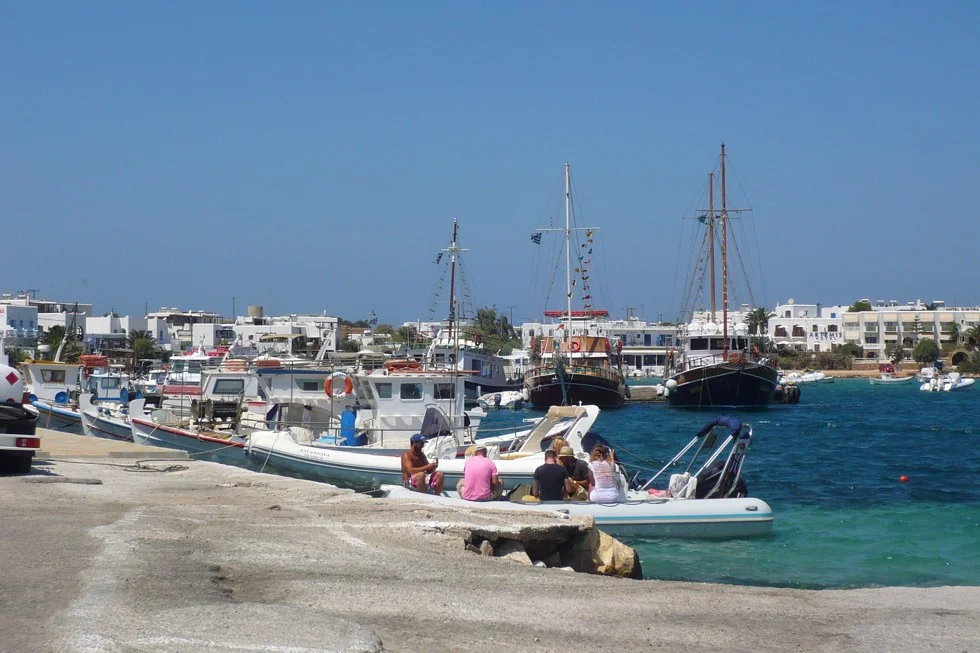
On the water, three wooden boats — named Alexandros, Captain Ben, and Iason — run trips around the island. Their version of island hopping includes fresh octopus, sea urchin, souvlaki, and a generous pour of ouzo from the captain. It is an entirely reasonable way to spend an afternoon.
A Venetian Wall and an Islet of Ruins
In the middle of Antiparos Town, a single wall remains of a Venetian castle built in 1440. It stands as the kind of ruin that a smaller island accumulates without fuss — not a major tourist draw, not a reconstruction project, just a stone wall at the centre of a Greek village, marking time.
To the southwest, the uninhabited islet of Despotiko floats a short boat ride away. Visible from Antiparos's southern shore, it contains the remains of a Doric temple built around 500 BC and has been under active archaeological excavation since 1997. The finds there — an Apollo sanctuary of substantial scale, pottery bearing the god's name, a long processional wall leading from the ancient port — have reshaped what archaeologists understand about religious life in the central Aegean. Some of those artefacts now sit in the Archaeological Museum in Parikia, on Paros. Despotiko itself remains quiet, reachable only by small boat from Antiparos.
Evenings on the Main Street
As the sun drops toward the northwest, Sunset Beach — a five-minute walk from the main street — fills with people nursing drinks and watching the light change over the water. The description 'one of the world's prettiest sunsets' may be boastful, but it is at least an honest boast: the Cycladic light at dusk, with the sea turning rose and then purple, is difficult to improve upon.
The main street itself comes alive after dark in summer. Tavernas line it and branch into small alleys, and the consensus among travellers is that it is genuinely difficult to eat badly on Antiparos. The food is traditional — grilled fish, salads, fresh seafood — and the quality is reliably good across the range of establishments. Yanni's Place is often cited for its pasta, a happy anomaly on a Greek island. The town is small enough that you will likely walk past the same faces twice in an evening, and that, too, is part of the offer.
How to Arrive, and When to Come
Two ferry routes connect Antiparos to Paros: a ten-minute crossing from Pounta that runs almost hourly, and a half-hour service from Parikia with around ten departures a day in season. Paros itself is well connected to Athens and Santorini by larger ferries. The nearest airport is Paros National Airport (LGPA), a short ferry ride and taxi away.
The island rewards visits outside the August peak. In May, June, and September, the beaches are accessible without crowds, the wind is present but not punishing, and the tavernas are run by people who have time to talk. The Cyclades are famous precisely because their pleasures are genuine — Antiparos simply offers them at a quieter volume.
From the Air
Antiparos lies at approximately 37.00°N, 25.05°E in the central Cyclades, directly west of Paros across a shallow strait. At cruising altitude, the island is visible as a compact landmass separated from the larger Paros by a narrow channel. The closest airport is Paros National Airport (ICAO: LGPA), located on the eastern side of Paros, about 15 km northeast. Recommended viewing altitude for both islands is 3,000–5,000 feet; at that level the shallow strait between them — less than a metre deep at points — is visually apparent. In clear conditions you can also pick out the smaller islet of Despotiko to the southwest.
Nearby Stories
- Panagia Gremniotissa 13 km away
- Milos 17 km away
- Panagia Kanala 18 km away
- Delos 18 km away
- Serifos 19 km away
- Amorgos 27 km away
- 1956 Amorgos Earthquake 27 km away
- Ikaria 57 km away